• Welcome to ASR. There are many reviews of audio hardware and expert members to help answer your questions. Click here to have your audio equipment measured for free!

Small Room Speaker Recommendations

TheEman

Member
Joined
Dec 25, 2025
Messages
17
Likes
9
After 30 years of being a headphone guy, I’ve decided to move to speakers.

Note: I am treble sensitive

Headphones: Susvara, Nur Harmonia as my points of reference, with Susvara being my go-to for about 3 years now.

What I’m looking for: leaning towards warm, fatigue-free listening, prioritizing mids with excellent imaging extending beyond the speakers. Honestly, I just want to sit down, press play and be enveloped in beautiful music. I’ve spent enough years being hyper analytical with Susvara and am tired of having to stay away from certain genres and recordings because I know the headphone will expose every minor flaw and murder my ears.

I have a 12’x10’ room, fully carpeted:
—North wall (10’): a 72”(l)x36”(d) desk with the 72” almost flush against the north wall and the 36” almost flush against the west wall
—East wall (12’): blank, this is where the speaker setup will go
—South wall (10’): a sliding wooden door occupying 2’ and a cd cabinet
—West wall (12’): a closet shelving unit packed to the brim with clothes

Positioned speakers with drivers 42 inches from each wall. Spaced 65 inches apart. Sub is 10 inches inside the right speaker and 8 inches away from wall. +6 db on the sub. Listening 70 inches away. Ears are 42 inches off the floor, sitting in a large leather office chair.

Auditioned equipment:
—Kef R3 Meta
—Wharfedale Super Linton
—WiiM Amp Ultra
—Lyngdorf TDAI-2210
—Arendal 1961 1s

Music preferences:
Rock/prog rock/jazz rock, metal, EDM, classical

Started this journey with the R3 Meta, Arendal and WiiM. 15 degree toe-in, rear of speakers 12 inches from wall. Sub crossover at 80 hz. Amazing holographic presentation extending well beyond the speakers. But vocals were too hollow and metallic and did not play well with poorly mastered stuff. Too clinical. Dropped my listening position from 42 inches to 33 inches (basically sat on the floor so ears would be in line of tweeters). Helped, but not much. Felt like it was hard to get a good crossover with the sub. Room Fit sounded horrific.

Boxed up the R3, got in the Super Lintons. Same 15 degree toe-in, same 12 inches from wall, same 80 hz crossover. Much better with forgiveness of older recordings, but the warmth still simply wasn’t there. Better when I dropped down from 42 inches to 37 inches to place my ears in line of the tweeters. Tone sweeps showed (relative to baseline, used a decibel meter):
—60-70 Hz null (-10 db at 65 Hz)
—82-106 Hz peak (+9 db at 100 Hz)
—108-132 Hz null (-18 db at 118 Hz)
—200 Hz null (-8 db)
—212 Hz null (-7 db)

Got in the Lyngdorf TDAI-2210. Set distances and crossover then ran RoomPerfect. Amazing tight control, bloat gone. But still no warmth. Cold and clinical, harsh treble. And yes, I am treble sensitive. Very. And that imaging beyond the speakers simply isn’t there with the Super Lintons.

So…where do I go from here? I was thinking MoFi Sourcepoint 10 Master (the bookshelf speaker) would be the best of the R3 Meta’s holography and the Super Lintons softer tweeter. Thinking to have custom stands built to bring the 10’s up to my 42 inch listening height.

All thoughts welcome. Speakers are a totally new area for me. Thanks for reading.
 
Last edited:
Move your seat forward or backward and take measurements with REW if posible. If all speakers mentioned behaved poorly to your ears it sounds like a room null issue at the MLP or speaker placement. REW would answer that question. If not a room ior placement issue playing with RoomPerfect settings may help.
 
Your Lyngdorf TDAI-2210 has nothing to do with the "still no warmth, cold and clinical, harsh treble" issue you mentioned. Of course, it could be RoomPerfect causing it—creating a frequency response you don't like (automated EQ using target curves?). I should add that I don't actually know how the RoomPerfect EQ function works.

Both the KEF R3 Meta and the Wharfedale Super Linton are good speakers. From what I can see in Erin’s measurements (Erin’s Audio Corner), neither of them has elevated treble.

If you can set the Harman House Curve on your EQ, try that instead—assuming you currently have a flat response curve set. It smooths off the treble a bit, so to speak.

If you don't want so much treble, turn it down using your EQ.:)

Try different speaker placements; see:

Edit:
If you can handle bass management—applying a low-pass filter to the subwoofer and a high-pass filter to the speakers—via your Lyngdorf TDAI-2210, do so, provided you can bypass the subwoofer's built-in low-pass filter.
 
Last edited:
I agree with other commenters that "throwing more speakers at the problem" probably won't be sufficient to solve it. Your starting point loudspeakers were pretty on point. Unfortunately speaker room interaction is not a trivial matter.

It is possible that the nulls in the bass response contribute to your perception of a clinical response with a lack of warmth. To complicate matters these nulls (in contrast to peaks) can't really be corrected by equalising them.

Research the terms "Speaker Boundary Interference Response (SBIR)" and "Listener-Boundary Interference Response (LBIR)". Try to find out which room boundary causes the most significant nulls. Use online calculator tools and/or get a UMIK-1 measurement mic. See If you can do something about the boundaries that cause the most problems. Changing speaker or listening position might be one way. Sometimes the floor bounce causes the most significant nulls. In this case the solution might be counter intuitive for your small room: get a floor standing speaker with several woofers to spread out the distance between woofers and floor and reduce the nulls caused by the floor bounce reflections.
 
Thanks for the replies.

Unfortunately, my seat backs up directly against my closet shelving unit which extends 26 inches into the room from the west wall. I'll play with REW, and at least it can show me what RoomPerfect did. I've tried the various voicings on the 2210, but they are only minor improvements, and I'd rather not eq the already corrected profile. I bought the Lyngdorf specifically to avoid the need to eq (which of course would not be able to fix the severe nulls).

When I eq the treble in the RoomPerfect-corrected profile, the brightness is tamed, but the lush midrange and upper bass I am seeking is nowhere to be found. And that's consistent with the nulls in the 60-220 Hz I found with tone sweeps and a decibel meter.

I was hoping the Lyngdorf could at least adjust timing and response around those nulls to fix things. The result is a super punchy, clean response with no mudiness or boom. And that's great! The device did exactly what it was supposed to do. But it did nothing for upper bass and midrange warmth. I ran three calibrations with different microphone placements and compared each focus profile to the global profiles. The global profiles were slightly better with respect to midrange.

Adjusting the toe-in angle from 15 degrees to straight ahead tamed the treble but I lost considerable soundstsge width and depth along with the phantom center image. Moving the speakers from 12 inches to either 6 or 18 inches away from the wall didn't help.

And yes, high and low pass filters already applied at 80 Hz.

And I'm keeping the Arendal 1961 1s sub in all these setups. I cannot live without a sub!

As for floorstanders, I was under the impression that I'm sitting far too close (6 feet away). The sound from vertically positioned drivers simply wouldn't have sufficient distance to mix before reaching me, thereby resulting in a muddy mess. That's why I thought the MoFi Sourcepoint 10 Master bookshelf would be a superior choice to something like the 888. And putting the 10 on custom 32 inch stands would help with the supposed floor bounce reflections (instead of the low slung or short stands from the manufacturer). And the 10 has that switch in the back to tame treble.

I REALLY want to get speakers to work. Now that I have heard what a 2.1 system can do, even with the nulls I'm facing, I can't go back to headphones. I listened to my headphones and iems yesterday and was like "ah, nope, can't listen to this anymore!"

And I'm thrilled no one has yet said I'm out of my mind trying to get this to work in such a small space. Maybe I'm not completely insane after all.
 
Last edited:
After 30 years of being a headphone guy, I’ve decided to move to speakers.

Note: I am treble sensitive

Headphones: Susvara, Nur Harmonia as my points of reference, with Susvara being my go-to for about 3 years now.

What I’m looking for: leaning towards warm, fatigue-free listening, prioritizing mids with excellent imaging extending beyond the speakers. Honestly, I just want to sit down, press play and be enveloped in beautiful music. I’ve spent enough years being hyper analytical with Susvara and am tired of having to stay away from certain genres and recordings because I know the headphone will expose every minor flaw and murder my ears.

I have a 12’x10’ room, fully carpeted:
—North wall (10’): a 72”(l)x36”(d) desk with the 72” almost flush against the north wall and the 36” almost flush against the west wall
—East wall (12’): blank, this is where the speaker setup will go
—South wall (10’): a sliding wooden door occupying 2’ and a cd cabinet
—West wall (12’): a closet shelving unit packed to the brim with clothes

Positioned speakers with drivers 42 inches from each wall. Spaced 65 inches apart. Sub is 10 inches inside the right speaker and 8 inches away from wall. +6 db on the sub. Listening 70 inches away. Ears are 42 inches off the floor, sitting in a large leather office chair.

Auditioned equipment:
—Kef R3 Meta
—Wharfedale Super Linton
—WiiM Amp Ultra
—Lyngdorf TDAI-2210
—Arendal 1961 1s

Music preferences:
Rock/prog rock/jazz rock, metal, EDM, classical

Started this journey with the R3 Meta, Arendal and WiiM. 15 degree toe-in, rear of speakers 12 inches from wall. Sub crossover at 80 hz. Amazing holographic presentation extending well beyond the speakers. But vocals were too hollow and metallic and did not play well with poorly mastered stuff. Too clinical. Dropped my listening position from 42 inches to 33 inches (basically sat on the floor so ears would be in line of tweeters). Helped, but not much. Felt like it was hard to get a good crossover with the sub. Room Fit sounded horrific.

Boxed up the R3, got in the Super Lintons. Same 15 degree toe-in, same 12 inches from wall, same 80 hz crossover. Much better with forgiveness of older recordings, but the warmth still simply wasn’t there. Better when I dropped down from 42 inches to 37 inches to place my ears in line of the tweeters. Tone sweeps showed (relative to baseline, used a decibel meter):
—60-70 Hz null (-10 db at 65 Hz)
—82-106 Hz peak (+9 db at 100 Hz)
—108-132 Hz null (-18 db at 118 Hz)
—200 Hz null (-8 db)
—212 Hz null (-7 db)

Got in the Lyngdorf TDAI-2210. Set distances and crossover then ran RoomPerfect. Amazing tight control, bloat gone. But still no warmth. Cold and clinical, harsh treble. And yes, I am treble sensitive. Very. And that imaging beyond the speakers simply isn’t there with the Super Lintons.

So…where do I go from here? I was thinking MoFi Sourcepoint 10 Master (the bookshelf speaker) would be the best of the R3 Meta’s holography and the Super Lintons softer tweeter. Thinking to have custom stands built to bring the 10’s up to my 42 inch listening height.

All thoughts welcome. Speakers are a totally new area for me. Thanks for reading.


Regarding treble brightness,in my experience it's quite simple to remedy by eq. Every Genelec has this switch, but it can also be implemented by using eq on the WiiM or Lyngdorf.

Regarding lack of warmth, ime this is usually a lack of deep/effortless bass, ie a sub. Or a frequency slope that needs to slide down a bit more.

Applying both I got an amazingly similar sound from Genelec's 8030 plus sub versus a B&O beolab 9. The first in a study measuring 3 x 2 meters or thereabouts, the second in the living room measuring 5.5 x 10 meters.
 
Last edited:
Thanks for the replies.

Unfortunately, my seat backs up directly against my closet shelving unit which extends 26 inches into the room from the west wall. I'll play with REW, and at least it can show me what RoomPerfect did. I've tried the various voicings on the 2210, but they are only minor improvements, and I'd rather not eq the already corrected profile. I bought the Lyngdorf specifically to avoid the need to eq (which of course would not be able to fix the severe nulls).

When I eq the treble in the RoomPerfect-corrected profile, the brightness is tamed, but the lush midrange and upper bass I am seeking is nowhere to be found. And that's consistent with the nulls in the 60-220 Hz I found with tone sweeps and a decibel meter.

I was hoping the Lyngdorf could at least adjust timing and response around those nulls to fix things. The result is a super punchy, clean response with no mudiness or boom. And that's great! The device did exactly what it was supposed to do. But it did nothing for upper bass and midrange warmth. I ran three calibrations with different microphone placements and compared each focus profile to the global profiles. The global profiles were slightly better with respect to midrange.

Adjusting the toe-in angle from 15 degrees to straight ahead tamed the treble but I lost considerable soundstsge width and depth along with the phantom center image. Moving the speakers from 12 inches to either 6 or 18 inches away from the wall didn't help.

As for floorstanders, I was under the impression that I'm sitting far too close (6 feet away). The sound from vertically positioned drivers simply wouldn't have sufficient distance to mix before reaching me, thereby resulting in a muddy mess. That's why I thought the MoFi Sourcepoint 10 Master bookshelf would be a superior choice to something like the 888. And putting the 10 on custom 32 inch stands would help with the supposed floor bounce reflections (instead of the low slung or short stands from the manufacturer). And the 10 has that switch in the back to tame treble.

I REALLY want to get speakers to work. Now that I have heard what a 2.1 system can do, even with the nulls I'm facing, I can't go back to headphones. I listened to my headphones and iems yesterday and was like "ah, nope, can't listen to this anymore!"

To me it reads more like a listening position and room thing, than a speaker or equipment thing.

Ime getting some room between the back wall, where you're listening and your seat will clear/unmuddle the sound a bit. A least 30 cm/ 1 foot, but if possible more. Move the speakers as close to the front wall as possible. Let roomperfect fix the elevated bass. A well placed sub may help too.

Basically, I think you already have one of the best tools available, the Lyngdorf.

Regarding speakers it sounds to me you don't like the R3 sound profile, and the Linton was a bit too bass heavy, so I guess you like the sound of standmounts. The mofi sourcepoint is objectively a good choice. Try it with a sub.
 
Last edited:
I bought the Lyngdorf specifically to avoid the need to eq
Since the issue is room interaction the only way to avoid EQ is speaker and listening position optimization.
It should always be the first step, if possible to be done, once this is done, then You need much less from EQ to be achieved, if anymore tweaking is needed.
As many have said you speakers are not the problem.
 
Hollow metallic voices, clinical, harsh - all sound to me like the terrible auto-correction. They are not traits of the speakers you tried.

Turn off the auto EQ and just try manual adjustments to reduce those peaks a little bit then tune by ear if you can't be bothered to measure with REW. Don't try to EQ over about 200Hz (as a very rough limit).
 
As for floorstanders, I was under the impression that I'm sitting far too close (6 feet away). The sound from vertically positioned drivers simply wouldn't have sufficient distance to mix before reaching me, thereby resulting in a muddy mess. That's why I thought the MoFi Sourcepoint 10 Master bookshelf would be a superior choice to something like the 888. And putting the 10 on custom 32 inch stands would help with the supposed floor bounce reflections (instead of the low slung or short stands from the manufacturer). And the 10 has that switch in the back to tame treble.

You should first try to understand wavelengths and reflection paths. For wavelengths there are countless online calculator tools. Then do REW measurements and map out your room and the reflection paths with all surfaces. In your "problem areas" wavelenghts are so long, that you can probably ignore furniture and first focus on walls and floor.

To illustrate the concept let´s take your biggest null at 108-132hz and assume it´s average of 120hz. At 120hz the wavelength of sound is 112.5 inches. One soundwave cycle at 120hz takes 8.33ms. If you have a deep null at 120hz you should look for reflection paths that are roughly one half wavelength (56 inches) longer than the path of the direct sound signal, because the reflected sound of this path arrives one half cycle (8.33ms/2=4.16ms) later at your ear than the direct sound and causes the deep cancellation. Your listening position is "directly against your closet shelving unit which extends 26 inches into the room from the west wall". The reflection path between your backwall and your ears matches the 56 inches (2x26 inches plus some wiggle room).

Let´s take your second big null at 200hz to 212hz. The wavelength at 200hz is 68 inches, wavelength at 212hz is 64 inches. As the null(s) isn´t as deep as the one around 120hz we might not look for a reflection path that is exactly half of the wavelength longer (= exactly 180 degree out of phase). Also take into consideration that several reflection paths may add up. For example if the reflection path of the sidewall and the floor has the same length, this might reinforce things. My gut tells me it might not be the best idea to position the speakers exactly 42 inches from the sidewalls and the backwall.

Considering floor standing speakers and listening distance let's take a look at the MoFi888. It's 42 inches tall and the crossover frequency between midrange and woofers is 130hz. You sit 6 feet away. The three drivers of the MoFi are spaced something like 25-30 Inches apart. This means the distance between your ear and the lower woofer is just something like 5 inches longer than the distance between your ear and the coax (pythagorean theorem). The wavelength at 130 hz is 104 inches. This means the direct sound of the lower woofer will reach your ear 0,37ms later than the direct sound of the coax, while a one cycle soundwave at 130hz takes 7,7ms. This is rather negligible compared to room boundary reflections.
 
So…where do I go from here?
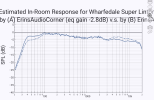
Before you pack up the Wharfedale, try applying a Peaking filter (Parametric filter) at 6360 Hz, Q 0.5, -2 dB inside the Lyngdorf which will correct the Super Linton's stock treble emphasis:

Screenshot_20261004-185944_Chrome.png
(dashed: stock in-room response, solid: corrected response)

You can also try applying a second Peaking filter at 42 Hz, Q 0.77, +2.8 dB to bump up the bass.
 
Thanks everyone.

OK. Got some big improvements.

I pulled the speakers out 18 inches from the wall and set the sub crossover, high and low pass filters to 100 Hz. Re-ran RoomPerfect. And I got a lot of warmth injected into the midrange and upper bass. Sounds so much better. Soundstage depth is also improved.

The eq at 6360 was helpful, though I think shifting that down to 4500 Hz was better for me.

But the soundstage width is still limited. A bit boxy, if you will. And I think this is simply a trait of the Super Lintons. I guess I'll be trying the MoFi 10 Master bookshelf after all; I think the 888 is too big of a footprint for my room and will collide with my desk.
 
Worth trying Buchardt S400mk2. Absolutely lovely midrange and very very smooth treble.
 
This may sound far fetched, but thinking about what you said about the desk, it may be beneficial to wall mount the speakers somewhat higher and point them towards you.

From what you say I get the impression the desk stands between the speakers. Is that correct?
 
There's a Pangea Vulcan audio rack 4 inches inside the left speaker, the Arendal 1961 1s is 6 inches to the right of the rack, and the right speaker is 13 inches to the right of the sub.

The desk is along the adjacent wall.

It actually sounds quite good now. Though I think my sub is running too hot of a singal at +6 db master volume. I had it configured that way in a futile attempt to fight the lower frequency nodes when my speakers were only 6 inches and 2.5 inches from the wall. I think dropping to +3 db or even 0 and re-running RoomPerfect will help to bring even more midrange presence.

Will probably still audition the MoFi 10 master bookshelf or the Buchardt s400mk2. I plan to keep this setup for a good long while, so might as well get something I'm truly in love with.
 
Thanks everyone.

OK. Got some big improvements.

I pulled the speakers out 18 inches from the wall and set the sub crossover, high and low pass filters to 100 Hz. Re-ran RoomPerfect. And I got a lot of warmth injected into the midrange and upper bass. Sounds so much better. Soundstage depth is also improved.

The eq at 6360 was helpful, though I think shifting that down to 4500 Hz was better for me.

But the soundstage width is still limited. A bit boxy, if you will. And I think this is simply a trait of the Super Lintons. I guess I'll be trying the MoFi 10 Master bookshelf after all; I think the 888 is too big of a footprint for my room and will collide with my desk.
Before you do that, I would suggest something like LS 50 Metas with a sub. I own the Metas and recently replaced them with ASCI A6b's and while the ASCI is unquestionably a better speaker, the Metas when paired with a sub were still excellent in my smaller 12' x 12' x 8' room. The Metas have excellent wide imaging and are quite height independent because of they rely exclusively on the coincident driver. And many people have also mentioned how the RS 3 Metas can sound a little meh compared to the LS 50's. Since they can be had for $1k, I think they're worth a shot, especially since they work so well in smaller rooms and in nearfield use cases. And they're certainly a lot cheaper than MoFi 10 Master bookshelves, though you would not know it to look at or listen to them. I used Dirac ART to get the subs and mains to work and play well together, but RoomPerfect ought to do the job as well.
 
As many people have already pointed out, this kind of subjective (and partly objective) acoustic optimization depends heavily on the speaker system being used and the room’s acoustic environment (including furniture placement), so it’s difficult to make definitive generalizations.

Therefore, based on the OP’s “written description” and my own experience and experiments, I’d like to offer two suggestions.

Since it appears that DSP and microphone measurements are available, I recommend first identifying the acoustic reflection surfaces that are the primary cause of the null at the listening position due to low-frequency standing waves. Rather than relying solely on the DSP, I suggest trying to physically absorb sound on those surfaces if possible (ref. my post #498 on my project thread).

After that, once you’ve boldly attenuated the high-frequency range (approximately 6kHz and above) of your main speaker system by -5 dB to -10 dB using the DSP, if you can try using a "variable-gain" super tweeter (which generally has a narrow directivity) capable of covering the 6 kHz to 22 kHz range with high efficiency, start with a very low gain setting and experiment with the physical 3D wide-angle sound dispersion of that super tweeter. For this, subjective verification and assessment of 3D soundstage perspective is far more important than microphone measurements (ref. my posts #912, #921, #926, #927, #929 on my project thread, and my post #39 on another hosting thread).

As Dr. Toole kindly and repeatedly pointed, "Our ears and brain are not identical to measurement microphone". ;)

Although they are extreme high-end audiophile systems, this web report article would be somewhat suggestive for the effects and merits of wide dispersion of tweeter (and/or super-tweeter) sound in improving your 3D sound perspective.
_
 
Last edited:
Back
Top Bottom