• Welcome to ASR. There are many reviews of audio hardware and expert members to help answer your questions. Click here to have your audio equipment measured for free!

Show us your Cars

I have an interest in wave, tidal (and river [not dams but small turbines in the river flow]), geothermal (& solar done on existing and new structures). I do not know about the weather there but I have seen the result's of 223 MPH (359 KP/H) gusts. I cannot think of any wind machine or solar panels that will handle that or boats and tractor trailers that are flung at them at that velocity. And believe that solar and wind (at least in the way that it is typically implemented in the USA (for the most part solar fields & wind farms [also wind farms in the ocean], as opposed to on existing or new structures) is very destructive to the local environment (where they are located: [flora and fauna {covers all plant life and wildlife in a region, not just the typical plants and animals we think of. It encompasses things like bacteria, fungi, insects, etc. It represents biodiversity}]).
More so than any pollution generated by transportation.
In my personal case, my homes are under enough tree cover that solar won't work and the building of even 1 windmill would cause massive environmental destruction (in the summer: you also can't find my homes via Google Earth, as (from above) it just looks like a green field because of the trees.
View attachment 550566
I guess there are different parameters that make sense in different places.
There does not seem to be a "one size fits all".
Maybe more nuclear would help?
Nuclear won't help, nowhere.
Wind, Solar and proper (battery and hydrogen) storage is the future.
This could be established within a few years, that those atomic fantasies would need too to be build.
So what's the choice?
 
Nuclear won't help, nowhere.
Wind, Solar and proper (battery and hydrogen) storage is the future.
This could be established within a few years, that those atomic fantasies would need too to be build.
So what's the choice?
Personally, I don't NEED (it is convenient, until it becomes restricted and controlled) any of it.
I'm perfectly fine with hunting, trapping, fishing and growing enough food for me and my family (and quit able to do so on the property that I have).
 
....is very destructive to the local environment...
Solar grid energy is not the villain.
The environmental politics of it all is to blame.
Here is an example, of the political bloat, though true:
{CLAUDE} >> Solar panels produced 51% of California's electricity in May 2026, the first time a large-scale power system has surpassed the halfway mark for an entire month, according to Ember's analysis of federal data. That specific fact checks out — real month, real data source (EIA), real analysis (Ember).
But there is a grand 'numbers-racket' going on, behind the scenes:
{CLAUDE} >> Where the sleight of hand lives — several layers:
  1. "For an entire month" is cherry-picked timing. California hit this because May is a "Goldilocks" month — usually neither cold nor hot, meaning lower overall demand, which lets solar cover a larger share of a smaller pie. This isn't a year-round achievement being announced as if it were — it's the single best month of the year, and headlines drop that qualifier fast.
  2. "50% of electricity" quietly means 50% of in-state generation, not 50% of total demand served. The month's imports from the SunZia wind project in New Mexico boosted solar's share in the mix Ember tracks — meaning some of what's counted as "California's" clean mix includes imported power, which changes what the percentage is actually measuring depending on how you slice generation vs. consumption vs. imports.
  3. The instantaneous peak numbers get blended with monthly averages in press coverage. CAISO hit 23 GW of solar covering 72% of regional demand on a single day in July — that's a real-time midday peak, wildly different from a monthly average, but both numbers ("51%," "72%") circulate in the same news cycle without careful readers distinguishing peak-instant vs. month-average vs. annual-average. The state's actual annual average solar share is far lower — California's overall share of electricity generation from solar in 2024 was about 28.2% — less than a decade of "for the whole year" gets conveniently omitted from a "51%!" headline.
  4. Rooftop counted alongside utility-scale conveniently pads the number. The 51% figure counts both large-scale installations and rooftop arrays together — combining two very different generation types (customer-owned vs. utility) into one number makes the state's centralized grid look more solar-dominant than the utility-scale build-out alone would show.
  5. Rate increases get left out of the celebratory framing entirely. Critics of the announcement specifically pointed to California's rising electricity rates as the uncomfortable side of the story that doesn't make the press release....
It should also be mentioned that since Cuba has been cut-off the Venezuela-oil and their electricity grid is in... I don't think they have a working one, anymore.:(
But it turns-out that the gracious Chinese government is extending help to a fellow-regime in dire-straits by finishing up a project (hundreds of million dollars) of 1GW solar farms on the island. When completed; it is said that it will be able to provide 1/3 of electricity needed by the 11million Cubans.

Some current car manufacturers, e.g.Hyundai, Toyota and Nissan, have models, which make use of solar rooftop integration, as a supplemental source for recharging their models' battery systems.

You don't have to be a tree-hugger to appreciate the solar's capabilities until politics stymies what could be a pretty cheap electricity source!
 
Solar grid energy is not the villain.
The environmental politics of it all is to blame.
Here is an example, of the political bloat, though true:

But there is a grand 'numbers-racket' going on, behind the scenes:

It should also be mentioned that since Cuba has been cut-off the Venezuela-oil and their electricity grid is in... I don't think they have a working one, anymore.:(
But it turns-out that the gracious Chinese government is extending help to a fellow-regime in dire-straits by finishing up a project (hundreds of million dollars) of 1GW solar farms on the island. When completed; it is said that it will be able to provide 1/3 of electricity needed by the 11million Cubans.

Some current car manufacturers, e.g.Hyundai, Toyota and Nissan, have models, which make use of solar rooftop integration, as a supplemental source for recharging their models' battery systems.

You don't have to be a tree-hugger to appreciate the solar's capabilities until politics stymies what could be a pretty cheap electricity source!
I've never believed in a solar grid, only in individual solar power. Or wind power. Or a combination of whatever works for you as an individual.
I'm not a tree hugging environmentalist.
But I do believe in conservation.
As far as I can tell, each is it's own subset, with a small portion of it being a crossing subset (I'm probably in that small portion of NOT extremist).
I don't believe in big cities and I do have a condo in one that has 38 million people (I have not been there except for 10 days in 2007 [but some of my family uses it on a semi regular basis]). Surprisingly, that city has a lot of greenery: trees planted in the sidewalks, natural grass soccer fields on top of buildings and the like.
I DO believe in living off grid. (and do that about 35% of the time)
I don't care what others do or how politics screw things up.
Unless it directly affects my trapping, hunting, fishing, shrimping, crabbing, harvesting oysters, growing food and otherwise living off the grid.
For instance: now I have to pay to have a hunting license, fishing license and trapping license to do these things for my family and myself (not for profit to sell to others) on my own property.
That is just DUMB.
 
...
In my personal case, my homes are under enough tree cover that solar won't work and the building of even 1 windmill would cause massive environmental destruction (in the summer: you also can't find my homes via Google Earth, as (from above) it just looks like a green field because of the trees.
View attachment 550566
....
Looking at your cool lake-side retreat, I am inclined to think that you have just about the best location for a solar system.:oops:
A portable DIY one; if you choose it to be... smack in the middle of that lake, on a float.;)
 
1786486650006.png

@EJ3, Oh, Mahn: Remember when!
AeroForceScanGaugesOBDIIms.jpg

;)
 
  • Like
Reactions: EJ3
Looking at your cool lake-side retreat, I am inclined to think that you have just about the best location for a solar system.:oops:
A portable DIY one; if you choose it to be... smack in the middle of that lake, on a float.;)
It's a highly environmentally protected river (Nothing can be built there that does not already exist and nothing can be added on to [my 800 square ft. home is as big as when my family built it over 50 years ago]). No putting floating docks or platforms into the river (it is navigable by canoes, kayaks, and boats up to about 22 ft. [unless it's winter and the water is low, then even kayaks may have to be portaged in many places), either.
Strategically positioned around the Ashepoo, Combahee and Edisto rivers, the 1.6-million-acre ACE Basin watershed is one of the largest areas of undeveloped wetlands/uplands ecosystems remaining on the Atlantic Coast. This remarkable interlocking web of ecosystems includes forested uplands and wetlands, extensive tidal marshes, managed wetlands, barrier islands and peatlands.
Rice plantations once covered the ACE Basin. It now supports important habitats for waterfowl, migratory birds and endangered species , as well as 33 types of natural plant communities. It can be low or it can be high (depending on the season and the upstate rains
Edisto-ACE-basin-SC-Alan-Cressler.png

As in 6 ft. deep under my house:
IMG_0028.JPG

When the river rises, everything has to come up onto my deck.
IMG_0021.JPG

IMG_0021.JPG

IMG_0025.JPG

At my other place 40 miles away, the water is a bit more predictable:
IMG_1610.JPG

IMG_1611.JPG

But not all the time (that is my 92 year old mother in the picture):
IMG_0041.JPG

Naturally, sometimes there are enjoyable to see (but dangerous) issues:
ISVE3226.JPG

Don't believe him, he's NOT inviting us for a swim:
IMG_1772.JPG

IMG_2371 - Copy.JPG

816.JPG

Cars again, shall we?:
314.JPG

IMG_4058.JPG
 
Last edited:
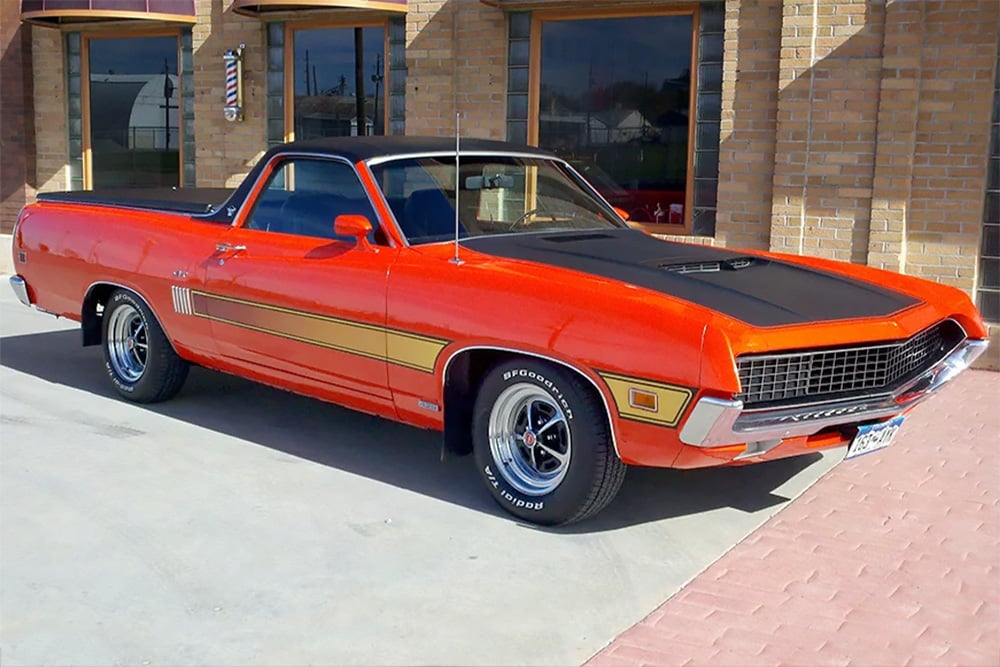
Not a separate from the passenger area bed. The cab area needs to be fully enclosed with it's own rear window.
No bed cover that you can't remove, roll up or fold up and yet have the passengers fully enclosed, please.
Ford Ranchero definition:
View attachment 551079
1970-ford-ranchero-gt-history

Ford introduced the Ranchero, a vehicle classified as a coupe utility, at the New York Auto Show on December 8, 1956. Though this was a new vehicle for the American market, some 22 years earlier Ford of Australia designer, Lew Bandt penned the first coupe utility in 1934. This was in response to Australian ranchers, who desired a vehicle that was rugged enough to haul livestock during the week and sufficiently elegant to go to church with the spouse on Sunday. This coupe utility became known as a ute in Australia. With a production run of 82 years (1934-2016), the Ute was a smashing success down under.
The Ford Ranchero debuted on December 8, 1956, as a 1957 model and was in continuous production until its last model year, 1979.

El Camino definition:
a coupé utility vehicle that was produced by Chevrolet in 1959 and 1960, and from 1964 to 1987.
Unlike a standard pickup truck, the El Camino was adapted from the standard two-door Chevrolet station wagon platform and integrated the cab and cargo bed into the body.

No photo description available.

That thing that you posted is just a seriously F'ugly hatchback.
It has a place in the grand scheme of things but not in my yard.

We have some people around here that drive dump trucks, too:
View attachment 551082
My wife told me that I can't have one of these and that I can't have a Musk truck, either.
But she is OK with my Silverado SS since I put an electrically deploying/retracting step that operates when you open and close the door on it.
https://oldchevytrucks.com/blog/2010/02/1936-1942-coupe-pick-up/
 
  • Like
Reactions: EJ3
Nuclear won't help, nowhere.

Nuclear fusion would, if it becomes viable.

Also, all those interstellar explorers would not exist without nuclear power. There is a place for it where it is the only viable alternative.

Wind, Solar and proper (battery and hydrogen) storage is the future.

I agree, but there's a high correlation between advocating renewable energy sources *and* a certain belief in global warming... meaning we should not just narrow it down to renewable energy because that source could become more unpredictable.

Never narrow down strategic survival choices to a singular one... there's probably a better quote in "Art of War". :-)
 
  • Like
Reactions: EJ3
Solar grid energy is not the villain.
The environmental politics of it all is to blame.
Here is an example, of the political bloat, though true:

But there is a grand 'numbers-racket' going on, behind the scenes:

It should also be mentioned that since Cuba has been cut-off the Venezuela-oil and their electricity grid is in... I don't think they have a working one, anymore.:(
But it turns-out that the gracious Chinese government is extending help to a fellow-regime in dire-straits by finishing up a project (hundreds of million dollars) of 1GW solar farms on the island. When completed; it is said that it will be able to provide 1/3 of electricity needed by the 11million Cubans.

Some current car manufacturers, e.g.Hyundai, Toyota and Nissan, have models, which make use of solar rooftop integration, as a supplemental source for recharging their models' battery systems.

You don't have to be a tree-hugger to appreciate the solar's capabilities until politics stymies what could be a pretty cheap electricity source!
Problem with intermittent sources (and their related BESS and "Virtual Dams") is their lack of inertia. See the blackout in Spain. I'm very close to these topics.
 
  • Like
Reactions: EJ3
Problem with intermittent sources (and their related BESS and "Virtual Dams") is their lack of inertia. See the blackout in Spain. I'm very close to these topics.
Back to cars:
Back in the day, my (in the 10 second 1/4 mile zone [4.44 optional rear end, E70 14 slicks rear tires and a blue printed factory 390 C.I. engine that put out well over 400 HP {VS the factory 315 HP rating]}) Rambler that I drove to high school in my Senior year (1974-75):
IMG_5365.JPG

IMG_5380.JPG

IMG_5377.JPG

IMG_5364.JPG

IMG_5370.JPG

Yep, in stereo: dual exhaust:
IMG_5371.JPG

The view most frequently seen by others ("Red, White and Blew your doors off"):
IMG_5373.JPG

This is exactly as the factory made it.
There was also a B trim version (not quit as loud):
250px-2022_Downtown_West_Allis_Classic_Car_Show_037_%281969_Rambler_S-C%29.jpg

250px-1969_AMC_SC_Rambler_Hurst_B-scheme_exterior_finish_at_Potomac_Ramblers_Club_meet_1of2.jpg


Prev
 
Last edited:
400bhp from a 6.3 litre engine, that's a pretty soft state of tune, around 75bhp/litre.

Times have changed, 100bhp, or more per, litre is not uncommon for an ordinary family car today. :)

It's funny to think that many of the high performance "supercars" from the 60s and 70s would likely be comfortably out-performed by a sporty saloon, or hatchback straight from the dealer, with no modifications.
 
I am amazed by the standard horsepower of american cars, like more than 200 hp is usual for you.

I have a 2009 Toyota Yaris (I think it is called Vitz in the US) with 100 hp and that's pretty good for a little european car. There is also the "city version" with a 70 hp motor.

The only version of this Vitz generation in the US is the sport one with ~130 hp.
 
400bhp from a 6.3 litre engine, that's a pretty soft state of tune, around 75bhp/litre.

Times have changed, 100bhp, or more per, litre is not uncommon for an ordinary family car today. :)

It's funny to think that many of the high performance "supercars" from the 60s and 70s would likely be comfortably out-performed by a sporty saloon, or hatchback straight from the dealer, with no modifications.
It's funny for me to think that the engines of which you speak are unlikely to go over 225 thousand miles without needing a rebuild to get there.
My 2004 5.3 Liter truck has 300 HP and 330 Ft. Lb.'s torque at the rear wheels. The engines low power level makes it lightly stressed. It also has 210,00 miles and I fully expect it to go 300,000 miles before needing a engine rebuild.
I just rebuilt the transmission, as it started acting up at 195,000 miles due to heavy towing being one of the things that I do.

I want to clarify that as far as the performance of the cars mentioned: that I am only talking about straight line drag racing in the up coming paragraphs:

The SC/Hurst Scrambler was factory rated at Torque @ rpm: 425 @ 3200 RPM and each Hurst SC/Rambler came equipped with the 315 hp (235 kW; 319 PS) 390 cu in (6.4 L) AMC V8 engine from the AMX. That translated into 10.03 pounds per horsepower.
[The key is not the engine output power but the package of that, the gearing and the weight.
As one of the most underrated muscle cars ever produced, most were used very much in racing with owners achieving the quarter-mile 12.07 seconds at 114 mph (183 km/h) in full street trim using street tires.
The power was intentionally underrated to avoid excessive insurance costs.

I guess that you have to believe the published power ratings without being able running them on the chassis dyno, as I have done with thousands of Porsche's from 35-100 a day, 5 days a week for four years 1984-1988), while I worked for the Porsche factory, as well as hundreds of other cars during my life.

I beat many a muscle and performance cars in my 105 HP somewhat Hot Rodded VW Beetles (1700 lb.'s) with a 4.125 ring and pinion final transaxle gear, 3.77 1st (= 15.55 to 1), 2.30 2nd (= 9.49 to 1), 1.33 3rd (= 5.49 t0 1), and a 1.05 4th gear (4.33 to 1) final ratio, topping my Beetle out at 144 KP/H (89 MPH) but it would get to that speed very quickly and in stop light to stop light racing, was much more often than not, a winner.
But on longer runs, the others would be able to blow by me, as my over 80 MPH acceleration rate hit the aerodynamic wall, needing logarithmic power increases to overcome it.

On power VS longevity, the brighter the match, the faster it burns.
In my experience: as automotive engines get over 70 HP per liter, they are starting to trade longevity for power.

Motorcycles are in a different category all together, as they are not dealing with the weight of a car or truck.

From 1969 to 2026 is a lot of technical innovation in all different fields. There was a taming of the truly high powered engines of the late 60's (780 HP 429 C.I. Fords with 780 HP for NASCAR into streetable power by using computers controlling electronic fuel injection and spark timing in ways that just could not be done in 1969.
 
Last edited:
I don't think it's too unusual for diesel cars to hit 200,000 miles or more without major issues. However, we don't generally drive as many miles in Europe, places are typically closer together. To some extent, by the time the engine is worn out, the rest of the car is generally way past it's best, shocks, bushings, switch gear, worn interiors, etc. and it becomes uneconomical to fix.

Since the 70s, there have been significant advances in oil, metallurgy and manufacturing tolerances. Even some pretty high powered, high revving motorcycle engines last pretty well, if you keep on top of the oil changes and maintenance.

 
Problem with intermittent sources (and their related BESS and "Virtual Dams") is their lack of inertia. See the blackout in Spain. I'm very close to these topics.
We have utility scale batteries with the solar arrays, in my area, which takes care of that issue.
 
I don't think it's too unusual for diesel cars to hit 200,000 miles or more without major issues. However, we don't generally drive as many miles in Europe, places are typically closer together. To some extent, by the time the engine is worn out, the rest of the car is generally way past it's best, shocks, bushings, switch gear, worn interiors, etc. and it becomes uneconomical to fix.

Since the 70s, there have been significant advances in oil, metallurgy and manufacturing tolerances. Even some pretty high powered, high revving motorcycle engines last pretty well, if you keep on top of the oil changes and maintenance.

People not keeping up with normal maintenance (oil changes, coolant changes [the best thing in anti-freeze is the dye, it will look fine long after it is causing corrosion throughout the cooling system], brake fluid and the like) on cars & trucks (not those that actually use them for a living) are the #1 reason that gas cars fail before 200,000 miles. And the typical diesel will go 500,000 IF it's scheduled maintenance is kept up with.
Currently my 2004 Chevy Silverado 1500 HD (with a touring car, bucket seats with fold down armrests interior from the factory) has 210,000 miles on it. It does not use or leak any fluids (I did replace the front and rear main seals and the gasket for the oil cooler lines, as well as a new water pump, radiator (because I was worried about it's age), the AC compressor and the mufflers and tailpipe. The headliner is beginning to fall down, so I'll spend the $1K to replace the headliner. With a bit of Tender, Loving Care: these trucks can easily last 350,000 to 400,000 miles.
IMG_5526.JPG

IMG_6131.JPG
 
We have utility scale batteries with the solar arrays, in my area, which takes care of that issue.
And your area is where? Not specifically but generally: a state or a country would likely be what I am talking about.
 
And your area is where? Not specifically but generally: a state or a country would likely be what I am talking about.
Florida.

majority appears to espouse right wing reactionary politics, but the utility company is interested in making money, and professes to care about the environment.
 
Last edited:
Back
Top Bottom