• Welcome to ASR. There are many reviews of audio hardware and expert members to help answer your questions. Click here to have your audio equipment measured for free!

Should digital headroom for DACs and DSPs be tested as part of review measurements?

Yes, it is true that it's a small fraction of the album. However, I still want the most accurate analog waveform. Who wouldn't?
The answer has been stated many times. Get a DAC that handles ISOs properly or simply reduce the digital volume by 3dB. This still won't really help loud mastering practices, so in my view, its putting lipstick on a pig. Give me an example of a song that you think has many ISOs and I will measure it for you - then the problem truly becomes clear.
 
The answer has been stated many times. Get a DAC that handles ISOs properly or simply reduce the digital volume by 3dB. This still won't really help loud mastering practices, so in my view, its putting lipstick on a pig. Give me an example of a song that you think has many ISOs and I will measure it for you - then the problem truly becomes clear.

Not sure if Youtube prevents ISO's, but these song are reported to contain significant ISO's.


Not sure if Youtube prevents ISO's, but these song are reported to contain significant ISO's.

Only measured the first one (this is with no digital attenuation):

ROSÉ & Bruno Mars - APT.wav Audio Analysis Report.jpg

So about ¼ sec. of ISOs over the entire approx. 3 min of the song, but it is loud with an integrated loudness of about -7.5LUFS, another victim of the loudness wars...


EDIT: Added the correct file.
 
Last edited:
But this is the real issue here - if there were real crap out there in quantities worth caring about someone would have noticed. Name a DAC that qualifies as crap in this sense?

Someone raise your hand if you're genuinely bothered more by the sound of overs than the idea of them?
I've owned YAMAHA CDX-596, a CD player from early 00 years, it shows really nasty wrap-around. Lower the output level (it's done digitally here) and it goes away.
Issue is not the DAC chip but a custom DSP chip doing their "Pro-Bit" stuff. Also used in many other YAMAHA players, millions of sold units. If it happened to YAMAHA, it can happen to anyone.
 
Anyway, I think it would feasible to at least show the reaction to the well-known fs/4 +3dBTP test signal (as shown in the video), select the steepest/longest digital filter and all volume controls set to 100%. Spectrum and waveform would give insights.

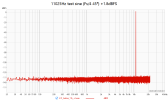
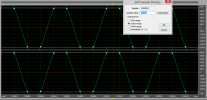
I created a 11025Hz redbook 0dBFS sine (45deg phase), added +2dB, burnt a disc, played through Marantz SA7001 + Topping DX5, FS digital volume, recorded via Cosmos Fs 96kHz and I see nothing in the audio band, just ultrasound mess.


11k_ISOs.png


11k_ISOs_time.png
 
Last edited:
I created a 11025Hz redbook 0dBFS sine (0deg phase), added +2dB, burnt a disc, played through Marantz SA7001 + Topping DX5, FS digital volume, recorded via Cosmos Fs 96kHz and I see nothing in the audio band, just ultrasound mess.


View attachment 561480


View attachment 561477
Pavel, you need to use a signal like this (with 45 deg phase offset) for the fs/4 ISO test. At 0dB peak samples it produces +3dBTP ISO's and most DACs show significant clipping distortion with ISOs that large.
1790605004930.png
 
Pavel, you need to use a signal like this (with 45 deg phase offset) for the fs/4 ISO test. At 0dB peak samples it produces +3dBTP ISO's and most DACs show significant clipping distortion with ISOs that large.
I did. It was a typo in my post. 45 deg, 4 points always at the same place as you have shown, amplitude of samples close to FS. So?

P.S.: I have corrected my previous post. Please also note the peak amplitude from the DAC (SE out), much higher than nominal 0dBFS. The DAC can handle ISOs.
 
Pavel, you need to use a signal like this (with 45 deg phase offset) for the fs/4 ISO test.
I did. It was a typo in my post. 45 deg,

To prevent misunderstandings, this is my test file.

ISOs_test.png


Sample values are 28506, so -1.2dBFS.

Peak value of the reconstructed sine test signal is +1.8dBFS.
L 01_testiso_11k_+2.wav.png
 
Last edited:
im streaming FLAC files from my Android Phone and using USB Player App.
I can control loudness from my phone so I assume that would help prevent any overs if I back the phone level down?
 
I see nothing in the audio band, just ultrasound mess.
Isn't it 3rd and 4th harmonic at very high level? Does it exist for the same input signal, but at lower level?
 
Isn't it 3rd and 4th harmonic at very high level? Does it exist for the same input signal, but at lower level?

No. Only when the reconstructed signal (peak) is over 0dBFS. But who cares? Will anyone hear -40dBr H3 at 33kHz? No. In fact it is not any high level, it is about 20mV of 33kHz. You get 10x more at 500kHz from class D amplifiers.
 
No. Only when the reconstructed signal (peak) is over 0dBFS. But who cares? Will anyone hear -40dBr H3 at 33kHz? No. In fact it is not any high level, it is about 20mV of 33kHz. You get 10x more at 500kHz from class D amplifiers.
Yes, but you have found clipping in oversampling algorithm. You probably can create a sample with ISO at 1kHz and get THD that can be heard.
 
I created a 11025Hz redbook 0dBFS sine (45deg phase), added +2dB, burnt a disc, played through Marantz SA7001 + Topping DX5, FS digital volume, recorded via Cosmos Fs 96kHz and I see nothing in the audio band, just ultrasound mess.

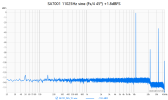
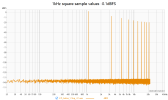
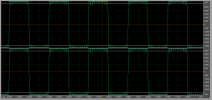
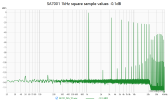
I was curious how Marantz SA7001 would behave without the external Topping DAC. So I have used the same +1.8dBFS 11025Hz sine (45°) and added a 1102.5Hz square with sample amplitudes of -0.1dBFS. Again, same as yesterday, there were no artefacts in the audio band, other then intrinsic CS low-level distortion on the square signal. Measurements shown below. Maybe the topic is overemphasized (as usually) and if there is an (audible!) issue, then it is within the recording itself.

L 01_testiso_11k_+2.wav.png ISOs_test.png SA7001_ISOs_Tr1.wav.png

L 05_testiso_1.1ksq_-0.1.wav.png ISOs_test_Trk5.png SA7001_ISOs_Tr5.wav.png
 
Maybe the topic is overemphasized (as usually) and if there is an (audible!) issue, then it is within the recording itself.
Exactly. Usually when you have lots of ISOs, the recording is already broken enough to not matter anymore. If those ISOs are simply and cleanly clipped, then they will be mostly inaudible anway. But we have seen other much less benign artifacts, from plain fold-over (wraparound) to sort of chaotic wave-forms, all depending on where exactly the processing of ISO does misbehave, and which also depends on setup like digital filter selection.
 
I have previously posted about ISO. However, those tests did not use a 20 kHz BW.
The FFT floor appears to rise.
0202_e50_db_sine_11025hz.png

0401_00_e50-0db_ap-0db_iso.png


There were instances where a clear effect was observed in the audible frequency range.
601_cdj2kn2_iso_44k_16_0500.png


I would appreciate it if someone could measure the THD+N at 44.1 kSa/s, 11025 Hz, 20 kHz BW for both 0 dBTP and +3 dBTP levels.
 
The FFT floor appears to rise.
I cannot see it with the CD player, 16-bit of course. And I doubt it would be audible with 24-bit files. Rather than speculations we would need to make a controlled DBT test and we would see if there is anything audible left, for a normally designed DAC. I would bet there is nothing.

testsig_vs_CDout.png
 
Again, same as yesterday, there were no artefacts in the audio band
If you want a test signal with audible artifacts when ISOs are clipped you can try one proposed by bennetng:
(note: it contains high level 18 kHz tone)
Discussed first here:
 
The problem is that the ISO is both DAC and conversion method dependent.

If Amir could be persuaded to test for this in the future the next question would be whether it would be just one simple test and consider that pass or fail and how much ISO would that be or should Amir do more elaborate testing exploring the max. headroom a DAC has (which could perhaps be done with one test as well ?)

And all of this for the super easy solution ... -3dB reduction digitally before sending it to a DAC, upsampler or format conversion.
Of course a solution is to buy a DAC that is known to handle ISO well.
 
If you want a test signal with audible artifacts when ISOs are clipped you can try one proposed by bennetng:
(note: it contains high level 18 kHz tone)
That signal works, however is absolutely unrealistic and is illegal, same applies for the 11025Hz Fs/4 45° FS samples signal. Sending such signal (8800+11000+17640Hz), even without clipping, is just good to destroy the tweeters. And clipping would not make any more hurt than the unclipped signal.
 
Back
Top Bottom