• Welcome to ASR. There are many reviews of audio hardware and expert members to help answer your questions. Click here to have your audio equipment measured for free!

Sealed versus Ported Bass, can the difference be measured?

Yeah, that was not my question, whether my present system is better than the previous. Or to compare apples to oranges. But about whether sealed versus ported differences are measurable. OK, many here say they are, and I believe I can hear them. I'm happy!
@Keith_W has asked for those MSAT files a few times.
What is stopping you?
 
sigbergaudio said:
My experience is that many of the really impactful sounds (like percussion) are quite wideband, so you need both the low-end and the range all the way up to 500hz in order.

I also swear to sealed subs, but recently ended up designing our full range loudspeaker to be ported to get enough capacity in the bottom end. And tuned to 28hz I'm hard pressed to say that it sounds any less tight and punchy than the sealed subs if I'm honest (which I try to be). :)


I agree 100%.

Now my sighted, flawed, changing tuning of my double 15's (just block 1 of the 2 ports), made an audible difference changing the tuning from 40hz to 27hz. The sound went from a thunk thunk to boom boom.

People talk of sealed bass being faster............
I stuffed both ports, there just was an octave less of bass, not faster, just not there....................

I think tuned speaker has the same group delay (as a sealed) 1 octave above tuning, so a 30hz tuning is just as fast as a sealed near 60hz (kick drum ?), but with more output below 60hz and much cleaner due to the cone not moving as far, then less and less till at tuning.................

A friend with 3 x 10" believed that sealed was "faster". He was amazed when a double 12" push pull PORTED to 27hz was "faster" and cleaner....................

Perlisten is using push pull now just as m&k did (early 90's ?) then Kreisel Sound (2012 review)............................
So, there must be something to the design, no ?


I've made 3 push pull slot loaded subwoofers. First was proof of concept double 12's, then 2 boxes of double 18's, then a single box with 4 x 12's.......


here is a link to some push pull diy stuff..............

Transients, or speed usually can be an integration issue.
I believe an audible culprit is the phase wrap (cause time delay) depending on the crossover point/slope..............

I just cringe at adding 20db of boost to make the amplified subwoofer get flat down to say 20hz in its too small of a box.

 
Last edited:
sigbergaudio said:
My experience is that many of the really impactful sounds (like percussion) are quite wideband, so you need both the low-end and the range all the way up to 500hz in order.

I also swear to sealed subs, but recently ended up designing our full range loudspeaker to be ported to get enough capacity in the bottom end. And tuned to 28hz I'm hard pressed to say that it sounds any less tight and punchy than the sealed subs if I'm honest (which I try to be). :)


I agree 100%.

Now my sighted, flawed, changing tuning of my double 15's (just block 1 of the 2 ports), made an audible difference changing the tuning from 40hz to 27hz. The sound went from a thunk thunk to boom boom.

People talk of sealed bass being faster............
I stuffed both ports, there just was an octave less of bass, not faster, just not there....................

I think tuned speaker has the same group delay (as a sealed) 1 octave above tuning, so a 30hz tuning is just as fast as a sealed near 60hz (kick drum ?), but with more output below 60hz and much cleaner due to the cone not moving as far, then less and less till at tuning.................

A friend with 3 x 10" believed that sealed was "faster". He was amazed when a double 12" push pull PORTED to 27hz was "faster" and cleaner....................

Perlisten is using push pull now just as m&k did (early 90's ?) then Kreisel Sound (2012 review)............................
So, there must be something to the design, no ?


I've made 3 push pull slot loaded subwoofers. First was proof of concept double 12's, then 2 boxes of double 18's, then a single box with 4 x 12's.......


here is a link to some push pull diy stuff..............

Transients, or speed usually can be an integration issue.
I believe an audible culprit is the phase wrap (cause time delay) depending on the crossover point/slope..............

I just cringe at adding 20db of boost to make the amplified subwoofer get flat down to say 20hz in its too small of a box.
With push-pull designs, you get the benefit of a dual-driver design, but do not double down on the potential distortion of both cones excursing in the same direction at the same time. I think newer, more well designed Drivers can really benefit from this, and Perlisten is a prime example. Also, the newer M&K Subs show this well.
 
With push-pull designs, you get the benefit of a dual-driver design, but do not double down on the potential distortion of both cones excursing in the same direction at the same time. I think newer, more well designed Drivers can really benefit from this, and Perlisten is a prime example. Also, the newer M&K Subs show this well.

Isn't it more the other way around? Newer, more well designed drivers would have less asymmetry, and needs this configuration to a lesser degree.
 
Isn't it more the other way around? Newer, more well designed drivers would have less asymmetry, and needs this configuration to a lesser degree.
You could look it at as a method to allow use of much cheaper drivers but still charge a premium.
 
Here is a video I just came across today that discusses ported vs sealed woofers:

I haven't watched that particular video, but you should really avoid that guy, his opinions are often wrong and he's often really rude and all out trolly in his comments to people.
 
I haven't watched that particular video, but you should really avoid that guy, his opinions are often wrong and he's often really rude and all out trolly in his comments to people.

I saw that as well, I’m in the market for the Kali IN-5 as an office upgrade and came across that video. He is pretty abrasive, but may have a point here. I was hoping someone in this thread had some more trustworthy answers.
 
Here is a video I just came across today that discusses ported vs sealed woofers:

Yeah, well... let's see what we have here: Luckily, the "geeks" requested pink noise, so we can actually see the frequency response of the 2 speakers:

Here is the reference:
1752228045380.png


Here is the Kali:
1752228004869.png


And the 3-way:
1752228350654.png


Here, both are overlaid (Kali in pink):
1752228558011.png


Clearly, there are major differences in frequency response. The large 3-way falls off earlier and slower, which makes sense, given that it's a closed box. So the Kali is actually louder until about 40 Hz. The slopes are also not the same; the Kali will probably sound slightly darker overall.

So yeah, most of what you hear is a difference in frequency response, not time domain issues. And better fix that 50Hz room null!
 
I haven't watched that particular video, but you should really avoid that guy, his opinions are often wrong and he's often really rude and all out trolly in his comments to people.

I watched that video (or rather, I listened to it while I was doing something else). All he does is play some tracks and say "you hear that? It's so obvious to me! It's like the difference between 96k MP3 and WAV!". No measurements, no psychoacoustic research, no actual science. As it turns out, I did not hear it. But I was listening to him on bluetooth speakers whilst I was preparing dinner.
 
REW WILL readily measure the difference provided that the measurement was done properly. However, you replaced 3 stacked Klipsch ported subs with one sealed SVS sub and posted a screenshot. As has been pointed out many times, it is impossible to specifically answer your question about the difference being due to group delay. BUT we can probably tell you if the new setup is better than the old one.

Please do this: copy all your measurements into one MDAT. Clearly label the measurement "before" and "after". Zip the MDAT and upload it to ASR.
How do I copy all my measurements into one MDAT, I am embarrassed to have to ask. I guess I 'zip' the files using a MacBook?
 
Isn't it more the other way around? Newer, more well designed drivers would have less asymmetry, and needs this configuration to a lesser degree.
I would generally agree this should be correct. Yet is it? ;) I think one still would need to get beyond production variance to make this true. While “lesser degree” is mostly accurate, the team at Perlisten still felt their flagship Sub would benefit from this approach.
 

Attachments

Yeah, well... let's see what we have here: Luckily, the "geeks" requested pink noise, so we can actually see the frequency response of the 2 speakers:

Here is the reference:
View attachment 462623

Here is the Kali:
View attachment 462622

And the 3-way:
View attachment 462625

Here, both are overlaid (Kali in pink):
View attachment 462626

Clearly, there are major differences in frequency response. The large 3-way falls off earlier and slower, which makes sense, given that it's a closed box. So the Kali is actually louder until about 40 Hz. The slopes are also not the same; the Kali will probably sound slightly darker overall.

So yeah, most of what you hear is a difference in frequency response, not time domain issues. And better fix that 50Hz room null!
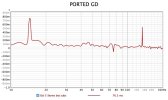
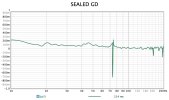
Do have the group delay graph for the 2 speakers you could post? Not that I think it will be revalatory but I am curious.
 
Do have the group delay graph for the 2 speakers you could post? Not that I think it will be revalatory but I am curious.
With that much room interaction, this will be rather pointless. But I'm sure the Kali will have more group delay because of the steeper falloff.
 
Do have the group delay graph for the 2 speakers you could post? Not that I think it will be revalatory but I am curious.
Isn't that in the MDAT file?
 

Attachments

  • PORTED GD.jpg
    PORTED GD.jpg
    96.9 KB · Views: 154
  • SEALED GD.jpg
    SEALED GD.jpg
    93 KB · Views: 127
I would generally agree this should be correct. Yet is it? ;) I think one still would need to get beyond production variance to make this true. While “lesser degree” is mostly accurate, the team at Perlisten still felt their flagship Sub would benefit from this approach.

They certainly make good subs with low distortion, but based on the measurements I suspect the latter is perhaps more a result of pretty strict and advanced limiter circuits, rather than the push pull configuration, but that is speculation. :)
 
Back
Top Bottom