• Welcome to ASR. There are many reviews of audio hardware and expert members to help answer your questions. Click here to have your audio equipment measured for free!

Scientific reasons why cables matter for audio

Be very careful when a person talks about electrical cable, and confuses the "impedance" of the cable with the "characteristic impedance" of the cable. Chances are that the person is giving you a full load of BS, or clueless on the subject, or both.

Let's take a look at where this "characteristic impedance" came from. Below is the derivation part copied from the Wikipedia page.
View attachment 529453
Notice that at the start, voltage and current are both expressed as functions of time (t) and position along the length of the cable (x)? This gives you the first clue that the "characteristic impedance" only matters when you expect there are significant variations in the voltage (and current) level along the length of the cable. So ask yourself: Are you expecting big voltage variations along the cable, that the voltage at the output end of the cable is going to be very different from the input end? If not, the characteristic impedance doesn't matter. Electricity travels at 2/3 the speed of light in copper cables. Unless the cable is very long (kilometers) or the signal frequency is very high (RF). At 2/3 speed of light, the wavelength of a 20 kHz signal is ~10 km.

Let's dig a little further. The starting equations (telegraph equations) describe dV/dx & dI/dx, which are changes in the amplitudes with position x in differential form (time dependence is factored out to the e^(jωt) term).

A few steps down, we got the expressions for V(x) and I(x) in terms of k & A & A₁. The characteristic impedance Z₀ is the ratio A/A₁, which are to describe variations in V or I in different positions along the cable. Therefore, the characteristic impedance is only relevant for those that care about what happen in the spatial domain of an electrical signal propagating in a cable. Which means it is only relevant when the cable length is of the similar order of magnitude as the wavelength of the signal in the cable, or longer.

Yes, but most competent engineers start thinking about the characteristic impedance of the interconnect starting around 1/10 of the wavelength. Once you get to more than a quarter of the wavelength it needs to be actively thought about. But the single largest contributing factor in signal quality is the termination impedance. Look at USB standards as to how sloppy the cable can be, 90ohms +- 15%. Huge tolerance but works reliably at 100+ MHz
 
Thinking about the properties of an electrical cable as described above leads me to this comment (offered strictly as-is and FWIW).
Physics, chemistry, and reality can have interesting intersections. ;)

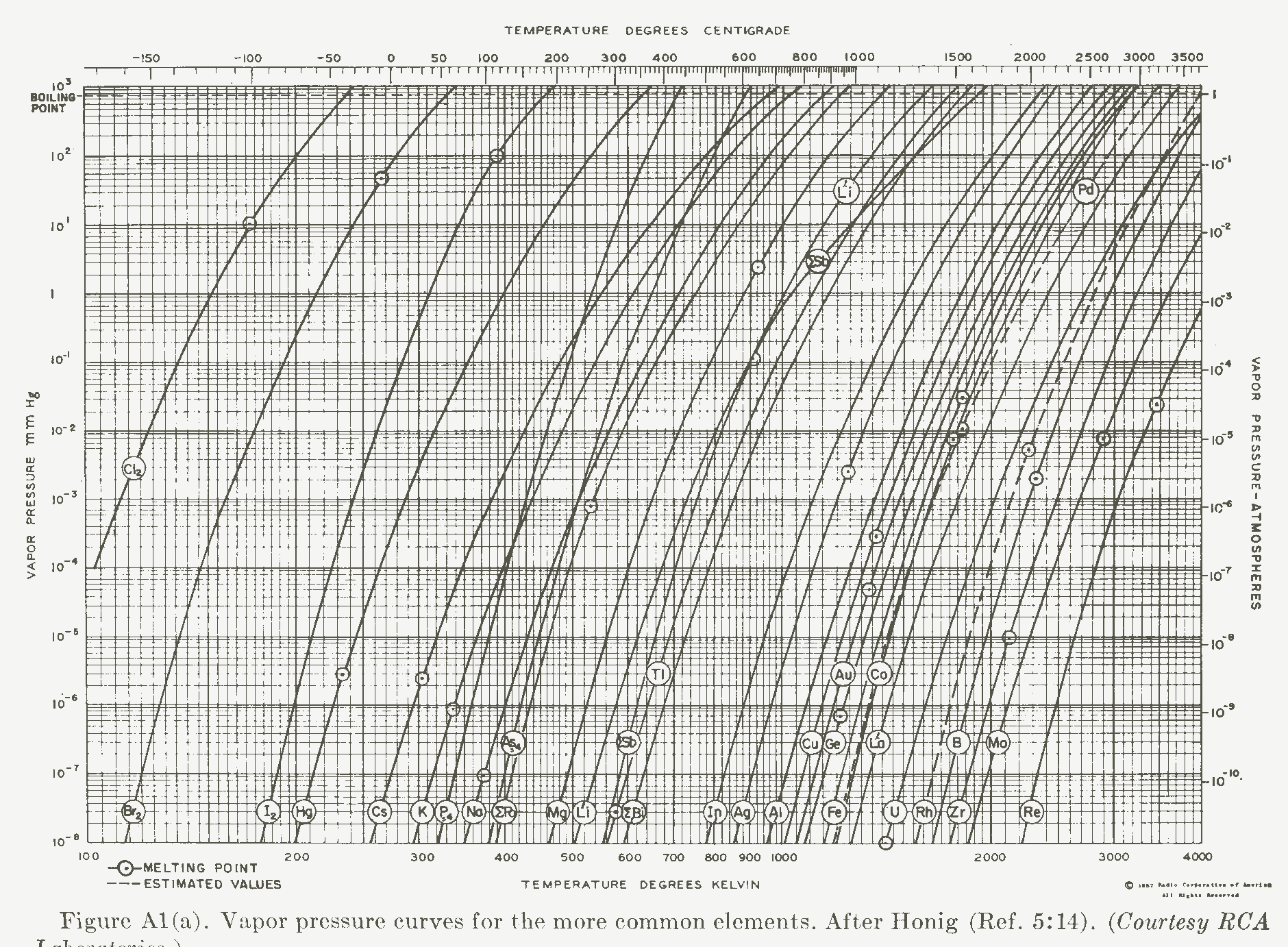
Here's my analogy: the elements have vapor pressures associated with them. If one's building mass spectrometers requiring very high vacuums, making spacecraft, you actually have to consider the vapor pressure of things like metals used in the evacuated part(s) of the instrument/machine.

Building a kitchen appliance, though: not so much.

Things that matter a lot at, oh I dunno, terahertz frequencies don't much matter at 1,000 Hz.
 
Here's my analogy: the elements have vapor pressures associated with them. If one's building mass spectrometers requiring very high vacuums, making spacecraft, you actually have to consider the vapor pressure of things like metals used in the evacuated part(s) of the instrument/machine.
;):D:p
vapor-press2.png
 
Hello,

I am new to this forum and I apologize in advance in case I did something wrong or violate any etiquette for newbies. I am a somewhat older audio buff with, among other things, some 14 years of track record (incl. on the moderating team) in a large German hifi-forum (but I'm no longer active there for a while now).

The reason for me regeistering just now is that a new "scientific reasons" video is live on the same channel this thread opened with. Among the comments there is one from a purportedly highly placed person, possibly making it appear as an endorsed statement. Among other things, the comment complains about "the naysayers and amir junkies usually appear like flies at a summer cook out," and goes on for a while in a similar fashion.

Perhaps this might be of some interest to the ASR community and this discussion, so I'm posting it here.

Again, if this violates something in your rules, I meant no offense.
 
People on snake-oil forums have been dissing us for years. I take it as a compliment,
 
Addendum:

That comment I have referred to has since been edited to remove or else weaken the most offensive language. My comment there qouting the original comment is still live (let's see for how long). I also have made screenshots just in case.
 
Addendum:

That comment I have referred to has since been edited to remove or else weaken the most offensive language. My comment there qouting the original comment is still live (let's see for how long). I also have made screenshots just in case.
Lol!
 
remove or else weaken the most offensive language
No matter. We'll just go on with our tin ears and Poindexter existence.
 
I am glad this interesting and novel topic has come up.

Since we are at a science forum I have performed a study to establish the role of cables in sound reproduction.

Double blind testing of my system with and without cables revealed they are an essential component. Without cables there was no sound.

So I would strongly agree with the sentiment expressed by the OP.

Cables do matter, they matter very much.
 
Cables do matter, they matter very much.

Yes, of course cables to matter. As @fpitas notes, long enough is very important... but it is also best to avoid excessively long ultra-thin cable as well.

Not sure if this was already covered in the thread. But I once heard an A/B test of two speaker cables using Monster Cable's in-store comparison device at a local Circuit City (circa 1998). The difference was quite audible — there was a very audible "winner" in that A/B test:
  • Speaker Cable A: spooled length of 50+ feet (15+ meters) of thin non-insulated 24+ gauge generic wire
  • Speaker Cable B: thick, heavily insulated, gold-terminated Monster Cable; likely 14 AWG or better wire
The results were clear: an absolutely horrible choice that is then poorly implemented (i.e. spooling an excess length of ultra-thin cable) is the choice you want to avoid.

The corollary was equally clear: a company that stoops to such fraudulent sales tactics is also the choice you want to avoid.
 
Have you seen this? I didn't watch the whole thing, but in short, it talks about the differences that cable impedance can make. If we get different results when the cable impedance is combined with the speaker impedance, wouldn't we see this when we measure the frequency response?

The ridiculous picture says it all. 500 ohms at 20 hz and physics in the same line. That would take 50,000' of 16 gauge speaker wire for the R to reach 500 ohms.
And the impedance from inductance of twin lead at 20 hz would take 10,000 km of cable to reach 500 0hms.
 
The reason for me regeistering just now is that a new "scientific reasons" video is live on the same channel this thread opened with. Among the comments there is one from a purportedly highly placed person, possibly making it appear as an endorsed statement. Among other things, the comment complains about "the naysayers and amir junkies usually appear like flies at a summer cook out," and goes on for a while in a similar fashion.

Damn it, my fellow flies found a summer cook out and I wasn't invited!

People don't like their religious beliefs challenged. Particularly people who have wasted thousands of dollars of their own money. I have no objection to luxury audio - if you offered me a beautifully built amplifier and asked for a reasonable price (maybe $3-4k) I would buy it, even if it offered no performance benefit over a $1k amp. The problem is all the claims of superior performance. All we are asking for is honesty, I don't think that is so unreasonable.

Anyway, welcome to ASR.
 
Hello,

I am new to this forum and I apologize in advance in case I did something wrong or violate any etiquette for newbies. I am a somewhat older audio buff with, among other things, some 14 years of track record (incl. on the moderating team) in a large German hifi-forum (but I'm no longer active there for a while now).

The reason for me regeistering just now is that a new "scientific reasons" video is live on the same channel this thread opened with. Among the comments there is one from a purportedly highly placed person, possibly making it appear as an endorsed statement. Among other things, the comment complains about "the naysayers and amir junkies usually appear like flies at a summer cook out," and goes on for a while in a similar fashion.

Perhaps this might be of some interest to the ASR community and this discussion, so I'm posting it here.

Again, if this violates something in your rules, I meant no offense.

If anyone starts his argument with "I am a xxx xxx scientist", it has the same weight as someone who says "I am / my son is a lawyer"
 
  • Like
Reactions: EJ3
Sorry that I am late to this thread. :(

Please advise if the posted yt video is mandatory...
Better yet, please also advise if all other pages are required-reading, so that I don't lose anymore sleep, worrying about my cable-stash.
Thank you!
 
Hello,

I am new to this forum and I apologize in advance in case I did something wrong or violate any etiquette for newbies. I am a somewhat older audio buff with, among other things, some 14 years of track record (incl. on the moderating team) in a large German hifi-forum (but I'm no longer active there for a while now).

The reason for me regeistering just now is that a new "scientific reasons" video is live on the same channel this thread opened with. Among the comments there is one from a purportedly highly placed person, possibly making it appear as an endorsed statement. Among other things, the comment complains about "the naysayers and amir junkies usually appear like flies at a summer cook out," and goes on for a while in a similar fashion.

Perhaps this might be of some interest to the ASR community and this discussion, so I'm posting it here.

Again, if this violates something in your rules, I meant no offense.
We can just post the video here, you know :)


Quick summary: dude got some expensive Iconoclast cables, mumbles a bit about “science” then concludes that that why they sound better.

On one hand, he argued about measurable differences, while in the next minutes claiming things are not. He’s basically listing a bunch of supposed engineering advantages of the cables, and then making up some allegedly audible differences from it. It’s very clear he doesn’t understand the science, nor simple logical reasoning. The whole video is one massive non sequitur.

And incidentally:

 
Especially the length. I tried shorter ones that don't reach, but performance suffered.
Depends on the source material. For some artists/albums, the performance of shorter cables that don't reach might be markedly improved relative to long-enough cables.
:eek:

:cool:

I am thinking, e.g., of Kenny G -- but YMMV, as they say.
 
We can just post the video here, you know :)


Quick summary: dude got some expensive Iconoclast cables, mumbles a bit about “science” then concludes that that why they sound better.

On one hand, he argued about measurable differences, while in the next minutes claiming things are not. He’s basically listing a bunch of supposed engineering advantages of the cables, and then making up some allegedly audible differences from it. It’s very clear he doesn’t understand the science, nor simple logical reasoning. The whole video is one massive non sequitur.

And incidentally:


Good job, Passion for Sound influencer-dude!
The change wrought by swapping cables most likely is indeed equivalent to that occasioned by upgrading one's DAC.
i.e., Negligible.
 
Back
Top Bottom