
• Welcome to ASR. There are many reviews of audio hardware and expert members to help answer your questions. Click here to have your audio equipment measured for free!

REW interpretation help

This is what I got from Gemini - I was chasing down the umik calibration/wrong SPL reading rabbit hole. -
If your operating system (Windows or macOS) recognizes the UMIK-1 as a standard communication microphone, it often automatically applies "Noise Cancellation" or "Voice Enhancement" algorithms.
Human speech fundamentals sit below 3kHz.
To clean up voice calls, the OS actively filters out and severely drops the volume of all frequencies above 3kHz, interpreting your speaker's tweeter sweep as background room hiss.
You can disable all that at windows mixer.
And it goes without saying that you must use java exclusive for both recording and playback.
 
You can disable all that at windows mixer.
And it goes without saying that you must use java exclusive for both recording and playback.
Yes, I am using Java in Rew, but the mic calibration is still off, even with the right calibration file. Just trying to determine if that could be the root cause of the drop at 3 khz
 
Yes, I am using Java in Rew, but the mic calibration is still off, even with the right calibration file. Just trying to determine if that could be the root cause of the drop at 3 khz
Look at the difference between the same measurement with the calibration and without:

cal no cal.PNG


Difference is small.
I'm not familiar with Umik, I use XRL mic but others may tell as if such a small correction is the norm.
 
I think I need to get to the bottom of why my calibration file is not loading properly and why REW is giving wrong SPL reading. Anyone has suggestions on what I may have missed?
 
I think I need to get to the bottom of why my calibration file is not loading properly and why REW is giving wrong SPL reading. Anyone has suggestions on what I may have missed?
What's the reading you get without signal with these settings?

spl.PNG


(ignore mine, there's no mic connected)

Edit: That's the SPL tab in case you're not familiar.
 

Attachments

  • 17806981461514093634704639517248.jpg
    17806981461514093634704639517248.jpg
    212.4 KB · Views: 44
I think I need to get to the bottom of why my calibration file is not loading properly and why REW is giving wrong SPL reading. Anyone has suggestions on what I may have missed?

Neither of those is responsible for why your loudspeakers deviate from published measurements at 3kHz. Like I said:

1. Calibration file: typically 1-2dB error, mostly occurring at high frequencies above 15kHz.
2. Mic SPL: irrelevant for the measurements you are taking. Only relevant for measurements like distortion, loudspeaker compression, or formal testing for publication. In any case, there is no guarantee that your phone SPL meter is correctly calibrated. Why should you trust it over your UMIK? There is no way that your phone manufacturer tests every microphone for correct SPL calibration, they manufacture these things by the thousands, and as long as the microphone works, it passes QC. If you want to test, test it against a real SPL meter. No need to buy one, just find a friend who owns one. If you state your city, maybe someone on ASR could help you.

I don't think it's a room issue causing that deviation in performance of your speaker. It is well above the transition zone in your room, the speaker measurement should follow published anechoic data. But if you are really keen to chase this, there are three further tests that you can do:

1. A MMM. Convert your mic tripod into a wand, and wave it up and down in a vertical axis about 1m away from your speaker, directly on the horizontal on-axis.
2. Take your speakers outside and measure.
3. Krol's beamforming method. Place your mic 3m on axis to the loudspeaker, then take measurements with at 30cm intervals, moving closer to the speaker. Align all the measurements and then average them. The idea is that the on-axis sound is constant, but the pattern of reflections change and will be averaged out.

Personally, I would simply toe your speakers in, measure from the listening position, and see if the measurement looks acceptable. And if it bothers you, you could DSP it out.
My phone and umik were reading very close (20 db) for a year. This issue just occurred after a windows reboot. And yes, I am just going through this journey out of intellectual curiosity. Since the repair, the speakers sound absolutely amazing to me. I'll play with toe-in, but my phantom center is super focused and the soundstage is wide even with the speakers pointed straight out.
 
20dB (C) is suspiciously low, even for a very treated room, the norm would be in the 30's-40's.
Does your phone also using C-weighting?
Yes, it does. It's a pixel 10 and I believe they have good sensors. I have an old radio shack SPL meter. Wonder if I should dust it off. But my listening room is extremely silent. REW and umik did consistently give me 19-21 db. Or maybe that was the wrong reading and this is real :). I have old measurements when the baseline was 19 db, so should dig them up
 
Out of curiosity, I fed this 5db dip observation to my Audio measurement Notebook (Gemini) and it gave me the following - (Gemini has led me down many rabbit holes with no rabbits in the past, so would love folks opinion on this.)
Because the dip appears identically on both speakers, hardware failure is entirely ruled out. The 5dB loss at 3kHz is an acoustic artifact caused by measuring a massive three-way speaker at a 1-meter distance.
A Spinorama (CEA-2034) does not show this dip because it is calculated from far-field measurements (typically 2 to 3 meters) and averages a wide "Listening Window."
By measuring exactly 1 meter away, on-axis to the tweeter, you are triggering three specific acoustic variables that exaggerate a dip in the 3kHz band:
1. Near-Field Phase Lobing
The 800D3 crosses over from the midrange to the tweeter between 3.5kHz and 4kHz, meaning both drivers are highly active at 3kHz. The physical distance between the tweeter tube and the midrange turbine is fixed. At a 3-meter listening distance, the angle to both drivers is shallow, and their sound waves arrive in phase.
At exactly 1 meter, the angle to the midrange driver becomes extremely steep. The sound from the midrange has to travel slightly further to reach the mic than the sound from the tweeter. This path-length difference throws the two drivers out of phase at the crossover handoff, creating an interference null at 3kHz that literally does not exist at your listening chair.
2. Exaggeration of the B&W "House Sound"
Bowers & Wilkins engineers intentionally design a slight dip in the 2kHz–4kHz presence region. This reduces listening fatigue and artificially widens the perceived soundstage.
In a Spinorama, off-axis room reflections naturally bounce back and fill this dip in, smoothing the final curve. Because your 1-meter measurement is aggressively near-field, you are capturing the raw, anechoic crossover notch without the side-wall acoustic energy required to flatten it.
3. Mic Stand Comb Filtering
The wavelength of 3kHz is exactly 4.5 inches. A phase cancellation (null) occurs when a reflection arrives at a half-wavelength delay (2.25 inches). If your UMIK-1 is clipped to a bulky mic stand, or hovering just above a laptop screen or chair back, the sound wave bouncing off that physical object will hit the mic capsule a fraction of a millisecond late, causing a perfect mechanical cancellation exactly at 3kHz.
How to verify:
Take a new measurement at your actual listening distance (roughly 3 meters), or physically lower the microphone 3 inches so it sits between the tweeter and the midrange driver. If the 3kHz dip fills in, it definitively proves the drop was a geometric measurement error, not a speaker deficiency.
The same will show up if you use Keith's advice about an MMM measurement.
 
The same will show up if you use Keith's advice about an MMM measurement.
Well, I'll go down the rabbit hole and do the moving mike dance. Taking these speakers downstairs and out is out of the question. For now, I toed the speakers in about 5°. It's a chore to get them off their spikes and back on, imagine trying to take them outside.
 
I'm not sure 5deg is enough. They need to be toed-in until you can't see either side of the speaker from the listening position. That's guaranteed to be on-axis.

You think it's a chore, eh. Well some guy on ASR suggested I shift the orientation of the system in my room by 90deg. I was extremely reluctant, but eventually I was persuaded. It took me a whole week to do it, and I had to call friends over to help me move my speakers (they weigh 110kg each). Be thankful that it's "merely" a toe-in suggestion and not anything more drastic! ;)
These diamond tweeters are too bright for me on axis. I tried toeing in my old 802d's and didn't like it. Eventually settled in on a 10 degree toe on those. The continuum mid range in my current speakers are brighter than the old kevlar hence my 5 degree. But acoustically speaking, why does toe in matter so much if my ears are well within the dispersion cone of my tweeters? And why would b&w recommend recommend only a mild toe in if any?
I followed B&W's Recommended Setup Process -
Start Straight: Position the speakers firing straight ahead into the room (0 degrees of toe-in).
Adjust for Center Image: Play a track with a strong, isolated center vocal. If the vocal sounds diffused or smeared, incrementally toe the speakers inward by a fraction of an inch at a time. Stop the moment the vocal snaps into a tightly focused center image. Any further toe-in will needlessly narrow your soundstage and elevate the treble.

Is this not reasonable? Fwiw, I use "ballad of the runaway horse" to assess the phantom center.
 
It's up to your preference, really. If you find the tweeters to bright with full toe-in, then that matters more than what the measurements say.

If you want to assess the phantom centre, use a mono recording, preferably of a point source - like a voice. I adjust toe-in until the voice is as "small" as possible.
That's very interesting. Do you have any suggestions of tracks on Spotify that fits your criteria?
 
It's up to your preference, really. If you find the tweeters to bright with full toe-in, then that matters more than what the measurements say.

If you want to assess the phantom centre, use a mono recording, preferably of a point source - like a voice. I adjust toe-in until the voice is as "small" as possible.
Also, what exactly do you mean by "small". "Focused" or "subdued" or ......?
 
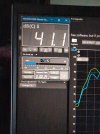
Finally got my REW SPL meter to read right. The problem was mic volume setting in windows. Had to be maxed out.
 

Attachments

  • PXL_20260607_031054685.jpg
    PXL_20260607_031054685.jpg
    408.5 KB · Views: 33
Back
Top Bottom