• Welcome to ASR. There are many reviews of audio hardware and expert members to help answer your questions. Click here to have your audio equipment measured for free!

Review and Measurements of Mytek Brooklyn DAC

Where can we see that standard? I assume this is similar to why some test CDs used 997 hz instead of 1 khz so it would exercise more bits more variably than a quickly repeating frequency.
They use a prime multiple to force every sample value to eventually be utilized. See: Fundamentals of Modern Audio Measurement Richard C. Cabot, AES Fellow Audio Precision, Inc. Beaverton, Oregon 97075, USA

upload_2017-8-1_22-40-14.png

upload_2017-8-1_22-41-34.png
 
So if we used a prime sample rate then there would be prime relation with every integer hertz frequency. Somehow that must be where digital took a wrong turn. Non prime sample rates. o_O
 
This will delve a bit deep into engineering, sorry guys.

Using relatively prime ratios of sampling rate to signal frequency means every harmonic, folded or not, ends up in its own FFT bin, making it much easier to analyze the results and properly determine e.g. SNR, SFDR, SINAD, THD, IMD, etc. There are other methods that will work but the goal of all of them is to provide a signal frequency "independent" of the sampling rate to ease spur separation. It also obviates the need for FFT windowing, which is how you handle the discontinuities that occur for non-prime (general) ratios.

Discussed somewhere in my WBF articles, which at some point I suppose I should update and copy here since I am not welcome there.

The Standard is an IEEE publication: https://standards.ieee.org/findstds/standard/1241-2010.html One of my former bosses (Tom L.), as well as a few other colleagues, worked on it (and the earlier 1057 digitizer standard) as part of the TC-10 comittee and I helped on some of the sections (though am not listed AFAIK, so believe me or not, Ripley). He (Tom) hosted the last TC-10 meeting...
 
Discussed somewhere in my WBF articles, which at some point I suppose I should update and copy here since I am not welcome there.

Do natural remedy forums ban MD's?
 
Discussed somewhere in my WBF articles, which at some point I suppose I should update and copy here since I am not welcome there.
Your in very good company with that Don :)
 
It's my own fault. I let myself get drawn into one of the threads Amir was involved with, one that degenerated as one might expect, and made a serious but tongue-in-cheek comment that was meant to help but was taken wrongly and just poured gas on the flames. Not banned but clearly not welcome so I look now and then but don't post. From what I've seen WBF is serving the subjectivist community quite well where AVS and ASR serve the more objectively-oriented. I don't frequent other audio forums (unless the trumpet forum counts), just not enough hours in the day.
 
Example:

Dots are sample values.

Three instances of 12kHz tone samples at 48kHz sample rate, and one at 11239Hz (a prime number near 12000)

First exercises 2 sample values plus zero
Second exercises 4 sample values
Third only exercises 2 sample values.
Last probably hits them all (maybe not every one of the combinations, but probably each of the 16 or 24 levels that contribute to the data->voltage conversion)

upload_2017-8-2_21-24-2.png

Seems to me like you'd want to exercise all (16 or 24) of the sample bits as a linearity check.
 
The IEEE method includes the equations to ensure every possible code is "touched" at least once.
 
Example:

Dots are sample values.

Three instances of 12kHz tone samples at 48kHz sample rate, and one at 11239Hz (a prime number near 12000)

First exercises 2 sample values plus zero
Second exercises 4 sample values
Third only exercises 2 sample values.
Last probably hits them all (maybe not every one of the combinations, but probably each of the 16 or 24 levels that contribute to the data->voltage conversion)

View attachment 8047

Seems to me like you'd want to exercise all (16 or 24) of the sample bits as a linearity check.

Different and not related to the point Don is making. Think about the fact if you are using unlocked DAC and ADC, the middle sample of your second 12 khz signal goes from the first condition and the third condition and back again. Probably at some point hitting every possible bit value in the process. Just do a small speed change of your 1st or 3rd 12 khz signal and you'll see what I mean. I use that fact to determine the speed difference in PPM between ADC and DAC. If it takes 100,000 samples to go form 1st example to 3rd example and back to the 1st example then there is a 1/100,000 difference in clocks speeds or 100 ppm.
 
Thanks very much for reviewing the Brooklyn.

I was seriously considering getting one, but no longer.

I'll go back to considering the RME ADI-2 Pro.

If only it came with remote control.....
 
I am not seeing anything to respond to. I did objective measurements. Not subjective. If they want to do a blind test, that would be most welcome. They better match levels though.

I post there and will answer anything concrete they may have.
 
Specifically, posts 93...97...and 102?
Didn't J. Atkinson conclude superb performance from Stereophile's measurements?
 
Specifically, posts 93...97...and 102?
Didn't J. Atkinson conclude superb performance from Stereophile's measurements?

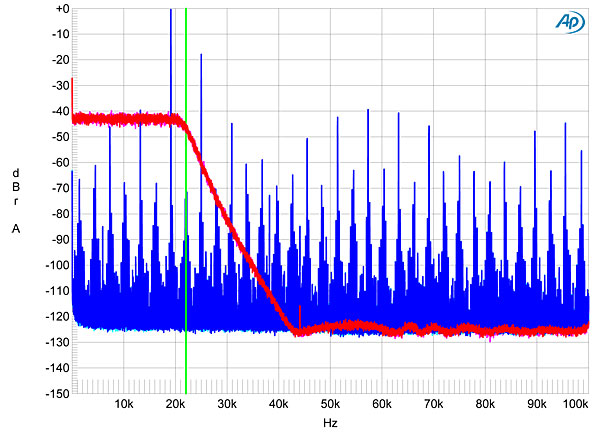
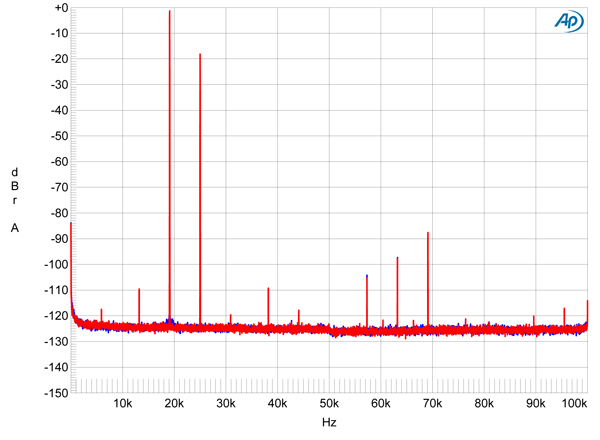
Look at JA's results in fig. 6 and fig 6A. The tone is in blue you can ignore the other signal. 19.1 khz tone at full scale 0 db. JA's result with the higher frequency tone is worse than Amir's result with 7 khz. I do wish Amir would do an 18&19 khz IMD test or 18&20 khz IMD test. They usually stress a device more than single tone THD test.

1016MyBrookfig06.jpg


Now the same 19.1 khz tone at - 1db. Left is blue, right is red.
1016MyBrookfig06A.jpg


Looks like a manifestation of the same issue.
 
Last edited:
Hi Blumlein,

Thanks -- boy, what a difference 1 dB makes! :eek:
 
When JA does this at the end of a complimentary review it is highly credible.

When Amir does it without appropriate fawning praise simply pointing out the results he is NOT credible. :p
 
I liked this comment:

"But there is a core of more profound fascination behind the provocation: Do we think that producers of active speakers put more than a few hundred dollars into their DACs? And do active speakers sound bad due to their lack of exotic DACs?"
 
Back
Top Bottom