• Welcome to ASR. There are many reviews of audio hardware and expert members to help answer your questions. Click here to have your audio equipment measured for free!

Review and Measurements of Marantz SA7001 CD/SACD player

I did my last measurements of Marantz SA-7001 in November 2021. Since that time, my measurement system has been grossly improved, thanks to E1DA Cosmos ADC. Let me post several new measurements, please.

1. THD and THD+N at 1kHz at various signal level

1.1. At 0dBFS
SA7001_1kHz_FS.png


1.2. At -60dBFS
SA7001_1kHz_-60dBFS.png


1.3. At -90dBFS
SA7001_1kHz_-90dBFS.png


Please note excellent linearity of this payer. The signals at low level are clean and free of spurious spectral lines in the audio band.


2. CCIF intermodulation distortion 19+20kHz (full scale)

SA7001_CCIF_IMD.png


Please note that intermodulation products all lie below -94dBr in the audio band, which is an excellent result.

3. Final remarks

Please make sure that your system is free of mains and similar spuriae spectrum products, when measuring audio components. Measuring errors may make distorted view of the tested product.
 
Interesting.
Did you use the standard version of REW or the beta?
The beta can compensate for the E1DA headroom (I see -12.9dBFS) so the ENOB is correctly calculated (it can be adjusted in the distorsion window of RTA).
I see you used dithered test tones, so that will improve linearity (at -90dBFS). But you showed -90dBFS undithered on scope, and the trace was very good, but not sure it was at the right amplitude, although I guess so since these SACD players are using shape dither anyways.

The IMD CCIF is relatively high (-70dB) and I see it is probably because of a not so efficient filtering that lets some artifacts go up to this level (the d2H is at that level and drives the result).

Cheers
 
Last edited:
It is a standard REW. There is more than enough resolution left in Cosmos ADC to measure the 16bit CD output properly and with a good margin.

Yes, I am using dithered test disc, for good reason. 16-bit format is, IMHO, unusable without proper dithering. Quantization noise (without dither) is heavily correlated to signal frequency and you get everything imaginable when changing frequency a bit. It is much better to have small TPD penalty than to see usual forest and grass of undithered tones, which may also contain near to mains frequency components (and you do not know if the spectra you see are a result of incompetence of the tester, poor device or quantization noise or all of that). This is not only about the -90dBFS signal, it covers the whole dynamic range.

Ultrasound 19+20k products are a result of filter leakage. Very usual with many CD players due to proximity of 19+20k tone to 22.05kHz. Inaudible, however.
 
Last edited:
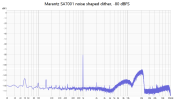
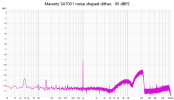
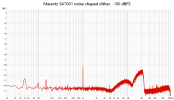
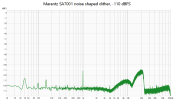
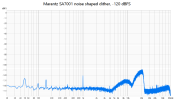
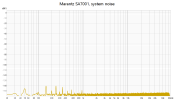
A set of measurements with 44.1kHz/16bit noise-shaped dither test signal from -80dBFS down to -120dBFS.

Marantz SA7001 noise shaped dither, -80 dBFS.png Marantz SA7001 noise shaped dither, -90 dBFS.png Marantz SA7001 noise shaped dither, -100 dBFS.png Marantz SA7001 noise shaped dither, -110 dBFS.png Marantz SA7001 noise shaped dither, -120 dBFS.png Marantz SA7001 system noise.png
 
There is always a space for improvements :). Below new measurements of Marantz SA7001 ==> Toslink ==> Topping DX5 ==> Cosmos ADC (SE 2.7V range).

THD and THD+N at 997Hz, 0dBFS
SA7001+Topping DX5 997Hz 0dBFS.png


CCIF IMD 19+20kHz
SA7001+DX5 CCIF IMD.png


sine 21.5kHz
SA7001+Topping DX5 21.5kHz.png


DIM test (transient intermodulation) sine 15kHz + square 3.18kHz
SA7001+Topping DX5 DIM test.png
 
Back
Top Bottom