• Welcome to ASR. There are many reviews of audio hardware and expert members to help answer your questions. Click here to have your audio equipment measured for free!

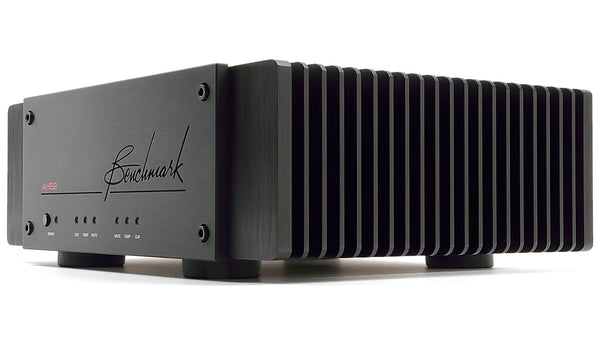
Review and Measurements of Benchmark AHB2 Amp

But it got 93 points. NINETY THREE POINTS! Isn't that enough for you people???!!!!

Probably indistinguishable from far more expensive amps with similar THD and SNR, but which get 96 to 98 points.
 
Rather then using a large transformer for the INPUT power, they are using a CLASS D style PWM variable rail voltage which changes the input voltage to the transistors depending on the demands of the music input source. The CLASS D section is not used to play music, it is used to provide the rail voltage to the A, A/B music section.

It is called a switching power supply.
 
Their measurements indicate that their load is not fit for the task - neither is their measurement equipment.
Are there any reliable DF measurements from another source (same load and level)? I am not aware of any...
 
Last edited:
The AHB2 does not have a class-D amplification stage. The outputs of the power supply are DC.

The AHB2 has an AC to DC switched mode power supply that provides two sets of regulated supply rails to a high-power linear class-AB amplifier. It also provides a set of DC rails for the class-A correction amplifier. The supply voltages at the output of the power supply do not track the audio. Just the opposite - the supply voltages are tightly regulated so that the voltages do not change under load. Unlike most linear amplifiers, the AHB2 does not use much capacitive energy storage at the power supply outputs. The power supply is designed to deliver current on demand. From an output current standpoint, the power supply responds to audio frequencies. From a voltage standpoint, the output is a tightly regulated DC on all output rails.

The class-G designation (or class-H if you prefer European definitions) for the main amplifier is due to the fact that there are two separate bipolar DC supply voltages for the main amplifier. Half of the bipolar output transistors are connected to the higher voltage rails and half are connected a pair of linear rails that are generated by the upper transistors or to the lower DC rails whichever is higher.

Please note that in our literature we often refer to the AHB2 as having a "class-H" main amplifier. This is a reflection of the fact that some members of our design team were originally from Europe.
 
Rather then using a large transformer for the INPUT power, they are using a CLASS D style PWM variable rail voltage which changes the input voltage to the transistors depending on the demands of the music input source. The CLASS D section is not used to play music, it is used to provide the rail voltage to the A, A/B music section.
The above is incorrect. All outputs from the power supply in the AHB2 are DC.
 
Yes, that is what I meant. The "Class D", or "switching power supply" changes the DC power output to the transistor power terminal (collector) that amplifies the music depending on demand. I am actually somewhat confused at this statement, as all rectification and power used in all electrical devices is DC. The only exception is amplifying music using the base of a transistor.

Good grief. You said the rails are class D, not John (who is Benchmark's Director of Engineering, and I tend to believe him); he was correcting your misunderstanding.

Look up classes of amplification to understand the difference between class G and class D. The AHB2 is by no means class D in any regard. A class G amplifier switches the voltage (not power) rails between two or more fixed (DC) values to reduce power consumption and raise efficiency at lower power levels. A class D output produces a PWM signal that is filtered to produce a baseband (audio) output signal. You could use a class D core and switch the rails but that is not what the AHB2 does.
 
Not so surprising due to mass presence of unqualified posters here.
We'll keep staring at the ground and drooling.
 
I am talking about BASH man... a REAL Class H amplifier. You know nothing and are unqualified. LOOK IT UP.
And everyone else is talking about Benchmark. It's even in the title!

Just because Pavel is channeling John Curl doesn't mean you need to as well. Please dial back the personal shit.
 
We'll keep staring at the ground and drooling.
It's best that way. Otherwise, the drool will dribble down our shirts and hit our shoes.
 
I edited my post to express that... because his first response never popped up at first. But why does the PR material claim it to be Class D when there is nothing Class D about it? Why even mention it? BASH used "Class D" power section, and is why I am confused at their PR material.

I have not seen any Benchmark PR material saying the AHB2 is class D. The company very clearly states that it is not. BASH uses a class-D power supply tracking the signal for a conventional class-AB amp. That is not what the Benchmark AHB2 does. It is switching the rails, class G, not modulating them, like class H or BASH. Also note class D was defined long before BASH was invented. The AHB2 product page on the Benchmark site does refer to class H, but as @John_Siau noted, it is class G for us westerners.
 
Are you reading!?

"On the basis of these characteristics, the AHB2 resembles many class-D switching amplifiers. But make no mistake, the AHB2 is not a class-D amplifier! The AHB2 is a linear class-H amplifier with bipolar output transistors and a unique feedforward error-correction system."
BENCHMARK WEBSITE


Last time... WHY MENTION CLASS D IF IT IS NOT CLASS D!? BASH is a HYBRID design which USES A CLASS D (PWM) POWER SECTION, WHICH MIRRORS THE CLASS AB MUSICAL SECTION USING A FEED FORWARD CIRCUIT. IT IS GENUINE CLASS H WHICH IS WHAT THE ABOVE STATEMENT SAYS IN BENCHMARK AMPLIFIER PROMOTIONAL MATERIAL FOUND HERE.

But apparently it isn't Class D, Class H, or otherwise... so... honestly... wtf gives? I am not the one who dreamed up Class H or D... that is what their site constantly says.


@John_Siau and Benchmark describes the AHB2 architecture.
Is there a point being made?

- Rich
 
Are you reading!?

"On the basis of these characteristics, the AHB2 resembles many class-D switching amplifiers. But make no mistake, the AHB2 is not a class-D amplifier! The AHB2 is a linear class-H amplifier with bipolar output transistors and a unique feedforward error-correction system."
BENCHMARK WEBSITE


Last time... WHY MENTION CLASS D IF IT IS NOT CLASS D!? BASH is a HYBRID design which USES A CLASS D (PWM) POWER SECTION, WHICH MIRRORS THE CLASS AB MUSICAL SECTION USING A FEED FORWARD CIRCUIT. IT IS GENUINE CLASS H WHICH IS WHAT THE ABOVE STATEMENT SAYS IN BENCHMARK AMPLIFIER PROMOTIONAL MATERIAL FOUND HERE.

But apparently it isn't Class D, Class H, or otherwise... so... honestly... wtf gives? I am not the one who dreamed up Class H or D... that is what their site constantly says.

Because it is very efficient and they wanted to make it clear that it is not a class-D amplifier? Since people tend to associate high power and low heat (high efficiency) with class D? @John_Siau is Benchmark's Director of Engineering, the gentleman who responded to you earlier, and stated clearly it is class G.

I'm going to go back to my drooling now.
 
Last edited:
You talking nonsense @Paradigm5h1f7 and you know nothing about amplifiers. Not so surprising due to mass presence of unqualified posters here.
Hey guys, go easy on @Paradigm5h1f7. It is a common mistake to assume that the AHB2 is class-D. The small size and high efficiency imply a class-D topology. The switch-mode AC/DC power supply adds to the confusion.

The AHB2 is a very unusual amplifier and it takes some time to wrap your head around what is happening inside. Some of the technology is disclosed in the THX patents, but there are additional features that we consider proprietary.

For those of you who are very familiar with the inner workings of amplifiers, it may surprise you that the AHB2 has no bias adjustment, nor does it need one. Due to some proprietary circuitry, THD does not change with temperature or loading. Furthermore, there is not a single trimmer or adjustment in the entire amplifier. This means that the performance is not determined by the accuracy of the trim adjustments nor is it impacted by the drift in these adjustments over time and over temperature.
 
Back
Top Bottom