• Welcome to ASR. There are many reviews of audio hardware and expert members to help answer your questions. Click here to have your audio equipment measured for free!

Reference ABX hardware design and implementation

A few more updates, as ever feedback is welcomed with enthusiasm!

Speaker level switching: after reviewing the properties of a variety of real world amps I've switched the mosfets back to the 200V rated IPT067N20 (https://www.infineon.com/assets/row/public/documents/24/49/infineon-ipt067n20nm6-datasheet-en.pdf). This is a bit more expensive but gives headroom for any practical amp I can find data for from Hypex, Purify, ICEpower, Krell, Boulder, McIntosh, without requiring extensive fail-safe and monitoring circuitry. In theory amps exist that would exceed the 160V safe rating of the mosfets if the amps are wired out of phase, but a quick low-volume qualification check will discover and warn about inverted polarity. The mosfet based switching option is therefore only one that will be on offer to start with, and it has the benefit of silent switching. Also keeps @Armand happy :cool:

Single ended board: the single ended board is nearly ready to send for assembly, maybe in a week or so? @KSTR is reviewing it now. Extensive simulations suggest that the single-channel SINAD target is achievable, and that crosstalk is under control too. Hopefully that's borne out in testing.

Other boards: The SPDIF and control boards are also nearly ready.

Case: I'm using a nice-looking but generic split-shell case for the prototype builds, with 3d printed front and rear panels. This makes tweaking easy, but expect something a bit classier after prototyping

Display/UI: I've settled on a 320x240 2 inch LCD. It's not touch-capable, but it's bright and clear. The UI can be operated by an IR remote or over WiFi/BT through a web-app. There are reset buttons and a service USB port on the front panel, and one of the buttons allows to put the DSP MCU into service mode too via the rear USB port.

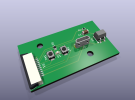
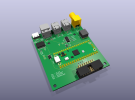
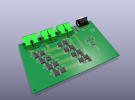
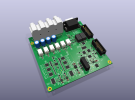
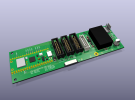
If everything goes well I should have a prototype ready for testing by the end of September. In the meantime here are some renders:

Screenshot 2026-09-04 at 09.00.10.png
Screenshot 2026-09-04 at 08.59.07.png
 
Last edited:
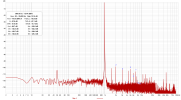
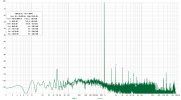
Interesting result while trying to find a reliable ARC->SPDIF converter. Both the modules I bought show the same non-transparent result, suggesting the TV is doing something nasty:

unit 2.pngunit 1.png
This is with MacBook -> TV HDMI input -> TV HDMI output (ARC enabled) -> ARC extractor -> TOSlink -> SMSL SU-1 -> E1DA Cosmos ADC -> MacBook.

Everything is running off battery power except the TV, so the 50Hz peak is immediately suspicious. In principle the HDMI out/ARC in loop at 24 bits should be way cleaner, and certainly shouldn't have 50Hz artefacts - that suggests a DA/AD conversion...
 
Everything is running off battery power except the TV, so the 50Hz peak is immediately suspicious. In principle the HDMI out/ARC in loop at 24 bits should be way cleaner, and certainly shouldn't have 50Hz artefacts - that suggests a DA/AD conversion
You may get the individual 50 Hz line even if everything is battery powered and floating, especially with RCA links. It may help to connect one component to PE to prevent all floating system.
 
so the 50Hz peak is immediately suspicious.
Looks like magnetic pickup of air-borne field to me. I'd grab for the tape head demagnetizer now to locate the exact ingress point.
 
Interesting result while trying to find a reliable ARC->SPDIF converter. Both the modules I bought show the same non-transparent result, suggesting the TV is doing something nasty:

View attachment 556384View attachment 556385
This is with MacBook -> TV HDMI input -> TV HDMI output (ARC enabled) -> ARC extractor -> TOSlink -> SMSL SU-1 -> E1DA Cosmos ADC -> MacBook.

Everything is running off battery power except the TV, so the 50Hz peak is immediately suspicious. In principle the HDMI out/ARC in loop at 24 bits should be way cleaner, and certainly shouldn't have 50Hz artefacts - that suggests a DA/AD conversion...
what frame rate was send to the TV?
 
You may get the individual 50 Hz line even if everything is battery powered and floating, especially with RCA links. It may help to connect one component to PE to prevent all floating system.
Fair, but the same setup running in a loop from the MacBook to an ADC to the DAC doesn't have the same pickup - I'll capture that soon and share. Even without the 50Hz, the distortion spectrum does not look like direct digital conversion
 
MacBook -> TV HDMI input -> TV HDMI output (ARC enabled) -> ARC extractor -> TOSlink -> SMSL SU-1 -> E1DA Cosmos ADC -> MacBook.
Point is, it is still a loop and might have enough loop area to pickup shield current in the cabling.
 
Point is, it is still a loop and might have enough loop area to pickup shield current in the cabling.
I think the only way I can nail this down is with a known-good digital TOSlink->USB interface
 
think the only way I can nail this down is with a known-good digital TOSlink->USB interface
If it is this kind of pickup you'd see changes when you move/bundle all the cables in the existing setup.
 
If it is this kind of pickup you'd see changes when you move/bundle all the cables in the existing setup.
I can handle all the cables, move things around, the FFT remains the same. That's why I'm suspicious. But a true digital conversion is the only way to know.
 
Open the devices and see if there's a codec in there?
An DA/AD conversion wouldn't make that much sense, and two different devices showing the same symptom make it even less likely.
Both devices have different HDMI interface ICs, and both are unfortunately obscured to avoid the HDMI forum tax. One is QFN-32 and the other is QFN-64. So of course there's some kind of codec in the extractors. The bigger question is how good are the ARC extractors in e.g a McIntosh or a WiiM. I don't think we've seem that tested yet.
 
could well be, of course. Is that line near 50kHz exactly at 48kHz? That would be a pointer.
Yes, exactly at 48KHz. The ADC is running at 192KHz.
 
I think the only way I can nail this down is with a known-good digital TOSlink->USB interface
In the end, yes (I use ADI-2 Pro for this). Together with evidence whether there is a DAC/ADC hidden conversion or not.
 
Most likely also a sample rate converter in the loop
 
Crunch time! The boards are ordered:
  • Power & control
    • 12V in, eFuse protection, isolated 24V, 5V out, plus the control MCU, wifi/BT, and all the connectors to the other boards
    • The brains of the device, using a medical grade DC/DC converter to create the primary isolated supply voltage. Local 5V supply for the MCUs also sits on here.
  • Single ended analog ABX - 2 in 2 out, plus connection to the speaker level board
    • A ridiculous number of relays, TMUX7612 muxes, GPIO expanders, more muxes, hardware fade circuits, you name it, it's got it. The difference between this and a normal preamp is actually quite incredible.
    • An even more ridiculous number of thin film precision resistors for the gain ladder to give 0.01dB level matching across all inputs and outputs
    • Generates +-13V audio level supplies from a +-15V DC/DC converter plus LDOs. Also generates local supplies for the ADC
    • OPA2211 at the heart of things
  • MOSFET based high level switching (+-90V, plus margin)
    • Uses 200V rated MOSFETs to offer ~500Wrms of silent speaker/amp level switching
    • Coordinated by the control MCU to manage ramp down/up between device switching
  • Digital ABX board
    • USB in (isolated), Toslink in, 2 x toslink & 1 x cook SPDIF out
    • Uses a second MCU to run DSPi

I won't go over all the features again here, just wanted to share the good news!

Many thanks to @amirm @KSTR @pma @Armand @PristineSound @MattHooper @Cascode and of course @hardisj for your support, engagement and encouragement.

front_panel.pngdigital_abx.pngspeaker_mosfet.pngline_analog.pngpower_control.png
 
Last edited:
Nice.
I see two diodes for each mosfet pair. Is it zenerers or TVR's? Have you done any calculations on the spike energy from the speakers?
 
Back
Top Bottom