• Welcome to ASR. There are many reviews of audio hardware and expert members to help answer your questions. Click here to have your audio equipment measured for free!

(re) Review of Sound Devices MixPre-3 II Multichannel Recorder Review - Advanced mode

Never thought about it since Totalmix is only available for iPads. Gonna try it out over the weekend. I think the Neutron Recorder App supports multiple tracks on an android phone. But who knows how stable that one works.
Totalmix will not work, but if the thing is pre-configured, you should be able to record.

Let me know.
I wanted to give it a try.
 
Any opinions on the discontinued Tascam HS-P82 field recorder? Has anyone here ever used one?
 
Any opinions on the discontinued Tascam HS-P82 field recorder? Has anyone here ever used one?
Used it occasionally, don’t like it because of relatively noisy mic pres and convoluted controls.
 
Totalmix will not work, but if the thing is pre-configured, you should be able to record.

Let me know.
I wanted to give it a try.
I can confirm, you can record multiple channels from the BF Pro in CC mode with an Android phone. I tested a few apps, some would crash others had trial versions that wouldn't let me record audio etc. However, with the trial version of USB Audio Recorder Pro I successfully recorded 4 channels at the same time https://www.extreamsd.com/index.php/uarp-trial I have no idea how stable this recording software is. You can either record one stereo pair, all channels or a number of stereo pairs, so either 1/2, 1/2/3/4, 1/2/3/4/5/6 etc., you can't choose 1/2 and 5/6 without 3/4.
 
I couldn't find a mixpre-6 version 1 for a reasonable price. However, I just bought a used Zoom F8 in great condition and with accessories for the equivalent of 280 Euros. Hopefully it will be delivered before the weekend. It also doesn't have the 32bit float shenanigans.

The manual says nothing about THD, it is supposed to have a dynamic range of 120dB (A-weighted). Looking forward to testing it. If it performs poorly, I should be able to sell it without a loss. Will let you know once I've run some tests.
 
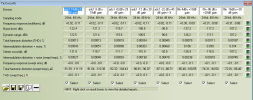
I have run some quick tests in RMAA, line out from the Adi-2 Pro FS into the Zoom F8: line in (+23.5 dBu) and mic in (+4 dBu).
1766098435221.png

Find attached the detailed reports. On a Russian website, they measured similar results: https://prosound.ixbt.com/interfaces/zoom-f8.shtml (and https://prosound.ixbt.com/interfaces/zoom/f8/2444.shtml) you can use your browser's translation tool ;-)
I don’t know why the frequency response rolls off at 20 Hz, reaching almost -1 dB on my unit but not on the one measured by that website. I made sure no HPF was enabled. Edit: Now I know why, the DAC filter "SD Sharp" in the Adi-2 Pro was responsible. No such roll off when using the "Sharp" or "SDLD" filter. Edit 2: Must have been a glitch in the RME device, now that I changed the filters a few times the "SD Sharp" filter also works as it should, no weird roll off anymore.
 

Attachments

Last edited:
It would be nice to have an all-in-one solution or at least not have to bring a macbook and babyface on top of the 442. That's why a mixpre-6 ii would be I nice solution, if the ADC performance wasn't so bad. Zoom is at least as bad and tascam is outright embarassing. Even the higher end Sound Devices recorders have questionable THD+N performance. Even the Zaxcom recorders don't reach 100dB THD+N.

Isn't there a battery powered 4+ channel recorder out there with comparable specs to the babyface pro? I mean the babyface can also be operated standalone with a powerbank, but it's not a recorder.
i saw your f8 measurements. i have a F8N pro (and an F3) that i can test with RMAA fed by a topping D90SE or RME UCX II. what are you basing the tascam take on? anything ive measured (from the handheld DR-2D to the DR100 mk iii) has been really good
\
 
i saw your f8 measurements. i have a F8N pro (and an F3) that i can test with RMAA fed by a topping D90SE or RME UCX II. what are you basing the tascam take on? anything ive measured (from the handheld DR-2D to the DR100 mk iii) has been really good
\
I did the usual 1kHz REW and RMAA measurements and also compared the noise floor of some real recordings taken with the x8, BF Pro and other devices, where I matched the input gain. I'll look it up tonight and upload the RMAA reports.

I speculate that the DR-100 MkIII performs better because they used better ADCs than the dual gain implementation used in the X8. When it changes from one to the other gain setting there is either an instant performance hit or gain, depending on the direction you turn up/down the gain. And the saturation/clipping point where the distortion starts going crazy is very early on, around -10dBFS for Mic in and line in even earlier.
 
Here is the best I achieved with the X8's "Mic in" with a +2.5dBu 1kHz input signal from the BF Pro:
1769720254131.png


Here is a stepped sine test with Mic in:
1769720491415.png

And here is the RMAA result (PDF), also Mic in, +2.5dBu signal:
 

Attachments

This is NOT GOOD.

OK, it's true that noise is more audible than distortion. But we're touching the level of distortion of your best microphones here.
So why to spend $x000(or more) per microphone to kill its performance by plugging it to a preamp with the same or worse distortion level ?

I'd be interested in a graph showing a preamp/ADC measurement - say a UFX III with a good microphone overlayed on the same charts (THD+N/EIN/etc) to sort of see the difference. (Or a UFX III/etc)

Like the standard charts/graphs you do for Mic preamps/ADC's ... but overlay a few standard mics such as a Earthworks Measurement Mic or DPA 4006/4007 (Higher noise of 14-26ish ... but better omni pattern and Frequency response/transient response) & a LDC with worse specs besides a low noise floor of 4dBa or so.

I suppose also a overlay of the noise floor of a standard recording studio too.

I think this would be an interesting topic/etc - as it might put into perspective what matters most and what may not really matter much at all.
 
i saw your f8 measurements. i have a F8N pro (and an F3) that i can test with RMAA fed by a topping D90SE or RME UCX II. what are you basing the tascam take on? anything ive measured (from the handheld DR-2D to the DR100 mk iii) has been really good
\
I would love to see the measurements for the F8N Pro.
 
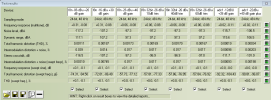
Zoom F3 tests. All tests with mic in (since line in just adds a 20 dB pad...), ranging from -25dBu input up to its maximum +4dBu. (I have -30,-35 and -40dBu as well but they dont fit on the RMAA comp)

methodology: RMAA generated 24/48 test file played back on computer>USB>topping D90SE>balanced connection>F3 at 32bit 48K

test files were recorded on unit itself, not looped back

since this is a 32 bit recorder, it doesnt really have any meaningful gain adjustment* so all recorded .wav files were volume adjusted to the same level (multitone peaks between -1 and 0dBFS) before analysis

html report attached. summary (sorry for some reason stereo crosstalk was unchecked when i generated the test wav):

summary.png


not sure what to make of the results because the dynamic range is pushing the limits of my topping device and im not sure how sound this methodology is. Unlike the unbalanced portable recorders where i could definitely outrun them with the D90SE, this one is pretty clean. noise and distortion in the range of -25 dBu to -10 dBU that you would expect to use with mic-in is pretty good. For as compact and convenient the unit is, the noise and distortion levels are certainly acceptable

According to Amir's tests I would expect the Topping to have decent performance, but with the F3 i am necessarily using it at lower volumes. mine is set to 4V output at 0dB volume which is about +14dBu. Sure enough -10dB on the topping gave the F3 its 4dBu max (~1.23V), bumping it to -9.5dB caused clipping. Amir's graph doesnt really go below 112dB sinad @ 750mV which is closest to my 0dBu measurement above

it appears with the F3 input noise is basically fixed and there is no real preamp. unlike mic preamps that have EINs approaching -130dB at a decent gain range of 30-60 dB, the F3 achieves its stated spec of -127dB at its max input and decreases from there... at least to the limits of my test rig. Outside of a dedicated AP analyzer i dont know how i generate signals with high dynamic range at lower volumes. Open to ideas, this harkens back to @Rja4000 and his mic preamp measurement threads
Since im setup ill measure the zoom F8N pro as well and maybe try to explore how clean the lover volumes on the D90SE are onsome of my cleaner ADCs like the Benchmark ADC1 or RME Fireface UCX-II (of which we have lower level measurements albeit different methodology)

*NB i did explore recording with the F3 at the different "magnification levels" it offers which affects the volume bit on the resulting 32bit file. I tried a -25dBu signal at X1 X4 and X1024, and while the recorded wavs were wildly different, when volume adjusted and analyzed by RMAA they yielded similar results
 

Attachments

Last edited:
I'd be interested in a graph showing a preamp/ADC measurement - say a UFX III with a good microphone overlayed on the same charts (THD+N/EIN/etc) to sort of see the difference. (Or a UFX III/etc)

Like the standard charts/graphs you do for Mic preamps/ADC's ... but overlay a few standard mics such as a Earthworks Measurement Mic or DPA 4006/4007 (Higher noise of 14-26ish ... but better omni pattern and Frequency response/transient response) & a LDC with worse specs besides a low noise floor of 4dBa or so.

I suppose also a overlay of the noise floor of a standard recording studio too.

I think this would be an interesting topic/etc - as it might put into perspective what matters most and what may not really matter much at all.
ive got some decent mic pres and an assortment of microphones. dpa 4006, 4011, schoeps mk41v, among others. havent really come up with a valid test method because in almost all cases the self-noise of the microphone just obscures everything else in the chain. best you'd get is a rough measure of the relative self-noise of each microphone which is already published data

unless im not understanding what you are saying
 
some F8N pro test. respectable, but has much higher IMD compared to a HQ dedicated ADC
 

Attachments

  • baseline.png
    baseline.png
    37.6 KB · Views: 98
  • secondtry.png
    secondtry.png
    35 KB · Views: 55
Welcome :)

If you read on this site, you'll see that SINAD is less of a goal in itself than an indicator of good engineering, predicting a lack of any issue and full transparency.
Which is what we try to evaluate here with those reviews.

Of course, in some area, there might be some compromises needed. But in 2023, we see no need for such bad ADC performance. Because doing it right costs basically nothing.

Of course, we see even less excuse for this on a device costing 1k USD.


If you read above, that's what I say.
I highlight the good noise performance as a key saling point.

But, again, that's not an excuse.
There are way cheaper interfaces out there that perform "perfectly" for noise AND for everything else, so why to accept less here?
Sure, everyone is making his/her choices, but, at least, one may now do an informed decision.


I think there are 2 main uses:
- Video sound recording. This will, of course, give better results than in board prosumer camera mic inputs.

- Field recording
I'm member of a group for classical music recording and I see quite a few users of those devices there. And some are using it with DPA 4006 and other Schoeps high end microphones.
Those people deserve better.

Of course, there may be more uses.

I measured headphones power, because, from my experience, being able to drive your headphones loud enough is important in the field.
Performance is good enough for low impedance headphones, but may be short if you intend to use high impedance ones.
Which may be important to know (and can't be guessed from the published specs).


My goal doing this review was to bring objective evaluation of this device's performance.

This is sometimes seen as a threat by some people, but there is actually no threat in bringing more information.


Audio quality is a quest that starts at the source, IMO. So, yes, the pro hardware vendors should also aim at increasing the quality of their devices.
Some do it right. They deserve recognition and praise.
Some could do better, and we should highlight the weak points to promote improvement.

Let me first thank you for this thorough test and starting this very interesting discussion. I am new to this forum, but I am very interested in some questions regarding the performance of these portable mixer-recorders.

You mention the DPA 4006 and similar high quality microphones. This is a good example. At the reference level of 94 dB SPL this microphone has a 79 dB signal-to-noise ratio (with the noise measured A-weighted, with flat rating just 67 dB). From a listener's perspective, 94 dB SPL is quite loud. A microphone can, of course, encounter way louder sounds in a classical orchestra, but those are loud levels where the ear doesn't hear as finely as otherwise. A very quiet audience probably also creates about 30 dB SPL background noise. What I am getting to is that the noise of the microphone probably would mask any distortion that is more than 80 dB lower than the signal. Why would such a microphone deserve a better signal path than the MixPre-3 II offers?

Or, what means "better"? In the 1970s it became clear that harmonic distortion, SINAD and even intermodulation distortion measurements don't fully correlate with the listeners' subjective judgement. How can the musicality, the natural quality of such a device be properly measured? Transient response, thermal stability, power supply reserve and other characteristics might also be in play.

I am mentioning all these because of my most on-topic question: how come the MixPre-3 II has such a gorgeous sound? I have heard a lot of beautiful sounding sound equipment, and Sound Devices preamplifiers and ADC architectures have alway struck me as just purely beautiful sounding. Especially the MixPre (and I assume the virtually identical preamps of the 8-series) is virtually noiseless, and every little detail sounds natural and clean. How come a sound recorder with - based on the review - rather poor characteristics can sound so beautiful? My question is honest, I am amazed at the expertise and measurement methods you and Amir have applied, and I would be grateful for any advice regarding how to measure if my impressions are objectively correct.
well RJA's criticism was more related to distortion levels, not really noise (sinad is the sum of both), and as we see the dynamic range is quite a bit larger than it needs to be but the distortion is the bugger.
.
in general, noise being below the level of mic self noise does not make it inaudible... as noise is additive. in regard to "why would a microphone need a better signal path than the mix pre provides" is because 94db/ 1Pa is an arbitrary measurement number. In reality microphones regularly find themselves in 120 dB environments in loud concerts and close mic'ing isntruments and vocals

"How can the musicality, the natural quality of such a device be properly measured?"

it cant, which is why this site is centered on objective, not subjective aspects, which are measurable

"Sound Devices preamplifiers and ADC architectures have alway struck me as just purely beautiful sounding. Especially the MixPre (and I assume the virtually identical preamps of the 8-series)"

these are actually quite different. even in the 7 series the 788 preamps are completely different than the 702. none of the 8 series use 32 bit float so the front end of the gain structure is almost certainly more old-school. I have a 702 here ill put on the bench. my guess is despite its age it measures better than the modern 32-bit zoom and mixpres. And thats not even a 'great' preamp by SD's own standards: https://www.sounddevices.com/788t-microphone-preamplifiers/

"how come the MixPre-3 II has such a gorgeous sound?"
Does there exist and good comps of mixpres vs other equipment with all other factors being equal? i find these very hard to come by. even attempting them myself in the field its almost impossible to duplicate exact mic angles and spacing, all other factors being equal. And in a live venue a few feet of separation between rigs can sound different as well

"How come a sound recorder with - based on the review - rather poor characteristics can sound so beautiful?"

because the dynamic range of a field recording is inherently limited. A good example would be the dozens of recordings produced at the recent Phish concerts at the sphere. No expense or amount of back-breaking lugging was spared to bring in the best recording equipment possible. Yet at the end of the day the sound in the venue, as state-of-the-art as it is, is not far from that 94 dB SPL you mention above (rare for rock concerts). And if you could isolate the crowd noise and use that as a noise floor youd find that we are working with maybe 50-60 dB max of dynamic range here. The same reason why tapers were able to make excellent recordings with the venerable sony D6 cassette deck for a decade, or alternatively why people swoon over their vinyl collection which struggles to hit 60 dB of noise floor.

i think RJA's point was not that its not a good-sounding useful recorder, more so that it isnt up to modern standards that you find in interfaces costing as little as $100-$200 these days, which is what we would expect from a good design

That said they know their market, and this fits a niche. Everyone i know who has a mixpre or zoom these days are pretty satisfied with the recordings they bring home while lugging a fraction of the gear they had to two decades ago. You used to need a dedicated pre pushing a high level balanced signal into a dedicated ADC then a reliable recorder to take the digital stream, and a big brick of lead to power it. Modern designs leverage the modern ADCs which have specs that didnt exist twenty years ago, and do not require as sophisticated of a supporting circuit architecture to get the most out of it. Thus instead of amplifying signals unnecessarily, we are taking the most direct path to a chip that doesnt want or need signals upwards of 10+V to perform their best.

but we shouldnt be comparing SD performance to stuff that was plenny good enough 20 years ago. We should be comparing it to the performance their competitors are achieving in the modern day. IMO it would be better if we were using studio-quality gear for field recording vs equipment that is "good enough for field recording". Same reason i archive all my recordings in 24 bit despite no human being able to hear the difference between that and a 16 bit recording
 
Last edited:
Back
Top Bottom