Just to think how good those Purifi midbasses and the AMT could become with current drive. Ok, near resonance, one would either have to revert to voltage drive or use some form of MFB. Actually, I have been thinking about converting a R Meta or Reference Meta to active XO and current drive. Think excellent radiation pattern AND low distortion.I use the Audient Oria Mini Room correction unit in my home setup - until further notice I keep my passive B&W 805 Matrixes. But I think - when someday I have to get new speakers - I will go for active ones - So I hope that Risbo and Radiant will get into the Active speaker market someday


-
Welcome to ASR. There are many reviews of audio hardware and expert members to help answer your questions. Click here to have your audio equipment measured for free!
You are using an out of date browser. It may not display this or other websites correctly.
You should upgrade or use an alternative browser.
You should upgrade or use an alternative browser.
Radiant Acoustics Clarity 66 Speaker Review
- Thread starter amirm
- Start date

Waxx
Major Contributor
On it's own it's a well executed slim tall speaker, but i don't like those and i think for that price, it should look a lot better. This looks like cheap plastic crap. I've seen one in real live and when you look closely it's actaully quiet decent build, but from a distance it does not look like that.
But i'm more after different type of speakers. i like wide baffle speakers a lot more than this in general, with bigger woofers. This type (even a revell) never sounded good to me. While a half decent wide baffle speaker often already does it...
But i'm more after different type of speakers. i like wide baffle speakers a lot more than this in general, with bigger woofers. This type (even a revell) never sounded good to me. While a half decent wide baffle speaker often already does it...
Yes it helps with bass extension. I was thinking about the lower midrange distortion. Was the 6.2 designed in a time before the alu cones?the alu version has higher moving mass which enables more bass extension. Also, the alu version has even lower distortion but a higher Q cone break up around 5kHz. However, we handle that in the filter including suppressing the distortion rise from the peak (see https://purifi-audio.com/blog/app-notes-2/low-distortion-filter-for-ptt6-5x04-naa-11).
And you keep avoiding to say if the AMT driver is different in the 6.2 vs the 66

I share that view, but slim floor-standing speakers are what the market wants. That said, the lion's share of the market goes to soundbars, of course, but it’s nice that there is still demand for proper hi-fi speakers.But i'm more after different type of speakers. i like wide baffle speakers a lot more than this in general, with bigger woofers. This type (even a revell) never sounded good to me. While a half decent wide baffle speaker often already does it...
To illustrate the point I made in post #138 regarding large DIY speakers: just how much demand is there for a pair of speakers featuring dual 18-inch woofers? Take, for example, this DIY build using two 18-inch EighteenSound 18LW2500 drivers per speaker—speakers that, by the way, weigh 200 kg each.
(yes, I know they are quite extreme as examples)
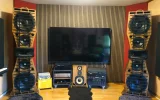
Here is the DIY thread about them:
HiFiForum.nu - Fjorgyn, Torshammare och en massa bröde!
 www.hififorum.nu
Last edited:

PristineSound
Major Contributor
You just described my perfect speakers, unfortunately, I don't think anyone will build it.Yes.
Ideally the external DSP electronics would conform to a standard. So the manufacturer of the speaker only needs to provide a file with the DSP settings.
That way speaker manufacturers don't have to be electronics experts.
More importantly for us consumers, when part of the electronics stops working and there are no longer any repair options, we can simply buy another DSP box, or another multi-channel DAC, or another multi-channel amplifier. We won't have to throw away absolutely everything (both speakers, both DSP and both amps), the majority of which is still in perfect working order.
I speak from painful experience. I recently had to bin everything when the surface mount electronics of just one of a pair of excellent active studio monitors stopped working just three years after I bought them. (The manufacturer gave me a generous deal on replacements, but it still hurts me to throw good equipment away.)
For no added cost, users could use standards-compliant free software to edit a copy of the manufacturers DSP settings file to adjust the frequency response to their taste, or to their room.
see_no_evil
Member
- Joined
- Feb 14, 2022
- Messages
- 46
- Likes
- 65
Pair of these driven by NAD Masters integrated is up there on my wishlist. But I'll wait for CLC65 measurements
yes, i also mentioned the lower distortionYes it helps with bass extension. I was thinking about the lower midrange distortion. Was the 6.2 designed in a time before the alu cones?
And you keep avoiding to say if the AMT driver is different in the 6.2 vs the 66
and yes this is especially in the midrange. I was not involved in the 6.2 except for the waveguide.
AMT is the same in all three models.

Does it really? Distortion is to die for, and quite some effort was made to control the radiation pattern. Horizontally, it is good, vertically not so much, but whether that is relevant depends on your room. I can think of speakers that fall far shorter for more money.For ten grand, this speaker falls quite short.
Let's not forget that controlled radiation is quite new on the list of desirable properties. I'm sure four and five way Backes & Müller or Silbersand did not do too well in that category but were highly regarded at the time. So who knows if it will stay relevant as the make or break criterium?
That's exactly right. There are still many advocates of a fully analog signal path in the world of high-end audio and Hi-Fi, and it doesn't look like that's going to change anytime soon.I listen to vinyl through a Waxwing DSP phono pre, and the phono signal goes 100% digitally to my active loudspeakers which perform D/A conversion after their internal DSP. I might not be representative for the "high end" crowd though...

- Joined
- Sep 10, 2025
- Messages
- 40
- Likes
- 28
So this amazing distortion is really down to this unfortunate looking but yet completely amazing woofer from Purifi? (Although like how an F1 car starts looking better as it racks up wins, this driver is growing on me.) In other words, 20kHz at 110dB is no big deal for HF drivers?
Vladimir Filevski
Addicted to Fun and Learning
- Joined
- Mar 22, 2020
- Messages
- 960
- Likes
- 1,494
Which other speaker is better, at the same price?For ten grand, this speaker falls quite short.

restorer-john
Grand Contributor
So who knows if it will stay relevant as the make or break criterium?
Circular bike race.
LOL.

Not only should this be required reading for anyone who is a diy type, it also is proof that there are situations where a purely active setup is inferior to a passive or hybrid approach. The rise in distortion from the bell resonance of a metal cone driver cannot be corrected in a typical active system where the amp is directly connected to the driver. Since the driver "sees" a low impedance" from the amp, there is no way to suppress the back EMF generated by the driver at resonance. Having a passive series LCR connected directly to the driver to suppress that EMF and damp the rise in distortion induced by that resonance is not achievable in an active system.the alu version has higher moving mass which enables more bass extension. Also, the alu version has even lower distortion but a higher Q cone break up around 5kHz. However, we handle that in the filter including suppressing the distortion rise from the peak (see https://purifi-audio.com/blog/app-notes-2/low-distortion-filter-for-ptt6-5x04-naa-11).
So a passive or hybrid crossover in this case has lower distortion than a purely active setup.
Really quite excellent analysis.

- Joined
- Jun 5, 2016
- Messages
- 3,504
- Likes
- 6,002
The horrible vertical dispersion would be a deal breaker for me. I wouldn't accept it for a 1k speaker, let alone a 10k speaker. I too think a 2.5 way configuration would have been much better. Yes, there are some disadvantages for the 2.5 way speakers too, but a 2 way with 2 woofers is really the worst of the worst. There's a reason the vast majority of 2 woofer speakers are 2.5 way, not 2 way.
The vertical dispersion is mostly a result of the tweeter geometry though.
- Joined
- Jun 5, 2016
- Messages
- 3,504
- Likes
- 6,002
These review threads are an interesting read as always. Apparently many find it expensive, I think it's pretty reasonable.
Also, I'm baffled that people don't think it measures well. No speaker is perfect of course, but surely this is a pretty well designed speaker?
View attachment 547623
FWIW, all of the “well measuring” speakers that have disappointed me in terms of tonality have been speakers that turned out to have “textbook” PIR attained by shaping the on/lw to compensate for dispersion problems. (NOT saying this is one of them. I haven’t heard them. I’m pretty sure saw them at Axpona but didn’t put them on my sit-down-and-listen list because time is limited and I generally don’t favor strip tweeters because the geometry ensures they will fall the sit-stand test. I’m just stating the trend.)
For that reason, i generally ignore PIR entirely.
Last edited:
- Joined
- Jun 5, 2016
- Messages
- 3,504
- Likes
- 6,002
Those CLC65s sounded fantastic at Axpona.Pair of these driven by NAD Masters integrated is up there on my wishlist. But I'll wait for CLC65 measurements
There is almost no mention of CLC65 anywhere, and very little information. I don't know; maybe they are selling so many that they don't want more customers.
But I have not been able to read a post anywhere from someone who owns them.
They need to send a pair to Erin and Amirm.
But I have not been able to read a post anywhere from someone who owns them.
They need to send a pair to Erin and Amirm.
Similar threads

- Replies
- 3
- Views
- 2K


- Replies
- 110
- Views
- 24K
- Replies
- 308
- Views
- 59K
- Replies
- 182
- Views
- 57K

