• Welcome to ASR. There are many reviews of audio hardware and expert members to help answer your questions. Click here to have your audio equipment measured for free!

Question regarding technical parameters of LPs.

I completely understand your viewpoint and wouldn't for a moment challenge your own criteria for what is worthless to you or not.

I happen to like subjective reviewing....well, some of it....along with the measurements. Fremer is so well known, and opinionated and can be obnoxious PLUS he's ascribed to any number of woo-woo ideas as a subjectivist. So the fact he comes up most often as a subject of derision isn't surprising.


However, even someone like that can be perceptive (when there is something to perceive) and I actually like Fremer's speaker reviews. He manages to put in to words quite well the sonic characteristics I've heard from the speakers he reviews. I've owned a few of the speakers he's reviewed and it's like he took the sound I was hearing and put it very well in to words.

Just to expand on that a bit: There is a tendency to think "well, if this guy is hearing differences between power cables then I can't trust anything he claims to hear." But that would actually be something of a fallacy: it would mean he is prone to sighted bias, just as anyone is including us. Which is why blind controls are particularly necessary for dubious audio claims. But the fact anyone is susceptible to sighted bias doesn't mean they don't hear real differences that exist. I'd reliably identify my mom's voice over the phone, where you would not. In the realm of speakers sonic differences are known to exist, so someone reporting a difference between speaker A and B is plausible in a way reporting a difference between cable A and B is not. And a perceptive person with good writing skills can put those differences in to words.

I certainly get why many here don't care for subjective descriptions and just want numbers, but I do enjoy trading experiences, talking with my audio friends about "what X system or speakers sounded like" and reading subjective reviews is an extension of that. Nowhere near scientific, but not *necessarily* of no practical use at all IMO.

(Defending Fremer, even a bit on a site like this leads me to say "just show me where the tar and feathers are...I'll do it myself ;-))
Sorry, but someone who tells me that the reduction in velocity of the groove as the stylus moves to the end of an LP side " is not an issue " is a bullshit artist, as far as I'm concerned.
 
Sorry, but someone who tells me that the reduction in velocity of the groove as the stylus moves to the end of an LP side is not an issue is a bullshit artist, as far as I'm concerned.

Yes, I can understand that :-)
 
Yes, I can understand that :)
Once I got into making needledrops for people with really old worn LPs my ear got attuned to that specific distortion. I cannot unhear that distortion no matter how good the LP and the playback gear.
 
Just to expand on that a bit: There is a tendency to think "well, if this guy is hearing differences between power cables then I can't trust anything he claims to hear." But that would actually be something of a fallacy: it would mean he is prone to sighted bias, just as anyone is including us. Which is why blind controls are particularly necessary for dubious audio claims.

Maybe a variation on that is that for someone in 'the industry' who either doesn't recognise common human limitations and the need for controls before some of the ridiculous claims, or chooses to ignore it all for personal gain, I can't get beyond that fundamental level of ignorance or arrogance.

I wish all of these reviewers would verifiably demonstrate their golden ear status by passing a few blind tests...along with hearing test results.
 
FWIW, here is a lab report on a turntable from a well establish manufacturer, giving an idea of what level of performance one can expect from a sanely priced turntable.

https://www.hifinews.com/content/pro-ject-classic-evo-turntable-lab-report

I'd like to see them test of the new $599 TEAC direct drive.

With an SAEC-designed knife edge arm, it looks pretty interesting for an MM-based set up.

https://www.teac-audio.eu/en/products/tn-4d-155523.html

It also to my theory that, if you're going to go MM, do it with an internal phono to keep the cable cap values low.

Here is the German review:

https://www.konsolenfan.de/hardwaretest-teac-tn-4d-vinyl-genuss-modern-verpackt/
 
Last edited:
Who needs autochangers....

S.
This 180 g Bolero disk is 16 minutes long.

Scott Hull at Masterdisk writes in his FAQ: "Under 18 minutes, I could cut almost anything. As loud as wanted up to the groove distorting. Full bass, metal, rock—it’s all good." Hull states that compression or level reduction will begin at lengths between 18 and 22 minutes a side, depending upon the original level of the program material.

As far as changers? I know you are making a funny point, and it is valid, however one thing to consider: heavyweight LPs do not always reliably work on automatic spindle changing mechanisms. Typically the stack will hang and/or refuse to drop, because of disc thickness.

This LP is sort of like teaching your dog to walk on its hind legs. A weird curiosity, it makes no practical sense at all, but might be sort of fun to show off at a party. After a few beers.
 
Ooh I want to play with that one. My preamp channels happen to be rather well calibrated.

Here's the square wave response for the XL-88D from the CBS CTC-310 record:


View attachment 41886
So, they ARE out there - somewhere ... CTC-310s, that is.

This is a very good result for this test record.
Then again, the cart used used to be the most expensive at the time of its introduction.
 
Win Labs did not make the Gale GT2101.

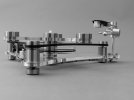
Ira Gale saw Kenneth Freivokh’s turntable at the Royal College of Art and purchased the design from him. Gale then handed the project over to DCA Associates to engineer and develop into the final production GT2101.

Freivokh’s original design was belt-driven, and he made several prototypes as part of his 1972 thesis. From that point through to the development of the final GT2101, there is currently no evidence that Dr Sao Win worked on the turntable itself.

Gale and Win did know each other from college/university, but the timeline is important. Win was working on cartridges and tonearms, and Win Labs was not formed until 1976.

The GT2101 eventually sold for around £1,200 (approximately $1,800 at the time) without a tonearm.

And this is where I think the Sao Win connection becomes particularly interesting.

Why would Gale develop such a sophisticated and expensive turntable without a tonearm?

Perhaps the answer is that the turntable and tonearm were separate projects, with Win’s expertise coming into the story at this stage. Rather than Win Labs making the GT2101, the evidence may point to Sao Win contributing specifically to the tonearm side of the system.


frievokh-2.jpg
 

Attachments

  • frievokh-1.jpg
    frievokh-1.jpg
    84.8 KB · Views: 13
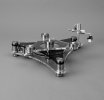
I can only remember seeing a few more ridiculous unconventional TT platter designs than this. Who thinks a good idea to totally expose the LP to airborne sound pressue waves from both sides like that? I do bet it can sound quite different from the norm. :(
Only a bit of common sense design would tell you to have the disc fully supported and at least partial isollated and dampned with a good mat along with the use of a spindle clamp or weight. I'm sure the designer has a load of BS pseudoscience marketing to promote this deranged idea. :mad:
This is what he says in his Uni thesis:
  • p. 21, on why he replaced the usual platter and mat with the triangular "tricept" and its three rubber-tipped supports: "The proposed system provides more positive support to warped records, reduces vortex action which attracts dust to the playing surface and eliminates the problem of dust, which invariable collects on rubber mats."
  • p. 11, where he cites J. Bickerstaffe, "Warp Wow", Hi-Fi News, October 1970: "supporting a record around its rim with the centre unsupported would tend to reduce wow, and would be well worth trying in toublesome cases of warping". ("toublesome" is a typo in the original.)
 
Also from his thesis:

p. 16 — the problem (chapter "4. Acoustic Feedback")

Often referred to as mechanical feedback, acoustic feedback occurs between the loudspeakers and the pickup/turntable assembly when loud bass passages are played and cabinet resonance is transmitted through floor vibration or directly if the loudspeakers and turntable are mounted together. It usually presents itself as a sustained "howl" from the loudspeakers, and becomes worse as resonances build up.

The trouble is due to inadequate isolation between the loudspeakers and the pickup. The sound waves produce vibrations at the turntable unit which are turned into electric signals by the pickup and hence returned to the speakers via the amplifiers.

Shock-proof mounting is essential to avoid feedback and to minimise the effects of jarring. This can be done by suspending the central bearing and pickup arm assembly by means of springs, the idea being to ensure a flexible link between the fixed base and the motor board. To prevent this system from becoming mechanically unstable at low frequencies it may be advisable to incorporate rubber or foam dampers in parallel with the springs. However, the dampers should not be too stiff to avoid over-riding the advantage of the springs.
p. 19 — overview of his design

To ensure adequate freedom from rumble, acoustic feedback and external shock the tone arm and turntable subassembly are solidly mounted together, sharing a common suspension system based on a combination of springs and damping pads. A resilient rubber belt between the motor shaft pulley and the drive pulley of clear acrylic acts as a rumble filter, avoiding vibrational transmission.
pp. 24–25 — "3. Suspension System"

In order to avoid transference of rumble arising from vibrations of the synchronous motor, and to achieve a high degree of isolation from external shock and overcome the problem of acoustic feedback, the entire turntable subassembly and tone arm share a common suspension system. A flexible link is therefore established between the adjustable baseplate which carries the motor and associated electrical components and the acrylic platform which supports the centre spindle and pickup arm. This sprung platform ensures a rigid link between arm and main bearing assembly and consequently maintains the critical distance from the arm pivot to the centre of the rotating record.

The sprung baseplate is suspended from three conical springs working in parallel with damping pads of soft polyurethane foam which prevent the system from becoming unstable at low frequencies.

[…]

This suspension system presents a considerable improvement over the conventional method of dealing separately with the problem of minimizing transference of motor vibrations to the pickup assembly and isolating the turntable from acoustic feedback and external shock. By suspending the complete turntable and arm assembly the proposed suspension system is dealing with a mass of considerable inertia. The alternative of springing the motor separately often proves difficult due to its low mass. This problem is commonly overcome by adding weight to the motor, using rubber bands instead of springs, etc., but this method still leaves unresolved the problem of isolating the turntable from acoustic feedback and jarring. This may require the additional incorporation of special shock-proof or acoustic-feedback legs on a separate plinth or, in the case of a cabinet mounted unit, on the cabinet itself.
p. 26 — belt drive (about motor rumble, not feedback)

The turntable is belt-driven to ensure minimum transmission of rumble from the motor to the revolving tricept and pickup.
p. 33 — why it stands on its own

The decision to make the unit free-standing was arrived at after consideration of the inherent problems and limitations of motor/turntable units supplied for cabinet mounting. Unfortunately these units are commonly placed in cabinets which house other components of hi-fi equipment, including records. This arrangement usually results in poor isolation from acoustic feedback and external shock, poor accessibility to the turntable, inconvenient height to control the operation of placing and cleaning the records, lowering and lifting the pickup arm etc.
 
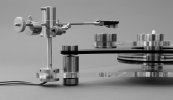
Sao Win claimed that the original Oracle was a knock-off of his design, made after the Oracle team visited him in California. Actually, he pretty much termed it industrial theft. I don't know whatever came of that, or if there was a suit/settlement. Win and Ira Gale worked out the basic suspension design when they were in engineering school (that's the story told), and shared the patents. You can see the similarity below.

Incidentally, the Gale was direct drive, the first iteration of the Win was belt, the second modified to direct using the SP-10 MkII motor. The tonearm Dr. Win used was the old Castagna (from the '60s), an interesting device which used opposed magnets and jewel bearings to reduce pivot friction.

View attachment 41279

View attachment 41281
Hey, old thread I know. Gale pretty much stole the design from a University student Kenneth Freivokh in 1972. Ken doesnt recall "receiving a penny" from Gale for using his design.
 

Attachments

  • frievokh-2.jpg
    frievokh-2.jpg
    122 KB · Views: 7
  • frievokh-4.jpg
    frievokh-4.jpg
    111.1 KB · Views: 5
It is puzzling why anyone would choose to support a record at only 3 points+ center
I cannot see that any of the quotes address @Sal1950 basic concern and criticism..

Claim in P21: does not make much sense either. Supporting a warped record in 4 points does not eliminate or compensate any warp, in fact it may even cause more tilt to the whole record,or leave one of the peripheral point without any contact with record.

This concept will maximize the possible record vibrations due to acoustic feedback. And maximize vibration from groove reaction as the stylus traces the groove.
This is absolutely the opposite of what the goal of the platter should be.


If you have a very noisy bearing or chassis vibrations that the enters the platter from the center you maybe want the record to have minimal platter-record contact. But then you would be compensating a poorly executed design by another design flaw.

This platter concept was left behind many years ago, like when JAm Michell Transcriptor was replaced my later models like Gyro, with record clamped to the Delrin platter


And what on earth is meant by Vortex action?
 
Last edited:
It’s just a thesis that a 22 year old did 50 years ago that was used in other turntable designs to this present day. He probably made the platter like that because it looked cool and filled the sciency part in afterwards……
 
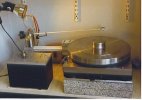
Nice thread revival, unrelated to the original topic but Nevermind. This turntable is very ugly, like the Transcription 300 from which it draws heavily. As a turntable, it at least meets some more or less objective criteria (although it brings absolutely no improvement whatsoever to vinyl playback, we can all agree on that).
 

Attachments

  • Be' Yamamura turntable 1984.jpg
    Be' Yamamura turntable 1984.jpg
    36.1 KB · Views: 19
Back
Top Bottom