
Agreed)). I haven't messed around with crossovers or listened to effects in a while; I should get around to it this fall; maybe I'll improve something.Crossovers with slow / steady (not abrupt) changes in phase shift between midrange and woofer is probably less of a problem (not that a phase shift between tweeter and midrange can be characterized as a huge issue either).

-
Welcome to ASR. There are many reviews of audio hardware and expert members to help answer your questions. Click here to have your audio equipment measured for free!
You are using an out of date browser. It may not display this or other websites correctly.
You should upgrade or use an alternative browser.
You should upgrade or use an alternative browser.
Properties of speakers that creates a large and precise soundstage
- Thread starter SigbergAudio
- Start date
-
- Tags
- imaging soundstage

My understanding and experience is that we're most sensitive to phase shift in the higher frequencies.
This has been my experience as well.
Psychoacostician David Griesinger advocates preserving the phase relationships of the upper harmonics and mentions the region above 1 kHz:
“The perception of proximity relies on the ear’s ability to detect the... phases of the upper harmonics.”
“Localization – and the perception of clarity – is a high-frequency phenomenon... The information content of speech and much music, and the sense of sonic distance, the perception of clarity, the ability to sharply localize instruments, and the ability to separate multiple sound streams, all depend critically on the harmonics above 1000 Hz.”
Last edited:

I would say audibility of properly constructed standard crossovers >1 kHz is nil, if anything phase linearity should be in low f crossovers.

Audibility of group delay at low frequencies
In the spectrogram tab You can change the appearance settings as well -- just change it to whatever method or resolution is needed to see things clearer. FDW doesn't affect the spectrogram at all, but it can clear up some of the reflection-induced rotations in seen in the phase traces. From...
I would say audibility is quite much lower threshold than the often cited 1-1.5 cycle at 100-200 Hz.
You're exactly right about the audibility of group delay from passive crossovers above 1 kHz. I highly doubt anyone in this thread claiming benefits of transient-perfect crossovers at high frequencies could pass a properly constructed ABX test that isolated phase as the only variable. I highly recommend that anyone who is convinced they can hear crossover-related phase distortion above 1 kHz to put that theory to the test with an ABX protocol.
Typically what happens is people hear a speaker that sounds good and has linear phase filters, and they attribute the good sound to the linear phase filters, when the speaker actually sounds good for other reasons.
Hi everyone, try this, virtual speakers in virtual room, everything adjustable realtime so one can quickly find out what makes into nice soundstage for you 
Group delay testable, among almost anything speakers and rooms even some auditory system effects.
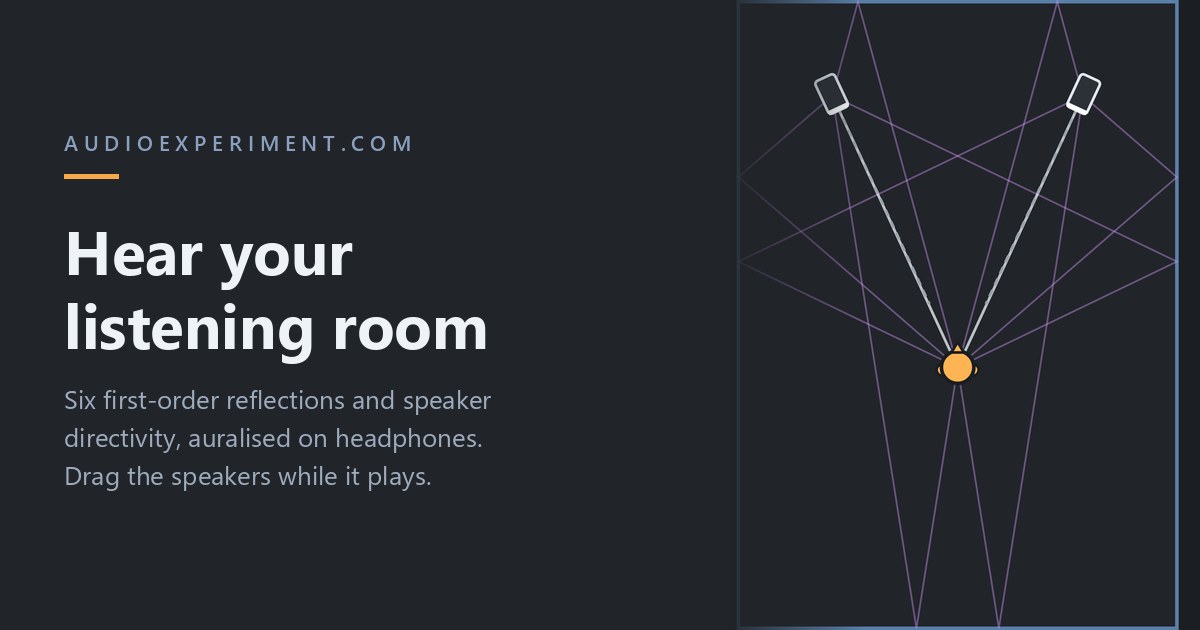
 audioexperiment.com
Diyaudio.com thread has more of an intro text, but it's a test suite to link written concepts, visual graphs (measurement / simulation data) and perception! For example the limit of localization distance, Griesinger stuff, kinda works! Testable in few seconds, few button clicks.
 www.diyaudio.com
Group delay testable, among almost anything speakers and rooms even some auditory system effects.
The ultimate loudspeaker-in-room listening test — reflections and directivity - Audio Experiment
Hear an idealised version of your listening room instead of calculating it. An image source model puts the six first order reflections on headphones, each with its own mute, and you can drag the speakers while it plays. Ideal directivity patterns or a measured VituixCAD polar, plus an analytic...
audioexperiment.com
Diyaudio.com thread has more of an intro text, but it's a test suite to link written concepts, visual graphs (measurement / simulation data) and perception! For example the limit of localization distance, Griesinger stuff, kinda works! Testable in few seconds, few button clicks.
New - Virtual loudspeakers in virtual room - ultimate listening test suite audioexperiment.com
HI, ultimate listening test suite online : https://audioexperiment.com/pages/virtual-listening-test-suite/ My long time dream listening tests now possible in virtual realm with headphones, made to enable connecting written concepts to audible perception. Import your own VituixCAD project to...
OP

- Thread Starter
- #1,205
Hi everyone, try this, virtual speakers in virtual room, everything adjustable realtime so one can quickly find out what makes into nice soundstage for you
Group delay testable, among almost anything speakers and rooms even some auditory system effects.
The ultimate loudspeaker-in-room listening test — reflections and directivity - Audio Experiment
Hear an idealised version of your listening room instead of calculating it. An image source model puts the six first order reflections on headphones, each with its own mute, and you can drag the speakers while it plays. Ideal directivity patterns or a measured VituixCAD polar, plus an analytic...
Diyaudio.com thread has more of an intro text, but it's a test suite to link written concepts, visual graphs (measurement / simulation data) and perception! For example the limit of localization distance, Griesinger stuff, kinda works! Testable in few seconds, few button clicks.
New - Virtual loudspeakers in virtual room - ultimate listening test suite audioexperiment.com
HI, ultimate listening test suite online : https://audioexperiment.com/pages/virtual-listening-test-suite/ My long time dream listening tests now possible in virtual realm with headphones, made to enable connecting written concepts to audible perception. Import your own VituixCAD project to...
Interesting concept, but it doesn't sound even remotely realistic to me, and also the bass seems to be distorting. This based on trying with an uploaded track.
Hi, yeah it's a generic HRTF, so not exactly real. In general headphhones never sound real, especially without head tracking. Beyond that, try adjust room settings to make it somewat real to you, or take it as purely synthetic thing, still lots of listening tests possible.
I'll check how much headroom there for audio tracks. You could disable room modes to reduce level, or move the listener out of a node Well it should not distort so I'll look into it.
I'll check how much headroom there for audio tracks. You could disable room modes to reduce level, or move the listener out of a node
Well it should not distort so I'll look into it.
Last edited:

kimmosto
Senior Member
- Joined
- Sep 12, 2019
- Messages
- 498
- Likes
- 1,103
GD (as phase only) due to 8th order acoustical XO at 1kHz is slightly above audibility threshold. 8th order acoustical at 1k can happen in some (rare) cases though electrical high-pass is proper passive 2nd or 3rd order.I would say audibility of properly constructed standard crossovers >1 kHz is nil
kimmosto
Senior Member
- Joined
- Sep 12, 2019
- Messages
- 498
- Likes
- 1,103
One problem imo is that a single variable requirement can prevent useful information and progress. Some implementations could produce benefits which are combinations of multiple features. Separating variables can be good basic science but may prevent progress towards a better outcome.I highly doubt anyone in this thread claiming benefits of transient-perfect crossovers at high frequencies could pass a properly constructed ABX test that isolated phase as the only variable.

But those cases are rare and what I would say not properly made crossovers.GD (as phase only) due to 8th order acoustical XO at 1kHz is slightly above audibility threshold. 8th order acoustical at 1k can happen in some (rare) cases though electrical high-pass is proper passive 2nd or 3rd order.
kimmosto
Senior Member
- Joined
- Sep 12, 2019
- Messages
- 498
- Likes
- 1,103
Maybe. I don't prefer 8th order acoustical if any other choice, though it could be "proper" also in IIR category.But those cases are rare and what I would say not properly made crossovers.
For example, phase-matched XO at 1200 Hz with 3rd order electrical high pass. GD hits audibility threshold at ca. 1000 Hz.
This was actual (active) speaker about a decade ago. Default preset had 2nd order electrical high-pass so GD was slightly shorter, below orange warning at 1 kHz. Later I have used linear-phase to keep GD below audibility threshold as low as possible.

witwald
Addicted to Fun and Learning
- Joined
- Jul 23, 2019
- Messages
- 630
- Likes
- 638
Is it possible to see the full transfer functions for one or two examples of those rare cases? It would be both interesting and instructive to see them.GD (as phase only) due to 8th order acoustical XO at 1kHz is slightly above audibility threshold. 8th order acoustical at 1k can happen in some (rare) cases though electrical high-pass is proper passive 2nd or 3rd order.
kimmosto
Senior Member
- Joined
- Sep 12, 2019
- Messages
- 498
- Likes
- 1,103
I did not save previous sample. This is not exactly the same, but quite close. Upper XO is a bit higher and no subsonic filter for woofer so GD stays lower - at audibility threshold above lower XO point. As already mentioned, actual speaker had 2nd order electrical high-pass between mid and tweeter. Drivers were BMS 12" woofer and coaxial. Nowadays I would do that with linear-phase and more than one sealed woofer.Is it possible to see the full transfer functions for one or two examples of those rare cases?
Should the ambechoic(-ish) ETC be considered incorrect or unsuitable or "not the one needed"?The spike at about 8 milliseconds on the horizontal axis is the "foreground stream of direct sound". The diffuse reflection energy beginning at about 18 milliseconds is the "background stream of reverberation". And the 10-milliseconds-ballpark gap between the two is "stream separation":

Mine are usually positioned in the corners 45º toed-in; I can’t space them more than 14 feet apart—unless I placed them against the 30-foot wall, but that would be difficult and inconvenient. Besides, I’ve long been accustomed to having the rear wall (the *actual* rear wall) quite a distance away from the listener.I’m curious if other people here have experimented with really wide spacing between their stereo speakers
I put mine in corners at first, but it was bad undefined hazy sound, didn't like it at all. Later I found out small enough is the ticket and "as wide as possible" is exactly opposite what makes good sound to me. Perhaps it's still what you fancy in your place with your system! ps. this is also fun easy test in the tool https://audioexperiment.com/pages/virtual-listening-test-suite/
Should the ambechoic(-ish) ETC be considered incorrect or unsuitable or "not the one needed"?
View attachment 561210
View attachment 561211
Disclaimer: Studio control room design is not my area of expertise.
My understanding is that an "ambechoic" control room is designed to have a nice long initial time delay gap (ITDG) like these other aproaches [<- EDIT: This is INCORRECT; see post #1220 below] but that it uses more diffusion. I would guess that an ambechoic room conveys "envelopment" very well. My understanding is that high frequency energy is progressively attenuated by diffusion so I have to wonder whether that has a perceptual downside.
Last edited:
I put mine in corners at first,
What kind of speakers do you have, and is it appropriate to place them in the corners?
My system is primarily designed for casual, ongoing (it was written differently; the translator altered the nuances of meaning))) listening—not just from a single armchair or sofa. That said, for fun, I sometimes move the speakers closer and sit in the sweet spot; a few years ago, I listened to the Chesky *Samba* track and—horror of horrors—the circle wasn't perfectly round, but slightly square. The green graph above was obtained using a stereo triangle smaller than usual 14 feet.
My question was about the absence of this gap in ETC. This is BlackBird Studio C:nice long initial time delay gap (ITDG)
I don't see the gap in that energy-time curve. Not sure why; I would have expected to see at least some time gap between the first-arrival sound and the first reflections due to the inevitable path length differences.My question was about the absence of this gap in ETC. This is BlackBird Studio C:
View attachment 561336
Has the first-arrival sound been deliberately omitted from that curve? Is there something relevant in the caption or accompanying text?
Well, that's how they are measured. https://www.soundonsound.com/techniques/sos-guide-control-room-design , Ambechoic at the end of the article. Also in the references there, B.Petrovic, Z.Davidovic, Acoustical Design of Control Room for Stereo and Multichannel Production and Reproduction — A Novel Approach, 129th AES Convention, San Francisco, 2010. And Boggi's posts on GS. And so on..
Attachments
Well, that's how they are measured. https://www.soundonsound.com/techniques/sos-guide-control-room-design , Ambechoic at the end of the article. Also in the references there, B.Petrovic, Z.Davidovic, Acoustical Design of Control Room for Stereo and Multichannel Production and Reproduction — A Novel Approach, 129th AES Convention, San Francisco, 2010. And Boggi's posts on GS. And so on..
You are absolutely right! My mistake!
In an ambechoic room, "there is no time delay before the reverberance begins" (Trevor Cox & Peter D'Antonio, "Acoustic Absorbers and Diffusers", page 59).
The photo on page 58 of Cox & D'Antonio's book shows the speakers partially embedded in diffusion, hence the zero initial time delay gap. On the other hand, the photo of that room in the Sound On Sound article DOES NOT show the speakers partially embedded in diffusion, so I THINK that an ETC of that configuration would have a discernible initial time delay gap.
Anyway in reply to your question, "Should the ambechoic(-ish) ETC be considered incorrect or unsuitable or "not the one needed"?", my response would be:
That's a significantly different approach which I don't know enough about to reliably evaluate in this context.
Or, in other words: I dunno.
Edited to add photo of Blackbird Studio C with speakers partially embedded in diffusion, resulting in zero initial time delay gap (ITDG):
Last edited:
Similar threads
- Replies
- 92
- Views
- 8K

- Replies
- 45
- Views
- 4K

- Replies
- 64
- Views
- 5K


- Replies
- 24
- Views
- 2K