I've been mildly obsessed with jitter for 20 years, and heard folks saying it's a solved problem all that time. Things like this don't help - supposedly
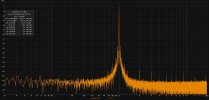
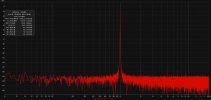
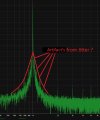
scientific research suggesting that 250ns of jitter is inaudible. Years ago, I used to compile the Jitter List , based on measurements published in HiFiNews & Record Review by Paul Miller :
Systems using an SPDIF connection from player to processor typically have a few 100ns jitter, and a few 1000ns with HDMI. The gap has narrowed, but HDMI is still the worst interface. SPDIF and AES/EBU are better, but I-link and async USB are clearly better, so I think the bar needs to be set quite high. I know some disagree, but I don't care.
I thought I could build my own no-compromise system using any good, modern DAC. But then Frunse's measurements showed that some DACs are capable of reducing jitter, while others are only capable of not making it any worse, and I don't know which.
I want to make a silk purse out of a pig's ear - I want great sound quality from any HDMI source. Maybe I need a digital to digital convertor (DDC) or re-clocker to do that, but I don't know much about them. Amir has tested the
Singxer SU-1 and
Matrix Audio X-spdif-2, but the results didn't conclusively show they improved audio performance. I looked at all the reviews and manufacturers websites and spec sheets that I could find, but there was very little information available anywhere that quantified jitter level and jitter attentuation, apart from what RME and Lynx Studio claimed. I found Audiophonics quoted SPDIF reclocking jitter = 20ps RMS for their
DIGIRESCUE DDC, and that was about it.
GoldenSound tested many DDC's, and he went a bit deeper. Instead of showing FFTs with jitter distortion amplitude vs frequency, he published jitter time vs frequency. I found ten of his tests and compiled the results with links. The better performing units had similar results, suggesting measuring equipment limitation (like DAC tests). The MUTEC MC3 was in the midfield, and I guess the MC4 is similar. The Chord M-Scaler was surprisingly the worst, echoing Amir's results, though the raison d'etre of that unit is the brick wall reconstruction filtering.
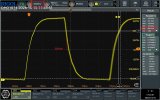
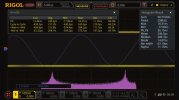
It's interesting to compare the charts side-by-side for the MUTEC and the best unit, the Holo Red:
Both plots are close to 1ps at 1kHz, which seems like very good performance. The MUTEC has more high frequency spuria, but they're largely over 20kHz, so probably not an audible issue. It does look like the MUTEC is the real deal, and the MC4 does have 8 channels rather than just 2. If a DDC can get jitter down to those sorts of levels - similar to what you might get from an HDMI extractor - I think good DACs are probably capable of giving good results.
That's a big data-dump, but I did find one other interesting piece. GoldenSound tested the
Benchmark DAC3B, which has effective ASRC jitter reduction. It didn't eliminate all jitter when he injected 25ns / 2kHz jitter on a 12kHz tone - the FFT side tones were down at -145dB. John Siau at Benchmark added some comments with some useful numbers:
Jitter immunity can be measured in terms of jitter attenuation. In the review, 25 ns of jitter was applied while playing a 10 kHz (sic) test tone. If there was no jitter attenuation, 25 ns would produce a pair of sidebands that would each measure about -58 dB relative to the test tone. In the test of the DAC3, the resulting sidebands measured about -145 dB relative to the test tone. This is equivalent to 1.4 ps jitter at the sampling clock. In other words, 25 ns is attenuated to just 1.4 ps. This is a ratio of 17,857:1 or 85 dB. Notice that we get about the same answer if we measure the relative difference of the sidebands. The difference between -145 dB and – 58 dB is 87 dB. So we can see that the jitter attenuation at 10 kHz is somewhere between 85 and 87 dB. This jitter attenuation is outstanding, but more importantly, it means that the jitter-induced sidebands are well below 0 dB SPL in any playback system (unless your playback system is producing an SPL exceeding 145 dB SPL).
There's not much good information like this around. It looks like Benchmark Ultralock is somewhat better than RME SteadyClock and Lynx Synchrolock, but not as good as SteadyClock FS or Synchrolock 2. However all three systems seem to really deliver.
If I want to find how other DACs perform, I might have to do what Frunse did and buy the test equipment, and test my system myself.