• Welcome to ASR. There are many reviews of audio hardware and expert members to help answer your questions. Click here to have your audio equipment measured for free!

Possible solution for DTS/Dolby/Atmos+eARC+HDCP to AES/EBU - via Dante? (for Okto DAC8PRO etc)

Other people have links in their signature, but I can't insert a link in mine, nor could I copy and paste the code from this post into my sig.

Amrim turned that off. Some people are grandfathered.
 
Anything you're looking for in particular?
Wanted to look into something that gives me the ability of a matrix mixer. So that I can do some manual routing or some upmix ability. AES in/out. I dont have space for an RME pcie card.
 
Wanted to look into something that gives me the ability of a matrix mixer. So that I can do some manual routing or some upmix ability. AES in/out. I dont have space for an RME pcie card.
I didn't collect that sort of information in the spreadsheet, but I did look at that functionality.
I'm not sure about the Audient Oria, but in general, all the professional interfaces provide matrix mixing.

The things to watch out for are whether they can operate stand-alone, or do they have to run with a PC or Mac full-time. Sometimes it's only one or the other.
There's usually software to install, but sometimes you have to pay a lot for it.
The AVID eco-system is widely adopted, but you have to decide whether to go all in, or all out, no half measures.
Many of the newer interfaces do digital room-correction, typically using SoundID or something similar.
My table concentrates on interfaces with multi-channel analogue outputs, so there are other digital only models.
AES3 I/O is a bit of a special case, and it's often the expensive modular interfaces with flexible I/O card configurations that support that.

Is it just matrix switching you need, or some DSP functions as well?
 
Wanted to look into something that gives me the ability of a matrix mixer. So that I can do some manual routing or some upmix ability. AES in/out. I dont have space for an RME pcie card.
The legacy Yamaha units that accept mini-YGDAI expansion card slots

MY8-AE
MY16-AE
MY16-AES

Can go for a song these days, picked up a frame-only DME64N (4x slots!) for a C-note.

Add MCHstreamer as USB interface but the ADAT cards cost more than the AES ones.

There's a Dante card also, not cheap
 
Is it just matrix switching you need, or some DSP functions as well?
For now just that, though dsp is a bonus. I am still tempted to just got for a trinnov ci, but then the cost of that is much higher than even interfaces like the grace design m908
 
Wanted to look into something that gives me the ability of a matrix mixer. So that I can do some manual routing or some upmix ability. AES in/out. I dont have space for an RME pcie card.
??? no space for an RME Card but for an grace design m908 or trinnov ci ???

Can you explain this a bit???

You can put an RME Card in to an 2HE HTPC Enclosure Horozontaly probably (Low Profile don't work here) is exactly that big like an Trinov ;)

16 Channels in and Out or 8 AES in and Out.

I used an biger enclosure because i wan't to have an Big TFT Screen in Front of that and the possibility to add an second RME Card in Future if i need it.

Like i postet here:

https://www.diyaudio.com/community/...ound-digital-aktive-setup.440807/post-8319556

Example 1,5HE PC:

https://www.yakkaroo.de/19-zoll-min...mu-s3i-q670-xl-pro-core-i3-i5-i7-dual-lan-itx

Thats around 2,1k€ with an RME Card ;)

Put CamillaDSP on and ready to go!

Also there are some Industriel Fanless PC with one or two Slots aviable:

Example:

https://shop.bressner.de/en/product...uters-with-gpu-slot/asus-iot-ruc-2000-series/

https://www.tpipc.com/product-category/product/embedded-industrial-pc/ipc-with-pci-pcie/
 
Last edited:
One interesting wiring challenge for these interfaces will be how to deal with AES IO if I want this device between the H16 that outputs via 2x db25 and the genelec 9301b that takes input via same 2x db25.

H16 outputs 16 channels (8x AES pairs) over 2 DB25. 4 on the 1st AES and 4 on the 2nd. Obviously it has no inputs, so the DB25 connector for the input channels is dead/unused/not connected.

Now if that needs to connect to an interface, and let's take rme hdpse as an example, it will need a special db25 cable. 1st db25 from h16 goes into the 1st AES input of the rme card. 2nd db25 goes into the 2nd rme AES slot. But now I have to take output from the same db25 out from the rme and send it to the genelec. So will need a special db25 cable whose connector at the interface takes in input from h16 but takes output from rme to genelec.

Alternative is obviously take multiple breakout db25 to xlr snakes or breakout box and connect that way, so more of a wire mess or yet another box on the shelf.
 
See AES-59 and AES-72 aka "Audio over CAT" & QTP, balanced and very long runs

Using soft "tactical" versions of CAT5e STP, 4ch per RJ45, 2x RJ45 per DB-25 can be very flexible.

If DIY is your thing, both can be customized using Euroblock style terminators.

Not just for analog and AES3, there are also specialist ADAT over CAT, USB over CAT devices.

Plus Ethernet ofc just don't mix them up
 
One interesting wiring challenge for these interfaces will be how to deal with AES IO if I want this device between the H16 that outputs via 2x db25 and the genelec 9301b that takes input via same 2x db25.

H16 outputs 16 channels (8x AES pairs) over 2 DB25. 4 on the 1st AES and 4 on the 2nd. Obviously it has no inputs, so the DB25 connector for the input channels is dead/unused/not connected.

Now if that needs to connect to an interface, and let's take rme hdpse as an example, it will need a special db25 cable. 1st db25 from h16 goes into the 1st AES input of the rme card. 2nd db25 goes into the 2nd rme AES slot. But now I have to take output from the same db25 out from the rme and send it to the genelec. So will need a special db25 cable whose connector at the interface takes in input from h16 but takes output from rme to genelec.

Alternative is obviously take multiple breakout db25 to xlr snakes or breakout box and connect that way, so more of a wire mess or yet another box on the shelf.
I think I'm going back to analog. Shits over my head.
 
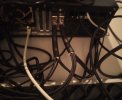
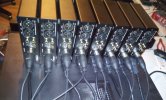
Easey like this ;) LOOOL

IMG_20260825_012757_9.jpg IMG_20260825_012727_0.jpg IMG_20260825_012740_4.jpg

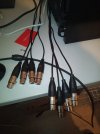
Inputs to RME Card:


IMG_20260825_012824_8.jpg

2x DB25 Tascam Style 4 AES in 4 AES Out each 1m long

I removed most of the Outer Protection shell so each AES Cable become more flexible.

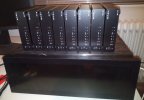
Need to build me an Frame for the 8 DAC's or an Housing ......

Used this Cable:

https://www.thomann.de/de/alva_aes25_4f4mpro1.htm

Breakoutbox with XLR connectors cost a bit more ;)

https://www.thomann.de/de/rme_dtox_32.htm

And you need 2 DB25 connector Cable from RME to Breakoutbox, and XLR Cable from Breakout to DAC, so don't forget to count this too ;)

Easey more than 500€ at all :(

The DAC'S will be placed under the PC in my Hifi Rack so this 1m Cable will work like it should. (150€ at all for this 2 Cable)
 
Last edited:
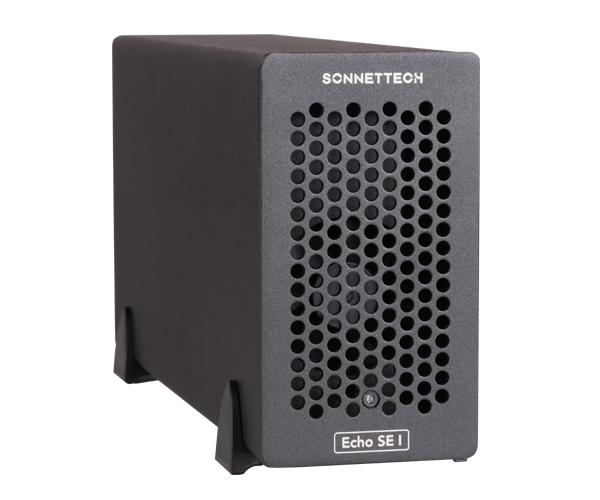
Something like these also may work
They even list rme. And can use with macs too.
Yes, iwas also looking in this Thunderbold Enclosures but they all works with Thunderbold , for MAC user great but with an RPI5 i am not sure how good it would work.
Instead using the PCIX1 extension PCB (Still not tested)

Also not very cheep.

But may be you could fit an RPI5 with that PCI X1 PCB and one RME Card together in such an smal Case without using Thunderbold at all ;)

I payed 129€ for my HTPC Case ;)

https://www.amazon.de/SilverStone-SST-GD04B-USB-hochleistungsfähigem-geräuscharmen/dp/B008B0DDVE?source=ps-sl-shoppingads-lpcontext&ref_=fplfs&smid=A3JWKAKR8XB7XF&language=de_DE&th=1

Also gave me the opurtunity to use max 2RME Card'S at once if i need it.
 
Last edited:
There are many plain USB to PCIe adapters and enclosures that allow RPi5 to use standard PCIe cards, and most are cheaper than that.

Thunderbolt is supposed to be backward compatible but TB just adds costs if you host is USB2 / USB3 only.

Also Sanctuary Systems "Sentinel Core" should ship soon, hosts CM5 instead of RPi.

Of course the PCIe card you want to use must work with Linux.
I don't think the RME Card would work with such an USB to PCIE Adapter on an RPI5 but not sure never used one.

RME Card is not officialy supported for Linux, the Driver are made from other People not from RME his self so i will test it with that PCI X1 Adapter i have.

The Sentinel Core is prety sweet if you start from scratch but i had already an RPI5 also the orientation with that PCIe X1 PCB is easier to include in to an smal enclosure.

The Sentinel Board needs an Raisercard than to get the Footprint smal with the RME Card.

I would go for RPI5 only because off geting an smal overall Footprint! Let say 1HE Enclosures or smaler.

For my own i have already an HTPC Enclosure for max. 2 RME Card's and use Ubuntu Studio ;)
 
There are many plain USB to PCIe adapters and enclosures that allow RPi5 to use standard PCIe cards, and most are cheaper than that.

Thunderbolt is supposed to be backward compatible but TB just adds costs if you host is USB2 / USB3 only.

Also Sanctuary Systems "Sentinel Core" should ship soon, hosts CM5 instead of RPi.

Of course the PCIe card you want to use must work with Linux.
You can only do PCI-e pass through with USB4, the rPI5 only has USB3 the only way to get PCI-E on an rPI5 is via the M2 Hat and an M2 format interface.
 
You can only do PCI-e pass through with USB4, the rPI5 only has USB3 the only way to get PCI-E on an rPI5 is via the M2 Hat and an M2 format interface.
USB conversion is just one path.

My preference would be using RPi5 native PCIe. Yes limited to x1 lane but I think that's plenty for audio cards.

Pi's internal 16-pin FFC is a full PCIe port, M.2 is just the physical interface, plain PCIe otherwise.

There may be multi-slot expansion HATs with a switch backplane enclosure that enable both concurrently, but they would share the x1 bandwidth
 
USB connector can provide PCIe only if there are PCI-e lines available and switchable by the controller chip. There is no USB->PCIe bridge in some adapter, the functionality works by switching the USB3+ connector pins between lines provided by USB host controller and by PCI-e-host controller. Both technologies use 2 symmetrical lines/2 twisted pairs so the shared connector and cable is handy (likely by coincidence, both technologies are ruled by different bodies). No such functionality is available on RPi5. It has a separate connector with 1-lane PCI-e, but the USB3 ports are USB-only.
 
Last edited:
That what i gueesed and bought that PCI X1 PCB for an RPI5 ;) RME HDSPe AES is an PCI X1 Card
RME HDSPe AOX-D is PCI X4, that why i use the AES Card instead of Dannte or AES67 ;)

Also makes all easier to setup, plug the DAC and forget, all other i setup in CamillaDSP.
 
Back
Top Bottom