Hey everyone!
I'm hoping someone with more experience repairing vintage turntables can help me figure out what's going on with my Panasonic RD-820. I've been troubleshooting this issue for a while, and despite cleaning connections, testing components, and resoldering wires, I still haven't been able to resolve it.
I'm trying to determine whether I need to replace the RCA cables, repair the tonearm wiring, replace the cartridge/stylus, or look somewhere else entirely.
The crackling is noticeable when playing records. The left channel still produces music, but the sound is accompanied by crackling that makes listening unpleasant.
The right channel sounds normal, with no noticeable crackling or distortion.
The turntable is connected to a receiver using its red and white RCA cables, with the receiver set to PHONO.
This was one of the first tests I performed.
When I swapped the left and right RCA connections at the receiver, the crackling followed the turntable's left RCA cable.
The right RCA output sounds clean when connected to either PHONO input.
This makes me believe the issue is coming from the turntable rather than the receiver's left channel or speaker.
I also tested the receiver using FM radio, which sounded normal.
2. Tested the cartridge using a multimeter
I previously measured resistance across the cartridge's left and right channels.
My readings were approximately:
Both channels appear to have reasonable resistance readings, although I'm not sure whether the difference between them is significant.
My understanding is that these readings suggest neither cartridge coil is completely open or shorted, but they don't necessarily rule out an intermittent cartridge problem.
3. Cleaned the cartridge pins and electrical connections
I used electrical contact cleaning spray on the cartridge pins and the small connectors that attach to them.
I also cleaned the RCA connections at the receiver.
Unfortunately, this made no noticeable difference. The left channel still crackles.
4. Resoldered wiring
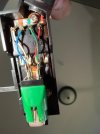
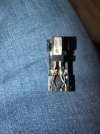
I've worked on the small wires near the cartridge/headshell and resoldered connections.
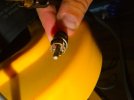
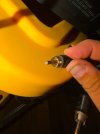
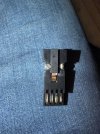
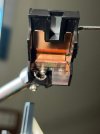
At one point, the small brass connector attached to the red cartridge wire had come loose. I soldered the wire back onto the connector and reattached it.
I've also worked on the tonearm wiring connections.
Despite these efforts, the crackling remains.
5. Performed a cable wiggle test
With a record playing, I gently moved and flexed the RCA cable to see whether the crackling changed.
I believe the crackling changes slightly when moving the cable. At times, it seems to become softer or slightly louder.
The change isn't dramatic enough for me to confidently identify a specific damaged section, but it makes me suspicious of an intermittent connection somewhere in the RCA cable or its solder joints.
I haven't conclusively isolated the fault to the cable itself.
My thinking is that replacing the old cables would eliminate the existing RCA leads and their solder connections as possible sources of the problem.
However, I don't want to spend time replacing them only to discover that the actual issue is inside the tonearm, cartridge, or headshell.
I'm also wondering whether the stylus could be responsible, although the fact that only one channel is affected makes me question that possibility.
My goal is to repair the turntable properly rather than simply replacing components at random.
I'd really appreciate any suggestions on how to narrow this down or what tests I should perform next.
I can provide photographs of the cartridge, headshell, RCA cables, and internal wiring if that would help.
Thanks in advance for any advice!
I'm hoping someone with more experience repairing vintage turntables can help me figure out what's going on with my Panasonic RD-820. I've been troubleshooting this issue for a while, and despite cleaning connections, testing components, and resoldering wires, I still haven't been able to resolve it.
I'm trying to determine whether I need to replace the RCA cables, repair the tonearm wiring, replace the cartridge/stylus, or look somewhere else entirely.
The problem
The left audio channel produces crackling and distortion, while the right channel sounds perfectly fine.The crackling is noticeable when playing records. The left channel still produces music, but the sound is accompanied by crackling that makes listening unpleasant.
The right channel sounds normal, with no noticeable crackling or distortion.
The turntable is connected to a receiver using its red and white RCA cables, with the receiver set to PHONO.
Turntable and equipment
- Turntable: Panasonic RD-820
- Cartridge/stylus: Replaced approximately 1–2 years ago.
- Connection: RCA cables connected to the receiver's PHONO input.
- Issue: Crackling exclusively in the left audio channel.
Troubleshooting I've already completed
1. Swapped the RCA connections at the receiverThis was one of the first tests I performed.
When I swapped the left and right RCA connections at the receiver, the crackling followed the turntable's left RCA cable.
The right RCA output sounds clean when connected to either PHONO input.
This makes me believe the issue is coming from the turntable rather than the receiver's left channel or speaker.
I also tested the receiver using FM radio, which sounded normal.
2. Tested the cartridge using a multimeter
I previously measured resistance across the cartridge's left and right channels.
My readings were approximately:
| Cartridge channel | Resistance |
|---|---|
| Left (white and blue wires) | 469 ohms |
| Right (red and green wires) | 446 ohms |
My understanding is that these readings suggest neither cartridge coil is completely open or shorted, but they don't necessarily rule out an intermittent cartridge problem.
3. Cleaned the cartridge pins and electrical connections
I used electrical contact cleaning spray on the cartridge pins and the small connectors that attach to them.
I also cleaned the RCA connections at the receiver.
Unfortunately, this made no noticeable difference. The left channel still crackles.
4. Resoldered wiring
I've worked on the small wires near the cartridge/headshell and resoldered connections.
At one point, the small brass connector attached to the red cartridge wire had come loose. I soldered the wire back onto the connector and reattached it.
I've also worked on the tonearm wiring connections.
Despite these efforts, the crackling remains.
5. Performed a cable wiggle test
With a record playing, I gently moved and flexed the RCA cable to see whether the crackling changed.
I believe the crackling changes slightly when moving the cable. At times, it seems to become softer or slightly louder.
The change isn't dramatic enough for me to confidently identify a specific damaged section, but it makes me suspicious of an intermittent connection somewhere in the RCA cable or its solder joints.
I haven't conclusively isolated the fault to the cable itself.
What I'm currently considering
At this point, I'm leaning toward replacing both RCA cables entirely, starting from their internal connection points inside the turntable.My thinking is that replacing the old cables would eliminate the existing RCA leads and their solder connections as possible sources of the problem.
However, I don't want to spend time replacing them only to discover that the actual issue is inside the tonearm, cartridge, or headshell.
I'm also wondering whether the stylus could be responsible, although the fact that only one channel is affected makes me question that possibility.
Questions for anyone familiar with vintage turntables
- Based on these symptoms and tests, what would you investigate next?
- Is there a reliable way to isolate the problem between the cartridge, headshell wiring, internal tonearm wiring, and RCA cable using a multimeter?
- Could a damaged stylus cause persistent crackling in only one channel while the other sounds completely normal?
- Would you recommend replacing the RCA cables at this point, or is there another diagnostic test I should perform first?
- If I replace the RCA cables, does the Panasonic RD-820 require a particular cable type, or can I use a good-quality, shielded, low-capacitance stereo RCA cable?
- Are there specific internal solder joints, terminal strips, or common failure points on this model that I should inspect?
- Could a cartridge develop an intermittent fault even if both channels show relatively normal resistance readings?
My goal is to repair the turntable properly rather than simply replacing components at random.
I'd really appreciate any suggestions on how to narrow this down or what tests I should perform next.
I can provide photographs of the cartridge, headshell, RCA cables, and internal wiring if that would help.
Thanks in advance for any advice!