• Welcome to ASR. There are many reviews of audio hardware and expert members to help answer your questions. Click here to have your audio equipment measured for free!

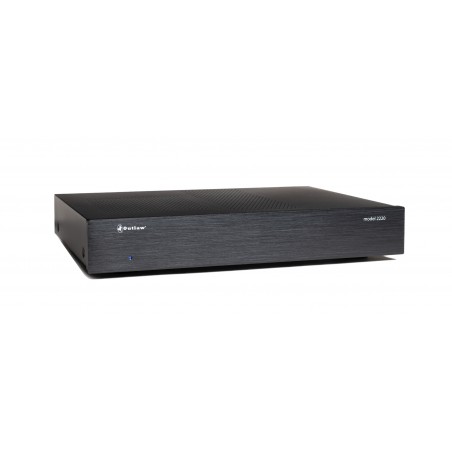
Outlaw 2220 Review (Monoblock Amplifier)

Rate this amplifier:

  • 1. Poor (headless panther)

    Votes: 6 1.9%
  • 2. Not terrible (postman panther)

    Votes: 15 4.7%
  • 3. Fine (happy panther)

    Votes: 168 53.0%
  • 4. Great (golfing panther)

    Votes: 128 40.4%

  • Total voters
    317
For sure two of these. Far more power and cleaner.
Question Amirm, you mentioned that 2 of these is by far better than 1 of the Schiit Vidar. Is this the same advice when comparing the Schiit Aegir? I realize the SINAD is in the 90s compared to the Outlaw 2220, but was curious on everything else when comparing the devices, thanks.
 
Question Amirm, you mentioned that 2 of these is by far better than 1 of the Schiit Vidar. Is this the same advice when comparing the Schiit Aegir? I realize the SINAD is in the 90s compared to the Outlaw 2220, but was curious on everything else when comparing the devices, thanks.

Uhhh Aegir is a 20 watt amp. These are 300+/4ohm and 200w+/8ohm
 
Uhhh Aegir is a 20 watt amp. These are 300+/4ohm and 200w+/8ohm
Sorry, thanks for the glaring issue in my miscalculation on simply zero placements, 20 not thinking 200, ok, well I do like the Outlaw, but now the 5000X looks good but at 50 pounds, damn....damn.
 
I have never been a fan of stacking components directly on to of each other for thermal reasons.

Are there any issues stacking these from a heat retention standpoint?
 
I have never been a fan of stacking components directly on to of each other for thermal reasons.

Are there any issues stacking these from a heat retention standpoint?
Outlaw says:

Ventilation Slots and openings in the cabinet are provided for ventilation and to ensure reliable operation of the unit and to protect it from overheating, and these openings must not be blocked or covered.

The openings should never be blocked by placing the unit on a bed, sofa, rug, or other similar surface. The unit should not be placed in a built-in installation such as a bookcase or rack unless proper ventilation is provided. There should be space of at least 12.7 mm (0.5 in.) and an opening behind the unit. The feet are engineered to be the minimum
height required for proper ventilation, and must not be removed.

I have two 2220 amps on shelves with an inch above them and they run cool.
 
Outlaw says:

Ventilation Slots and openings in the cabinet are provided for ventilation and to ensure reliable operation of the unit and to protect it from overheating, and these openings must not be blocked or covered.

The openings should never be blocked by placing the unit on a bed, sofa, rug, or other similar surface. The unit should not be placed in a built-in installation such as a bookcase or rack unless proper ventilation is provided. There should be space of at least 12.7 mm (0.5 in.) and an opening behind the unit. The feet are engineered to be the minimum
height required for proper ventilation, and must not be removed.

I have two 2220 amps on shelves with an inch above them and they run cool.
My lesson learned. I have an open rack and thought it would be fine to set my Oppo BDP103 on top of my Harman Receiver. It sat there ten years with just the feet of the Oppo supplying the air gap.
Finally, I had a failure!
Guess which device?…. The Oppo. It seems to not have been designed to handle the heat of the HK AVR520, which does vent it’s heat out the top.
FYI Most the time, I only use two of the AVR power amps. Occasionally I’ll use the center channel amp to drive my deck and patio speakers. ( Mono) and the Mai channel amps power the side channels in my 4.2 setup.
Now nothing sets on the HK and is does put out a bit of heat.
 
one of my jobs over the years was managing server data centers and equipment placement, cooling and airflow were among my top priorities having seen what poor management can do to equipment. Placement for two of these could be problematic as I only have 7 1/2 inches to play with.

For about the same price I could get their 5 channel amp and just run two channels. :)
 
one of my jobs over the years was managing server data centers and equipment placement, cooling and airflow were among my top priorities having seen what poor management can do to equipment. Placement for two of these could be problematic as I only have 7 1/2 inches to play with.

For about the same price I could get their 5 channel amp and just run two channels. :)
I BBB actually think there would be no issues with a stack of three in a rack. These were designed for this and average wattage I’d like 1-2 watts if playing loud music.
 
I have a few questions about the 2220:

1) I just bought a pair of Maggie 1.7i's which are nominal 4 ohms but have been measured down to 2.8 ohms at certain frequencies. The 2220 is rated to 4 ohms but not sure if going below this will strain the amp, cause it to clip, or trigger thermal protection are decently high levels?

2) I'm considering pairing it with a Quicksilver Line stage pre-amp. The RCA input on the 2220 has an input impedance of "Less than 10k" while quicksilver has an output impeadance of "100 ohms, 20 Hz-20 KHz" and maximum output of "60 volts RMS, 20 Hz-20 KHz". The 2220 has input sensitivity of "1.6V 8ohm load/ 1.4V 4 ohm load".


So reading these stated specs anything to be concerned about with pre / mono matching in this case?

 
I have a few questions about the 2220:

1) I just bought a pair of Maggie 1.7i's which are nominal 4 ohms but have been measured down to 2.8 ohms at certain frequencies. The 2220 is rated to 4 ohms but not sure if going below this will strain the amp, cause it to clip, or trigger thermal protection are decently high levels?

2) I'm considering pairing it with a Quicksilver Line stage pre-amp. The RCA input on the 2220 has an input impedance of "Less than 10k" while quicksilver has an output impeadance of "100 ohms, 20 Hz-20 KHz" and maximum output of "60 volts RMS, 20 Hz-20 KHz". The 2220 has input sensitivity of "1.6V 8ohm load/ 1.4V 4 ohm load".


So reading these stated specs anything to be concerned about with pre / mono matching in this case?

It is not possible to give you a reasonably accurate answers without more information such as your listening habit, distance, and the 1.7i's impedance and phase angle curves.
A generic answer could be something like, if you don't listen too loud, the speaker's impedance dip to 2.8 V only briefly at a few points, phase angles not more than 45 degrees especially don't coincide with the impedance dips, at below 1 kHz, then there is no concern, but that's a lot of "if(s)".

I know you didn't ask, but I can't help being curious about the specs of the Quicksilveraudio preamp's 60 V output, are you sure about that, their website mentioned it but it might have been for one of their power amps? I thought the way they present the information on their website is confusing at best. I am alos confused but their seemingly high output impedance, yet no balanced output? You mentioned 100 ohms but the manual says 750 ohms, which one is the right one? To me, it is the kind of preamp that I would avoid, but you must have your own reasons.
 
It is not possible to give you a reasonably accurate answers without more information such as your listening habit, distance, and the 1.7i's impedance and phase angle curves.
A generic answer could be something like, if you don't listen too loud, the speaker's impedance dip to 2.8 V only briefly at a few points, phase angles not more than 45 degrees especially don't coincide with the impedance dips, at below 1 kHz, then there is no concern, but that's a lot of "if(s)".

I know you didn't ask, but I can't help being curious about the specs of the Quicksilveraudio preamp's 60 V output, are you sure about that, their website mentioned it but it might have been for one of their power amps? I thought the way they present the information on their website is confusing at best. I am alos confused but their seemingly high output impedance, yet no balanced output? You mentioned 100 ohms but the manual says 750 ohms, which one is the right one? To me, it is the kind of preamp that I would avoid, but you must have your own reasons.


The specs are listed on the above link.

In regards to the bolded part I've searched but I have not clue on how to answer the above. I could not find a measured curve across all frequencies nor phase angles. Perhaps I need to just blind buy the 2220s and test and plan to pay shipping to return them.
 
Last edited:
I have a few questions about the 2220:

1) I just bought a pair of Maggie 1.7i's which are nominal 4 ohms but have been measured down to 2.8 ohms at certain frequencies. The 2220 is rated to 4 ohms but not sure if going below this will strain the amp, cause it to clip, or trigger thermal protection are decently high levels?
I really doubt the 2220 will have any problem driving 1.7i's. They are about 4 ohms nominal and dip a little lower, but their impedance is mostly resistive, so a low but relatively "benign" load for an amplifier. Amplifier specifications assume nominal loads and have margin to tolerate dips (and peaks) in impedance. The 1.7i's are not very sensitive so having the extra power of the 2220 strikes me as reasonable. I wouldn't worry, though do make sure there is adequate airflow around the amp. How much power you actually use depends upon how far away you are and how loudly you listen. You could get an idea from an online calculator such as: http://myhometheater.homestead.com/splcalculator.html

2) I'm considering pairing it with a Quicksilver Line stage pre-amp. The RCA input on the 2220 has an input impedance of "Less than 10k" while quicksilver has an output impeadance of "100 ohms, 20 Hz-20 KHz" and maximum output of "60 volts RMS, 20 Hz-20 KHz". The 2220 has input sensitivity of "1.6V 8ohm load/ 1.4V 4 ohm load".


So reading these stated specs anything to be concerned about with pre / mono matching in this case?
The preamp will probably drive the amp just fine though 10 k-ohms is a little low for many tube preamplifiers. I would drop an email to Quicksilver and ask them. It's a tube preamp so very high output voltage is not unusual, though that is usually unloaded or into a high-impedance (e.g. 1 M-ohm) load. Another thing to ask is about turn-on and turn-off transients; some tube preamps have large voltage spikes when you turn them on or off. I did not read the manual to see if it has protection or muting. When I used tube gear I would turn on the preamp and wait a few minutes before turning on the power amp, and turn off the power amp and let it bleed down (sound go away) before turning off the preamp. That old gear had no output muting/DC protection circuit that most modern gear has, however, so I suspect (hope) it is not a problem for the Quicksilver line stage.

FWIWFM - Don
 
Last edited:
I bought my three last year for much more. Heading for my pillow to cry into... But, I would not have missed having them for the world.
 
I bought my three last year for much more. Heading for my pillow to cry into... But, I would not have missed having them for the world.

"would not have missed having them for the world".... I'm not 100% clear if this means you love the amps or if you would be OK without them.

I'm not giving you a hard time; I'm on the fence about buying these myself.

Cheers!
 
"would not have missed having them for the world".... I'm not 100% clear if this means you love the amps or if you would be OK without them.

I'm not giving you a hard time; I'm on the fence about buying these myself.

Cheers!
Sorry to be unclear. I loved them.
 
I'm trying to debate with myself if these would be an upgrade over SMSL A300 monoblocked.
 
Curious how a pair of these would compare to the power section of the Outlaw RR2160 receiver (I don't think that particular model has been tested here).

I have the RR2160 currently, but am planning to change to a multi-channel AVR plus an external amp for front L&R. The RR2160 is great, but it's too big for me to keep in my cabinet just for that role. So I'm wondering if a pair of 2220 would have about the same performance. I know I'd be changing preamp sections too, but would probably utilize direct mode on the AVR for most 2-channel listening (though that silences the subs, which is a conundrum). Anyway, I digress. Just wondering if these would probably outperform the power section of the RR2160.
 
Curious how a pair of these would compare to the power section of the Outlaw RR2160 receiver (I don't think that particular model has been tested here).

I have the RR2160 currently, but am planning to change to a multi-channel AVR plus an external amp for front L&R. The RR2160 is great, but it's too big for me to keep in my cabinet just for that role. So I'm wondering if a pair of 2220 would have about the same performance. I know I'd be changing preamp sections too, but would probably utilize direct mode on the AVR for most 2-channel listening (though that silences the subs, which is a conundrum). Anyway, I digress. Just wondering if these would probably outperform the power section of the RR2160.

The m2220 is about 2x more powerful.
 
Back
Top Bottom