• Welcome to ASR. There are many reviews of audio hardware and expert members to help answer your questions. Click here to have your audio equipment measured for free!

Omnidirectional speakers

Another thing I noticed [with omnis] was the low level detail was quite good, something that was not expected.

This makes sense to me.

In many cases there is a tradeoff relationship between clarity and a sense of envelopment, but Floyd Toole mentions studies showing that reflections can actually improve speech intelligibility. He theorizes that the ear/brain system can better decipher complex sounds when it gets multiple "looks", which implies that those reflections should be spectrally correct. And getting the reflections spectrally correct is something good omnis excel at.
 
This has generally been my experience too, with the notable (and memorable) exceptions being when the room was large enough to push the first horizontal-plane reflections fairly far back in time. In such cases the long reflection path lengths (relative to the direct path length) also raised the direct-to-reverberant sound ratio at the listening position, which imo is often too low with omnis in small-to-medium size rooms.
My experience resonates with yours.

In my perspective, there are numerous pitfalls associated with using omnidirectional speakers that contribute to polarized opinions about them.

Firstly, it's crucial to note that not all speakers claiming to be omnidirectional truly fit the classification. Take the Linkwitz Pluto, for instance; its omnidirectional dispersion is limited to 2-2.5 kHz. I suspect some Bose speakers that market themselves as omni speakers might share similar dispersion characteristics. Thus, forming opinions about omnidirectional speakers based on experiences with such models can be misleading.

Secondly, omnidirectional speakers thrive in larger rooms. The most remarkable encounter I had with MBL speakers was at my friend's house, boasting a spacious 50-square-meter (6m x 8m) room. The MBL speakers, positioned 2 meters from each wall, produced an exceptional and lifelike sound for orchestral and vocal choral performances. The imaging was superb, devoid of the usual haze encountered in smaller rooms or when the MBL is conventionally placed (around 1m from the wall). Unfortunately, such setups are never showcased in MBL showrooms during events I attended throughout years.

In short, to truly unlock the full potential of omnidirectional speakers, , you'll require both a high-quality implementation, MBL or at least German Physik ( i don't have any experience with duevel) and a spacious room. Unfortunately, these options come with a hefty price tag, particularly for those of us residing in Europe. This is why I've opted for a reasonable compromise—dipole speakers with small baffle
 
Last edited:
Omni's are intrinsically wrong, some half baked idea to replicate a live orchestra, good for parties though.
Keith
On a previous post you said Omni's are not hi fi. I say speakers that are not omni's are not hi fi.
 
I am afraid I am firmly with B&O when it comes to omnis, only good for parties.
IMG_3394.png


Keith
 
@jim1274 now that you have had a taste of omnis, it's time for you to start saving for a pair of MBL's or hope that a pair appears second-hand at an affordable price ;) You should do your best to go listen to them, they are truly remarkable speakers.

Trust me, I’ve already thought of that and am scoping out MBL and Morrison onmis, plus keeping an eye out for used ones. I’m not done on this Omni journey by any means.
 
I am afraid I am firmly with B&O when it comes to omnis, only good for parties.View attachment 339363


Keith

No arguments on imaging—not as pinpoint as a conventional speaker. I find that the sense of envelopement and spaciousness more than offset it, for me at least.

B&O said “may” impact timbre based on sidewall reflections. I find timbre good here, but speakers are 4’ from side and rear walls and my room has much less reflective properties than most as noted earlier.

I noticed no loss of punch on the bass, but will listen more carefully and make notes when switching back to forward firing speakers to compare these various characteristics.

Lastly, I completely agree they are great used as a “party” speaker—that’s what actually led me to them. After using my small portable Omni around the house when moving around a lot within a workspace, it dawned on me that these needed to be tried outside for “party” speakers around the pool and deck. Other than obvious sound level drop off with distance, they sounded good everywhere in the area. I never envisioned Omni to be my living room primary speaker for 2 channel stereo, but now contemplating my next “better” Omni.
 
... omnidirectional speakers thrive in larger rooms...

In short, to truly unlock the full potential of omnidirectional speakers, you'll require both a high-quality implementation, MBL or at least German Physik ( i don't have any experience with duevel) and a spacious room. Unfortunately, these options come with a hefty price tag, particularly for those of us residing in Europe. This is why I've opted for a reasonable compromise—dipole speakers with small baffle

I agree that dipoles have some real-world living-with advantages: First the proximity of the sidewalls isn't an issue so they will work very well in much smaller rooms than are desirable for omnis; and second, the direct-to-reflected sound ratio is typically higher for a dipole. Not that we want the direct-to-reflected sound ratio to be too high, but we start trading off clarity and imaging if it's too low. The arrival times matter too, which is why dipoles like to be pulled out from the wall fairly far, to push the arrival of the backwave energy back in time.

Coming from a dipole-intensive background (I've been a SoundLab dealer for almost 25 years), my first attempt at a "reasonable compromise" was a controlled-pattern bipolar loudspeaker, sort of like a Mirage M1 but with horns. Currently I'm doing controlled-pattern monopole speakers with a fairly wideband rear-firing horn, the latter being aimed up-and-back to delay the arrival of the "backwave energy" at the listening position, which in turn allows placement much closer to the "front" wall than would normally be recommended for a bipole or dipole or omni speaker.
 
Last edited:
No arguments on imaging—not as pinpoint as a conventional speaker. I find that the sense of envelopement and spaciousness more than offset it, for me at least.

B&O said “may” impact timbre based on sidewall reflections. I find timbre good here, but speakers are 4’ from side and rear walls and my room has much less reflective properties than most as noted earlier.

I noticed no loss of punch on the bass, but will listen more carefully and make notes when switching back to forward firing speakers to compare these various characteristics.

Lastly, I completely agree they are great used as a “party” speaker—that’s what actually led me to them. After using my small portable Omni around the house when moving around a lot within a workspace, it dawned on me that these needed to be tried outside for “party” speakers around the pool and deck. Other than obvious sound level drop off with distance, they sounded good everywhere in the area. I never envisioned Omni to be my living room primary speaker for 2 channel stereo, but now contemplating my next “better” Omni.
You might want to join the Linkwitz OPLUG forum where you can post on the LXMini seeking audition thread if you are interested in having a listen to a pair. The LXMini is not a full range omni in that it transitions to a more cardiod pattern during the x-over (about 700Hz) to the upper driver and then transitions again to a dipole. I find that subjectively the LXmini has many of the desirable qualities of an omni regarding envelopment but individual vocals, instruments etc present a much more solid image. Additional bass (and SPLs) can be provided using a dipole bass unit or a closed box works well also. I find it a highly enjoyable speaker.
 
You might want to join the Linkwitz OPLUG forum where you can post on the LXMini seeking audition thread if you are interested in having a listen to a pair. The LXMini is not a full range omni in that it transitions to a more cardiod pattern during the x-over (about 700Hz) to the upper driver and then transitions again to a dipole. I find that subjectively the LXmini has many of the desirable qualities of an omni regarding envelopment but individual vocals, instruments etc present a much more solid image. Additional bass (and SPLs) can be provided using a dipole bass unit or a closed box works well also. I find it a highly enjoyable speaker.

Uh-oh…I’m easily enticed into a new “rabbit hole”…

I am familiar with Linkwitz, at least the Orion. I considered building a pair several times some years ago. I don’t think there were any Linkwitz designs commercially available at that time.

Thanks much…I think…headed to the forum right now.
 
LXMini is not related to omnidirectional speaker by any means. Its omnidirectional characteristic go up to around 600 Hz, same as any conventional box speaker from KEF R3 to BMR monitor. The special properties of LXmini is that there is a cardioid region around 700 Hz then change to dipole at higher frequency, and it has nothing to do with omnidirectional. So please, if anyone wants to experience omnidirectional, try a real one.
 
On a previous post you said Omni's are not hi fi. I say speakers that are not omni's are not hi fi.
Not sure if I’m ready to say that yet, but am pretty smitten with the Omni “sound”, enough to already be looking at another Omni here after buying 2 pairs of Duevels in pretty rapid succession. I’m working on getting a pair of Soundlabs here, and unless the ESL sound
pushes the Omnis to the side, I’m trying more Omnis.
 
The arrival times matter too, which is why dipoles like to be pulled out from the wall fairly far, to push the arrival of the backwave energy back in time.

Yes, I put my dipole speaker 1.3m from wall, so the delay between direct and indirect sound is at least 7.5 ms.
Another advantage of dipole speaker is that if you opts for nude driver construction (no baffle) like me, the dispersion to floor and ceiling will be low too. The only downside is cost as nude driver need more power for certain sound pressure and the requirement of better driver to have higher xmax and keep the distortion low. It is a deal breaker for manufacturer, but as diyer, it is ok

Coming from a dipole-intensive background (I've been a SoundLab dealer for almost 25 years), my first attempt at a "reasonable compromise" was a controlled-pattern bipolar loudspeaker, sort of like a Mirage M1 but with horns. Currently I'm doing controlled-pattern monopole speakers with a fairly wideband rear-firing horn, the latter being aimed up-and-back to delay the arrival of the "backwave energy" at the listening position, which in turn allows placement much closer to the "front" wall than would normally be recommended for a bipole or dipole or omni speaker.

Very clever idea, Duke. But I imagine it will be nightmare to fully match the sound from front and back.
 
Yes, I put my dipole speaker 1.3m from wall, so the delay between direct and indirect sound is at least 7.5 ms.
Another advantage of dipole speaker is that if you opts for nude driver construction (no baffle) like me, the dispersion to floor and ceiling will be low too. The only downside is cost as nude driver need more power for certain sound pressure and the requirement of better driver to have higher xmax and keep the distortion low. It is a deal breaker for manufacturer, but as diyer, it is ok

Very interesting!

Very clever idea, Duke. But I imagine it will be nightmare to fully match the sound from front and back.

I readily admit it's a highly counter-intuitive approach, but consider this: Suppose you could correct the spectral balance of a speaker's off-axis response without affecting the first-arrival sound.

So the rear-firing horn is "voiced" to complement the front-firing array's off-axis response. The spectral balance and level of the rear-firing horn are both user-adjustable, and the adjustments are pretty easy to make.
 
LXMini is not related to omnidirectional speaker by any means. Its omnidirectional characteristic go up to around 600 Hz, same as any conventional box speaker from KEF R3 to BMR monitor. The special properties of LXmini is that there is a cardioid region around 700 Hz then change to dipole at higher frequency, and it has nothing to do with omnidirectional. So please, if anyone wants to experience omnidirectional, try a real one.

Thanks for the clarification. I own a pair of BMR monitors. Sounds like I don’t need that Linkwitz “rabbit hole”.
 
This thread was where I made my first forum post less than a week ago, hand wringing whether bad form for posting to a thread dormant for almost 6 years. I never expected to see it get rolling like this, maybe even getting no responses. My post was #72, now at #155 in less than a week.

Just want to thank everyone who has commented, and learned so much along the way, even if some went above me head a bit. (Ok—maybe more than a bit). I just hope not TOO many eye rolls from my comments in response to posts. At least, so far, nobody has dressed me down…yet…

Saying this is a Tremendous forum is not high enough praise, and becoming a forum donor was just a token of appreciation and recognition of the forum value.

Wife said “you’ve been buried in that for over 12 hours a day for days , you do realize that?“. She now quizzes me what day it is…. This is a good forum for someone who wants to lose weight—not taking much time out for that lately.

Anyway, this post is off topic, probably bad form, but wanted to recognize the folks following and posting. I’m afraid to dig into the other thread on Omnis, the “best design available” one.
 
Just to throw another option at you, since you already have an 11.x system, Floyd Toole endorses upsampling 2-channel music to get the immersive efffect. Without trying to look up the exact quotes, I'm pretty sure that his current thinking is that this gives an overall better result than 2-channel with omni speakers.
 
LXMini is not related to omnidirectional speaker by any means. Its omnidirectional characteristic go up to around 600 Hz, same as any conventional box speaker from KEF R3 to BMR monitor. The special properties of LXmini is that there is a cardioid region around 700 Hz then change to dipole at higher frequency, and it has nothing to do with omnidirectional. So please, if anyone wants to experience omnidirectional, try a real one.
I'm not sure of your point here. At no time did I say that the LXMini was a full range omni. In fact I was careful to say that it wasn't. As you state it is omnidirectional up to about the x-over so it certainly has omnidirectional properties, whether conventional box speakers have that property or not is irrelevant and I'd argue that by 400Hz most box speakers are far less omni than a LXMini.

My point is that @jim1274 is interested in speakers that have have 3D imaging and the LXMini excels at that.
 
Just to throw another option at you, since you already have an 11.x system, Floyd Toole endorses upsampling 2-channel music to get the immersive efffect. Without trying to look up the exact quotes, I'm pretty sure that his current thinking is that this gives an overall better result than 2-channel with omni speakers.

I’ll investigate, but this is more than straight up-sampling since I’m playing mostly 24/XX(X) resolution now? Some DSP involved? Can’t imagine how the former would add “immersion” in any way, unless you meant stereo sources manipulated and played on 11 channels as opposed to fronts only.

I’m always ready to try something, but should mention that my 2 channel listening system is completely independent of the 11.1 rig. I’m running the 2.0 rig through my Eversolo DMP-A6 (until my Benchmark DAC3 arrives) to Benchmark AHB2 now, mostly steaming via Tidal or Quobuz in highest available resolution. All my 2 channel rigs are Roon zones, so suspect whatever DSP we are talking about might be doable within Roon? If so, I could experiment in all 4 Roon zone systems.
 
I'm not sure of your point here. At no time did I say that the LXMini was a full range omni. In fact I was careful to say that it wasn't. As you state it is omnidirectional up to about the x-over so it certainly has omnidirectional properties, whether conventional box speakers have that property or not is irrelevant and I'd argue that by 400Hz most box speakers are far less omni than a LXMini.

My point is that @jim1274 is interested in speakers that have have 3D imaging and the LXMini excels at that.
Linkwitz%20LXMini%20Horizontal%20Contour%20Plot%20%28Normalized%29.png


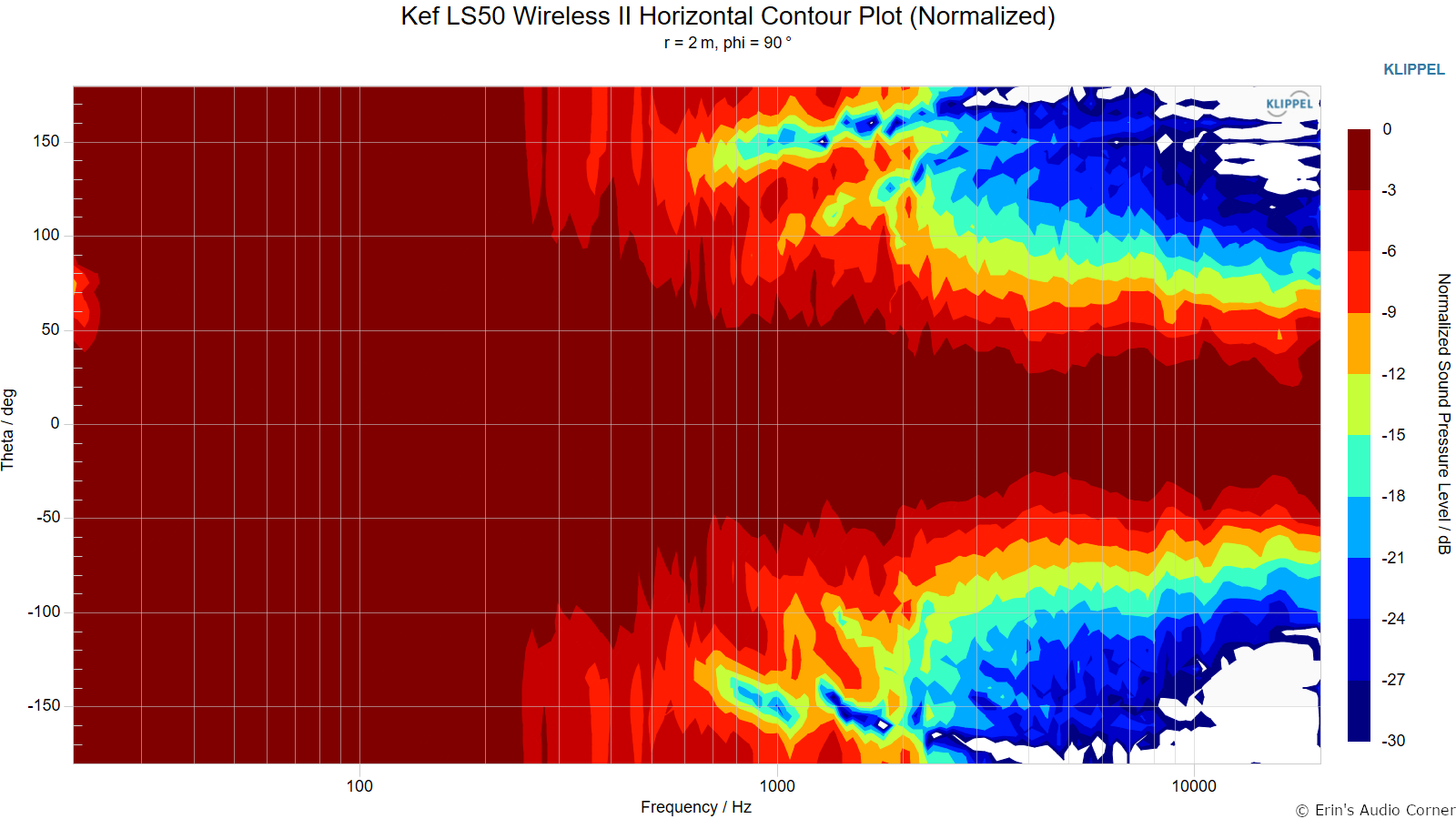
Kef%20LS50%20Wireless%20II%20Horizontal%20Contour%20Plot%20%28Normalized%29.png


From that kind of measurement, do you really think LXmini is more omnidirectional than KEF LS50 Wireless? Ok in term of strictly omnidirectional LXmini is a bit better (350Hz) when compare to 250 Hz of LS50 wireless. But to call it significant more omni is laughable
 
Back
Top Bottom