• Welcome to ASR. There are many reviews of audio hardware and expert members to help answer your questions. Click here to have your audio equipment measured for free!

omnidirectional loudspeakers = best design available

ASR is not a subjectivist forum.

ASR does not bar people reporting their experience owning or hearing gear.
In fact, it’s clear that many members appreciate not only having measurements available for gear, but user reports as well.
And we do have after all a section of the forum for people reporting their experience and impressions at audio shows. Nobody’s demanded to carry around measuring equipment when they do that.

There’s measurements available for the MBL speakers. If that’s all you need, you can make your decision as to what you think of them based on that.

Unfortunately, there aren’t blind listening test results for MBLs. So we have what we have.

Somebody who has owned them can offer their impressions of how they actually worked out in practice in their own room, which is what I have done. You are free to take it or leave it. But again other people appreciate reading somebody’s experience with such exotic loudspeakers (or other loudspeakers, they might be interested in).
 
I see what you did there .. well played sir, well played :cool:

I was never a huge fan of MBL, but for certain types of music and the right listening space, I can certainly understand how some would love them. As an engineer, I also hugely respect the engineering and technical prowess behind them. I do hope they survive, but the pricing (as with most of HEA these days) is killing not only these companies, but also our beloved hobby, especially for the younger generation that can’t even afford a home any longer. A $$$$ audio system FAR from folks mind just trying to make ends meet. I have been fortunate to purchase just about whatever I want, most are not in this position. Makes me sad as in the end it is about the music and how it moves us, and most will never hear what a world class design is capable of and how it truly can improve one’s life, simply due to cost of entry. Though the newer crop of high performance at non-mortgage/car pricing gives me hope.

Sorry, got a bit off topic there
MBL was overprized all the way from the beginning, compared to other concepts, but they made it over half a century ... what reflects the active lifetime of a startup founder ...
 
Dude. Chill.
Matt, you act like an MBL fanboy

I have no problem being an MBL fanboy if that’s what you wanna call it. Yeah I really love the sound of those speakers. And…?

not having any data supporting your claims.

What claims are you concerned with?

Again, there are at the very least measurements from stereophile. What other data do you want?

Are you unaware that Omnis are generally capable of producing what many people perceive as a more spacious presentation in many rooms versus the typical forward, firing loudspeaker? Some people find certain aspects of this “ more natural” sounding - or at least pleasing - in some respects. Floyd Toole has pointed out how certain designs can have this pleasing effect, including the Mirage (almost) omnis he himself owned and enjoyed for classical music, especially.

As I said, I did my own informal tests of listening to the MBL’s and other loudspeakers using recordings I made of instruments we own (and as I’ve also mentioned before my family’s voices). I’m simply reporting that the MBL’s sounded to me more like the real thing than other loudspeakers I’ve owned.

What other “ data” do you want in that regard? They weren’t blind tests so you can dismiss them on the grounds if you want. I don’t care.

Again, if none of this is interesting or satisfying to you, you do you.

But please don’t pretend to speak for the rest of the ASR forum, as if no user reports or subjective impressions are allowed here - they are! Taken with any caveats a reader wants to bring to them. And you are not speaking for the many ASR members who still enjoy talking about experiences with various loud speakers.

(not to mention your posts are not exactly full of data themselves. And you made a claim about people not finding MBL speakers “worthy” while ignoring that they are one of the longest lasting audio companies so clearly they have been seen as worthy by plenty of audiophiles)
 
Last edited:
Only if the surfaces reflect with a flat frequency response, most don't.

Agreed.

I was imprecise. I should have said something like "at least with omnis the off-axis energy, which is the primary contributor to the in-room reflection field, starts out spectrally correct."
 
Agreed.

I was imprecise. I should have said something like "at least with omnis the off-axis energy, which is the primary contributor to the in-room reflection field, starts out spectrally correct."

I’d like to point out that I know, with regard to your own speaker designs, you are interested in re-creating a natural sounding presentation with respect to spatial qualities.

Not having heard what you’ve achieved I wouldn’t suggest the MBLs are superior.

I only judge them against the speakers that I’ve heard.

Given a nice big room (and/or a really nice medium-sized room), ime the MBLs are magnificent. Conceptually the closest thing I've done to an MBL was a bipolar, and even then there were (imo) room size and speaker positioning constraints which I wanted to get away from.
 
ASR is an objectivist forum. You argue like a typical subjectivist.
You sound like you would be fun at parties. You can't have objective data without subjective interpretation, and the origins of how people want to test something is arguably subjective at the outset. Scientists are thinking all the time about novel ways to confirm their hypothesis. One side isn't wrong while the other is right. You can say something is green or purple and test the color to make sure it's exactly that hue, but not like one or the other.
 
Wrong. All instruments, voices, and almost all sound sources are directional, they sound different at different angles.

What the listener at symphony hall hears is a combination of direct and reflected sound. The relative contribution of each very much depends on distance from the sound sources.
 
So I was interested in hearing this special omnidirectional sound field. As luck would have it a pair of Mirage Nanosats with matching Mirage Nano CC was available secondhand very cheaply (they were the non-Prestige).

The stated frequency response (110Hz to 20 kHz (+/- 3dB)) is a total farce and they never should have advertised these like that.
It's only when I turned up the crossover (to a simple JBL SUP-150) in my AVR to 150 Hz that the mid-bass region started to somewhat appear again. Maybe it needs to be even higher.
Perhaps someone with the Nanosat Prestige edition has some (slightly) better experiences? 110 Hz is hard to take seriously regardless.

I did note these speakers sounded better when placed directly on the desk rather than on stands. Meaning that this type of design may lend itself to desktop use.
If only the woofers were made bigger than 2.75" which they are now.

It was also clear that putting them them close to the walls wasn't helping with the sound field.

I would support this type of speaker making a comeback for living rooms and ending the soundbar hype, but not in this small form factor where there's a big vacuum in the upper bass frequencies that are important to music.

Maybe these Omnisats would work well in a dual sub setup where you have stereo bass setting in your AVR, and then put these on top of 2 6"-8" sealed subwoofers or something, effectively making them three-way designs. Otherwise the bass may still be too localizable.

About objective measurements. The only Mirage speaker that I found to have been subjected to some measurements was this review by Audioholics https://www.audioholics.com/tower-speaker-reviews/mirage-omnisat-v2-fs

I'm very interested in what a Klippel estimated in room response graph of these would look like because seperate measuring points are apparently not 'reflecting' (get it) the way these sound at all.

"These sounded well balanced and tonally neutral. They measured as anything but."

"It's also clear in viewing the amplitude response plots that the v2s are directing substantial amounts of their acoustic output in directions other than front & center. Even at 45° and 60° off axis, the similarity between the on and off axis plots are remarkable. And the difference in plots between the on-axis response and 30° is remarkably minimal out to about 15 kHz, as can be seen in figures 6 and 7."

"EQ this portion of the v2s direct sound amplitude response flat (as I did for the fun of it) and you'll end up listening to what'll sound like a pair of loud, annoyingly efficient tweeters. So, for a system with the radiation characteristics such as that possessed by the v2s, that downward sloping amplitude response plot is exactly what you want to see in a measurement."

 
What claims are you concerned with?

I am neither Jim nor chiming in to his anti-subjectivistic concerns, but I am a bit reserved regarding enthusiastic reports on the performance of omnis.

If there is any plausible theory, controlled A/B tests or measurements backing up your claim that omnis can deliver excellent localization stability and minimum phantom source width, I would be very interested. It is something that I have never remotely experienced, and this is in line with every theory we have about imaging and phantom source localization.

Are you unaware that Omnis are generally capable of producing what many people perceive as a more spacious presentation in many rooms versus the typical forward, firing loudspeaker? Some people find certain aspects of this “ more natural” sounding - or at least pleasing - in some respects. Floyd Toole has pointed out how certain designs can have this pleasing effect, including the Mirage (almost) omnis he himself owned and enjoyed for classical music, especially.

Fully agreed on the aspect of ´spacious presentation´, ´pleasing sound´, and that is congruent with what we know about indirect sound field and reverb pattern. Sounds a bit like a theory by. Prof. Bose, though. His 901 was reportedly designed for countering the ´annoying directness´ and ´harshness´ of conventional speakers at the time with classical music by adding a fair amount of reflected sound (by a ratio of 8:1, if I am not mistaken). With today's best speakers for classical music in mind, delivering excellent ambience, depth-of-field, natural impression of proximity, localization and transparency (high end guys might call is ´silky´), I see no need for that anymore.

Another thing that arises doubts in me, is people claiming that they enjoyed classical music on such a setup. The deterioration of localization stability, localization blur, contradictive room reverb patterns (like ´musicians are playing in my room ´sort of reverb), overly distant presentation lacking proximity and attack, would make me feel that no-one who is listening to classical music live or recording such concerts, would be really satisfied with the presentation I know from several omnis.

I did my own informal tests of listening to the MBL’s and other loudspeakers using recordings I made of instruments we own (and as I’ve also mentioned before my family’s voices). I’m simply reporting that the MBL’s sounded to me more like the real thing than other loudspeakers I’ve owned.

My I ask which kind of recording venue was involved and how you captured its natural reverb? If these were rather ´dry´ recordings or some technique used to suppress the reverb (like XY mic arrangements of a compact recorder, or close miking), I find this result unsurprising, but it does not say much about the performance with recordings containing reverb.
 
If there is any plausible theory, controlled A/B tests or measurements backing up your claim that omnis can deliver excellent localization stability and minimum phantom source width, I would be very interested. It is something that I have never remotely experienced, and this is in line with every theory we have about imaging and phantom source localization.

I am far from a subjectivist, but when I first heard omnis I had to throw nearly everything I thought I understood about stereo imaging out the window. They are exactly as @MattHooper describes - somehow both spacious with well defined centre imaging. I looked earlier in this thread to get some answers, but alas there were none, only the same subjective observations that I made. Much as I would love to convince you with some psychoacoustic studies or come up with some kind of explanation why they work, I have to wave the white flag on this one. You'll just have to find someone with an omni system and go and listen.
 
You'll just have to find someone with an omni system and go and listen.

That is what I did numerous times. While I can confirm and unterstand all reports referring to ´spaciousness´, ´envelopment´, ´tonally balanced reverb´ and the impression of more ´natural imaging´ with rather dry sound sources, I have never listened to a system which would satisfy basic expectations when it comes to localization width and proximity. It always sounded blurred and overly distant with recordings containing natural reverb.

If I recall it correctly, a system based on German Physiks speakers involving a lot of room treatment (mainly diffusion), plus pretty sophisticated DSP correction, was showing the best result so far.

Much as I would love to convince you with some psychoacoustic studies or come up with some kind of explanation why they work, I have to wave the white flag on this one

I was not calling for studies or meaning to pressurize those who had simply expressed their personal experience, to delivering evidence. A description of the setup, room and how the (center) localization quality has been evaluated, would be already helpful.
 
@MattHooper , can't you just show the measurements of the speakers and explain what you mean is so exceptional?

Measurements from Stereophile (https://www.stereophile.com/content/mbl-radialstrahler-120-loudspeaker):

1021M120fig3[1].jpg

Elevated response in the low frequency region is partially (6 dB) artefact from near-field measurement technique.
Exceptionally flat frequency response for an omnidirectional loudspeaker.

1021M120fig2[1].jpg

Exceptionally inert enclosure.

MBL speakers: extremely expensive? YES.
Is there any less expensive omnidirectional loudspeaker with same (or better) measured performance?

Sounds great? Not to my experience.
Sounds great to many other people. Your experience is not more important, nor truer than others.

The reason MBL is seriously struggling: Not enough people find their products worthy.
MBL is 46 years old. For the first 40 years MBL was flourishing, which wouldn't be possible unless enough people find them worthy.
 
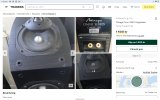
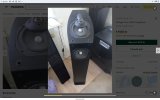
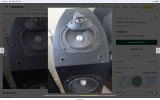
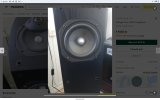
If I were to test a pair of omnis, what do you think about a pair of fully functioning used Mirage Omni 350s for $140? I think that model is around 15-20 years old.

The seller has added in the ad that you can suggest a price (Föreslå pris), so $140 doesn't seem to be set in stone.

Screenshot_2025-07-07_135049.jpgScreenshot_2025-07-07_135024.jpgScreenshot_2025-07-07_135035.jpgScreenshot_2025-07-07_135040.jpg
Information about them:

What I have to think about for myself is a reasonable price, so that at a later date, if I want, I can sell them for about the same as I bought them for. I understand that those of you who do not live in Sweden and are familiar with the used hi-fi market here can give me advice on that. But generally speaking, what do you think of the Mirage Omni 350 themselves?:)

I can't find any measurements on them. The only thing I found is this:


So probably a little more than twenty years old.
 
Last edited:
Back
Top Bottom