

MattHooper
Grand Contributor
- Joined
- Jan 27, 2019
- Messages
- 11,656
- Likes
- 20,951
PT 1
Since I’ve talked about finding the MBL omnis to be so successful in my room, I thought it might be worth taking a look at my room a bit. Perhaps it might give a bit of insight, or perhaps it might just be somewhat interesting to other members, or even might give somebody an idea or two. And I always like seeing photos of other peoples rooms, so I’m including them in my description here.
In 2009 I remodelled what was then my two channel listening room to do Home Theatre duty as well with a big projection screen and surround sound but also maintain a separate channel system speakers in the same room.
I hired my friend who is a clever architect as well as hiring a professional acoustician to help with the redesign. There are tons of features that help the room high-performance in terms of maintaining excellent image image contrast and immersion for the projected damage, as well as making the room very nice acoustically, and fairly flexible and that regard. There’s acoustic treatment hidden in various parts of the room.
The room is about 15 feet deep and 13 feet wide. With bay windows behind the listening sofa.
From outside the room (with my Thiel speakers):
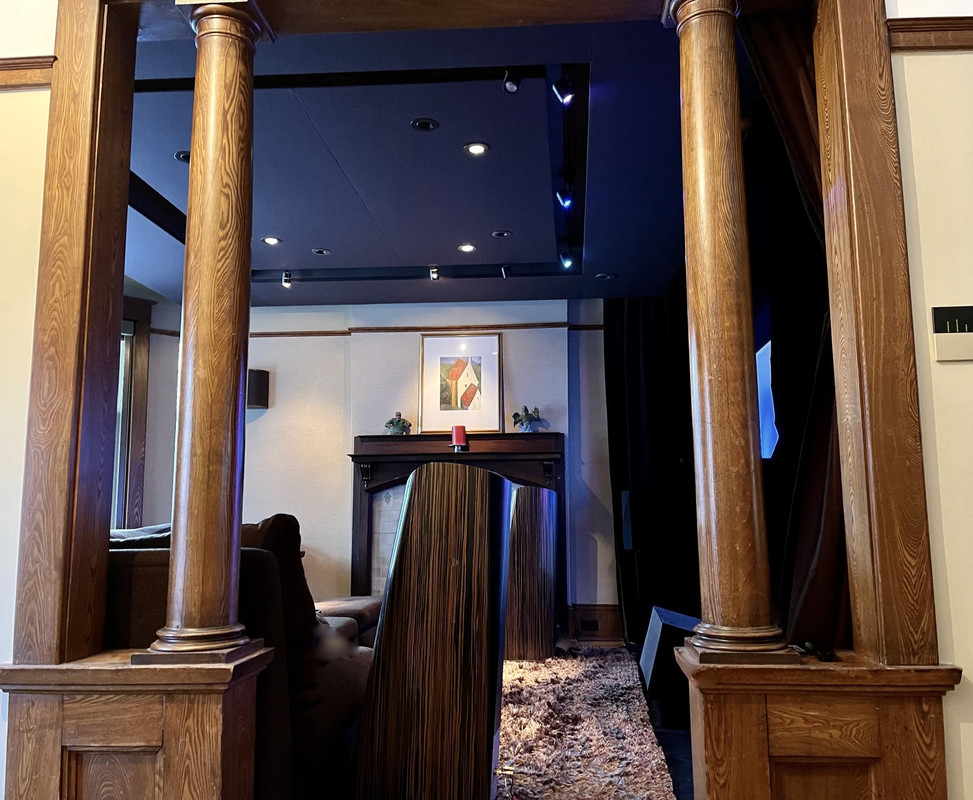
Closer look at the ceiling bulk head it was built down to contain lights, but more important, it is actually dark brown felt stretched tightly over a bulkhead frame, such that it appears completely solid. Materials, such as felt are much more effective at absorbing light than dark paint colours, and therefore help ensure that light from projected images does not reflect back onto the screen lowering contrast.
As well has a certain amount of acoustic property, but also in the bulkhead placed thick acoustic materials in strategic points:
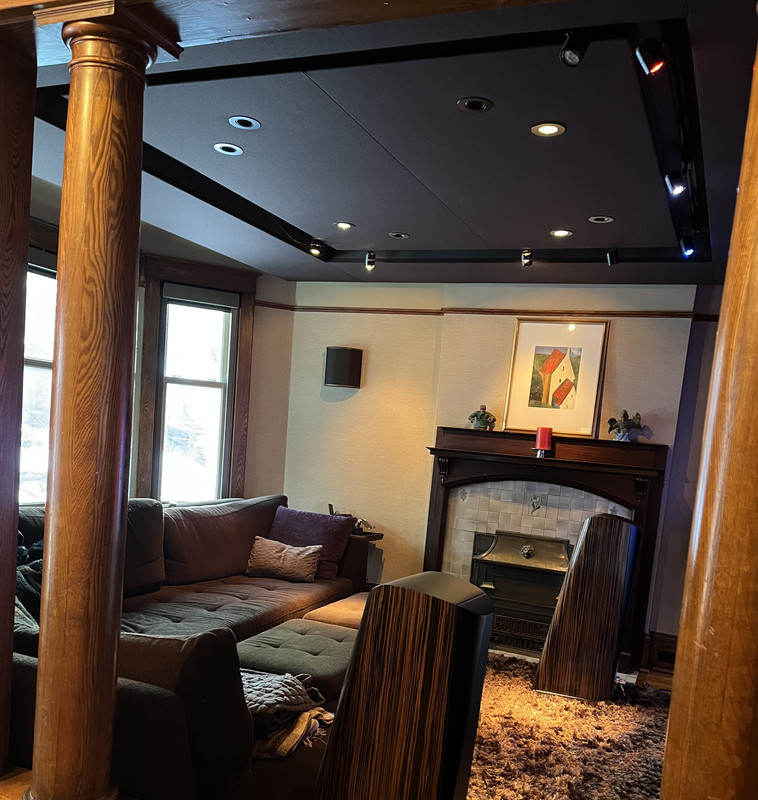
There’s also floor to ceiling columns of acoustic absorption hidden in the room corners behind the loudspeakers.
The room has a wall-to-wall, thick shag carpet, and a very large custom built sectional sofa. So a lot of stuff doing absorption.
But it’s not overboard, it just sounds beautiful in the room. Really calm. As a matter fact, guests often remark on their own, even just when we are talking “ wow it sounds so nice in here” … voice intelligibility is excellent.
Here’s a view looking from the screen wall towards the sofa. There is enough open uncovered walls to allow the room to be bright and cheery during the day as well as to provide enough liveness when I want:
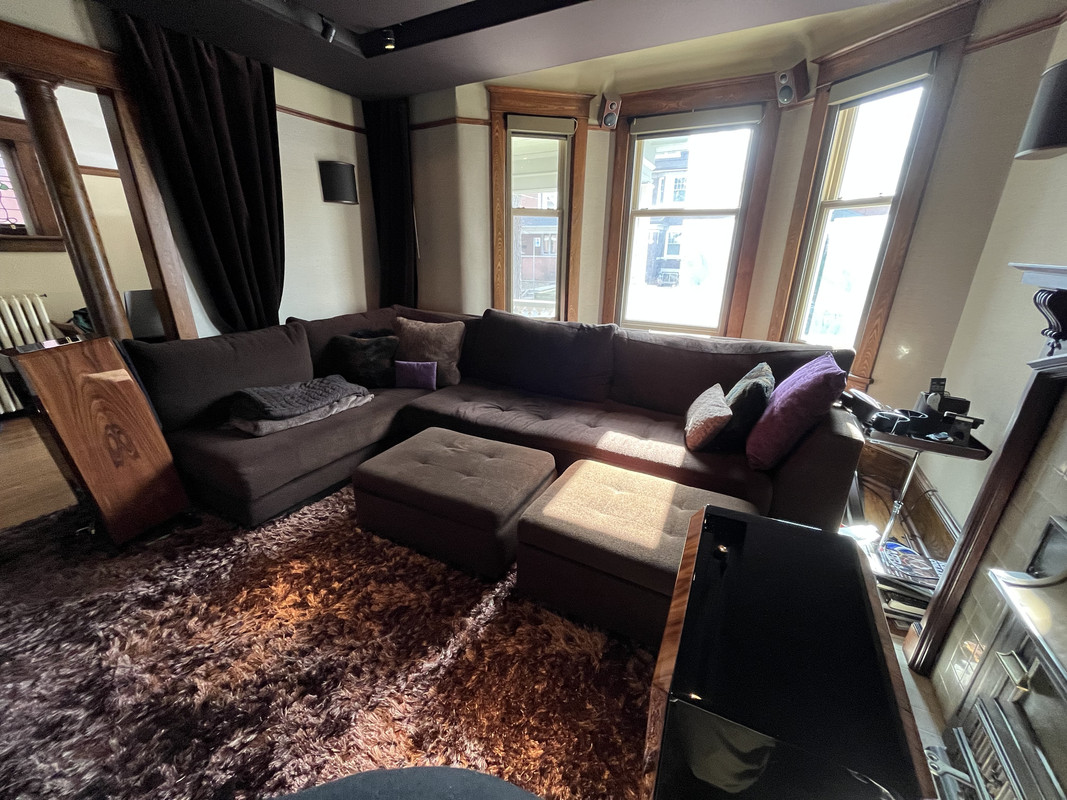
you can see the above photo to the left, two sets of thick, brown velvet curtains. Those are some of the many curtains available in the room they can be pulled to any reflection points.
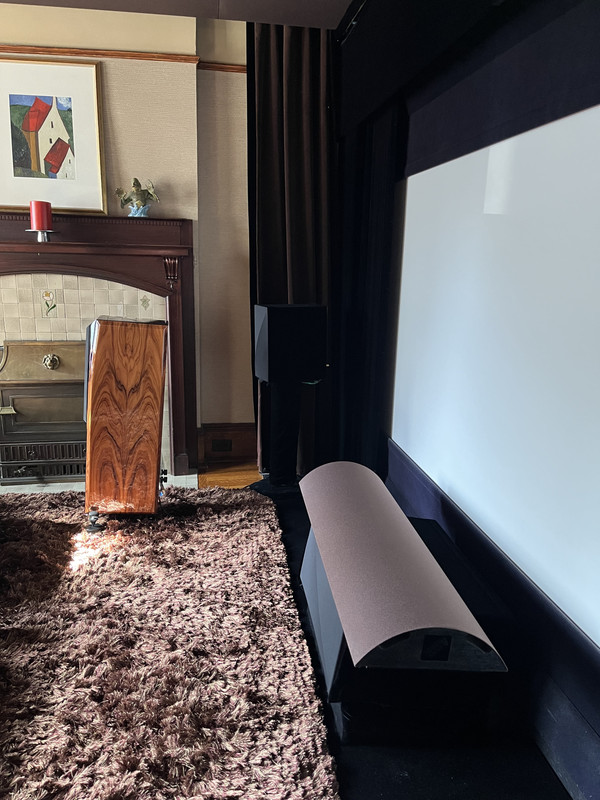
On the other side of the room, my left channel speaker sits near a tiled fireplace, which can add some harsher reflections to the sound. So I have a custom-made thick brown velvet cover that hooks onto that fireplace. When not in use the cover resides in the Ottoman beside that speaker. it takes just a couple seconds to put it on and it’s always on when I listen.
You can also see the hanging brown velvet curtains that I can either push back into the corners for more lively reflection, or I can draw those curtains along any place in the wall I want to dampen things up:
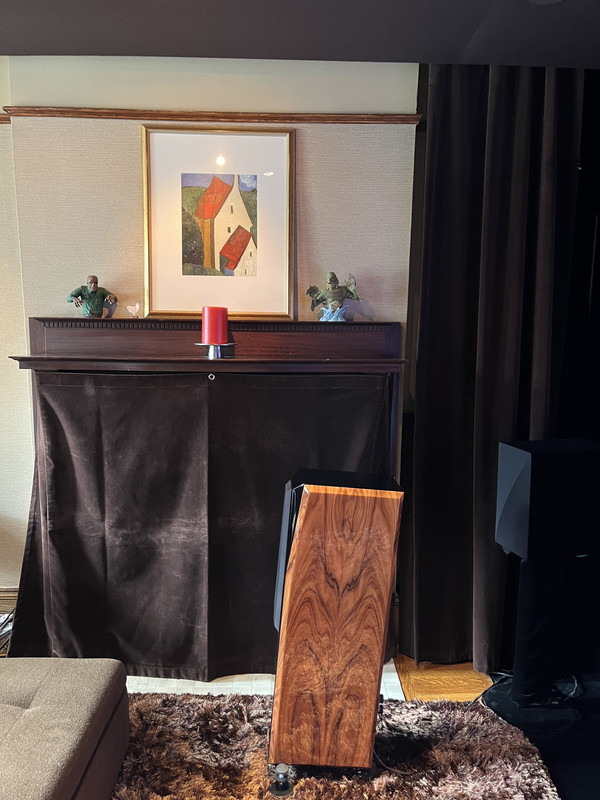
There’s also another nice trick: behind those thick brown velvet curtains, which match the room, is hidden another track of thin ultra dark light, absorbent, black velvet curtains.
Here they are pulled out a bit:
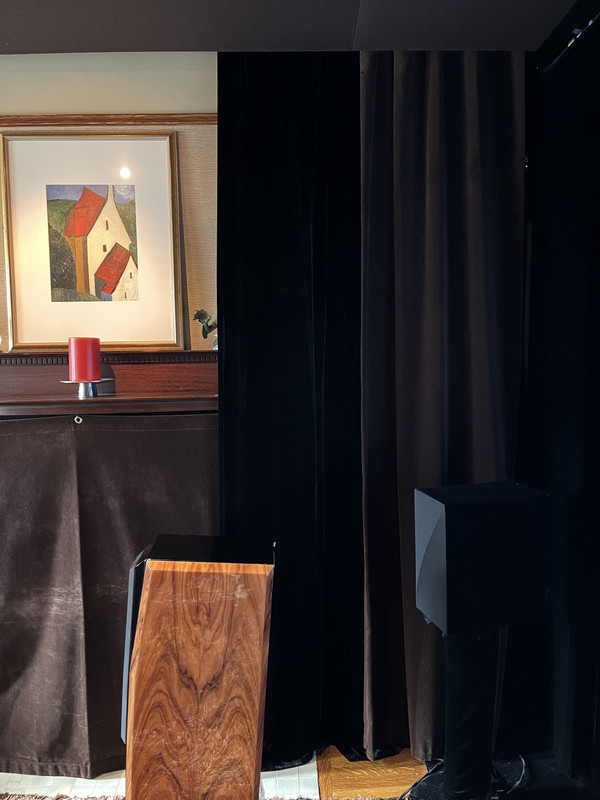
Those black velvet curtains can be pulled along the entire wall to cut off any light reflections from that wall back to the projection screen (with a cut out scene for my side, surround speakers):
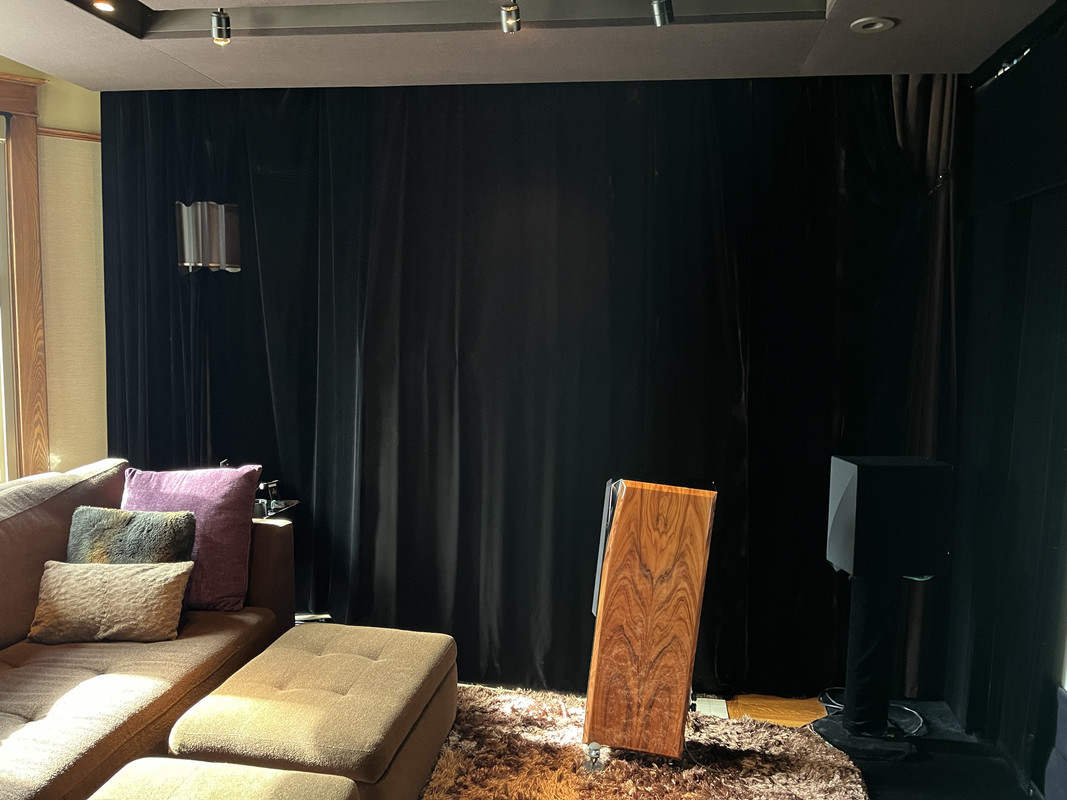
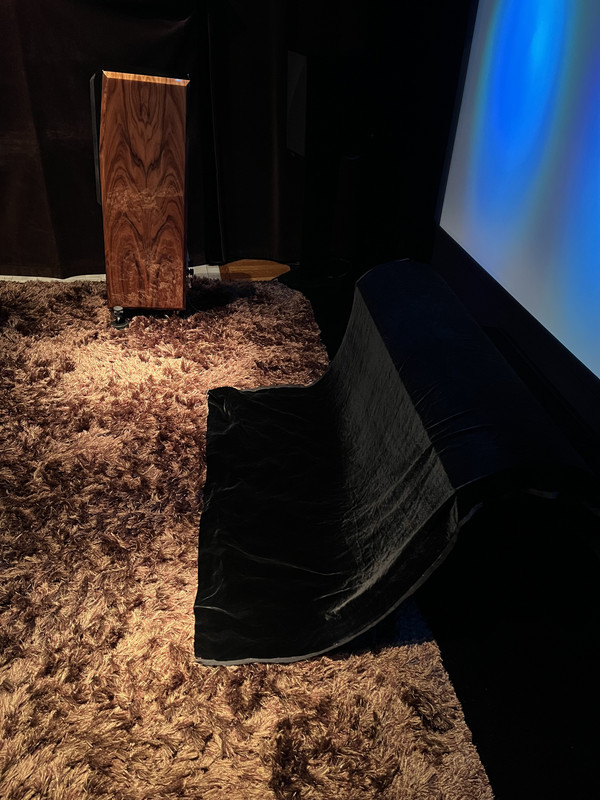
Black velvet curtains are hidden behind the Brown velvet curtains in each part of the room, so that they can be pulled across every wall, killing any possible reflections back to the screen, maintaining the highest possible image contrast, while also making the room
“ disappear” when watching movies, making for a very immersive viewing experience (it’s so dark. It’s hard to get a good picture without a flash):
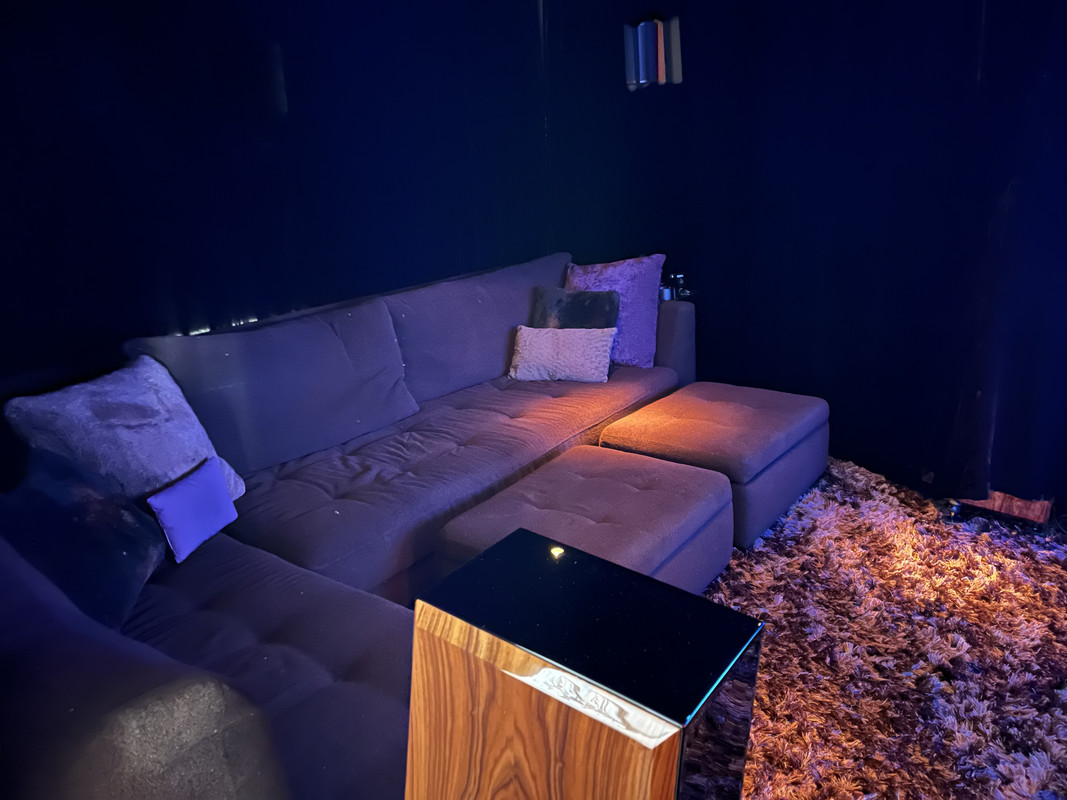
It literally takes me about 45 seconds to pull all the curtains along the walls. This way I get to preserve the brighter, cheery more normal looking room during the day or when not watching movies, but transform it into a very high performance, Home Theatre with no compromises for movie watching. There are also other tweaks in the room for movie watching which I won’t get into.
Since I’ve talked about finding the MBL omnis to be so successful in my room, I thought it might be worth taking a look at my room a bit. Perhaps it might give a bit of insight, or perhaps it might just be somewhat interesting to other members, or even might give somebody an idea or two. And I always like seeing photos of other peoples rooms, so I’m including them in my description here.
In 2009 I remodelled what was then my two channel listening room to do Home Theatre duty as well with a big projection screen and surround sound but also maintain a separate channel system speakers in the same room.
I hired my friend who is a clever architect as well as hiring a professional acoustician to help with the redesign. There are tons of features that help the room high-performance in terms of maintaining excellent image image contrast and immersion for the projected damage, as well as making the room very nice acoustically, and fairly flexible and that regard. There’s acoustic treatment hidden in various parts of the room.
The room is about 15 feet deep and 13 feet wide. With bay windows behind the listening sofa.
From outside the room (with my Thiel speakers):
Closer look at the ceiling bulk head it was built down to contain lights, but more important, it is actually dark brown felt stretched tightly over a bulkhead frame, such that it appears completely solid. Materials, such as felt are much more effective at absorbing light than dark paint colours, and therefore help ensure that light from projected images does not reflect back onto the screen lowering contrast.
As well has a certain amount of acoustic property, but also in the bulkhead placed thick acoustic materials in strategic points:
There’s also floor to ceiling columns of acoustic absorption hidden in the room corners behind the loudspeakers.
The room has a wall-to-wall, thick shag carpet, and a very large custom built sectional sofa. So a lot of stuff doing absorption.
But it’s not overboard, it just sounds beautiful in the room. Really calm. As a matter fact, guests often remark on their own, even just when we are talking “ wow it sounds so nice in here” … voice intelligibility is excellent.
Here’s a view looking from the screen wall towards the sofa. There is enough open uncovered walls to allow the room to be bright and cheery during the day as well as to provide enough liveness when I want:
you can see the above photo to the left, two sets of thick, brown velvet curtains. Those are some of the many curtains available in the room they can be pulled to any reflection points.
On the other side of the room, my left channel speaker sits near a tiled fireplace, which can add some harsher reflections to the sound. So I have a custom-made thick brown velvet cover that hooks onto that fireplace. When not in use the cover resides in the Ottoman beside that speaker. it takes just a couple seconds to put it on and it’s always on when I listen.
You can also see the hanging brown velvet curtains that I can either push back into the corners for more lively reflection, or I can draw those curtains along any place in the wall I want to dampen things up:
There’s also another nice trick: behind those thick brown velvet curtains, which match the room, is hidden another track of thin ultra dark light, absorbent, black velvet curtains.
Here they are pulled out a bit:
Those black velvet curtains can be pulled along the entire wall to cut off any light reflections from that wall back to the projection screen (with a cut out scene for my side, surround speakers):
Black velvet curtains are hidden behind the Brown velvet curtains in each part of the room, so that they can be pulled across every wall, killing any possible reflections back to the screen, maintaining the highest possible image contrast, while also making the room
“ disappear” when watching movies, making for a very immersive viewing experience (it’s so dark. It’s hard to get a good picture without a flash):
It literally takes me about 45 seconds to pull all the curtains along the walls. This way I get to preserve the brighter, cheery more normal looking room during the day or when not watching movies, but transform it into a very high performance, Home Theatre with no compromises for movie watching. There are also other tweaks in the room for movie watching which I won’t get into.


 and enjoy common speakers.


