• Welcome to ASR. There are many reviews of audio hardware and expert members to help answer your questions. Click here to have your audio equipment measured for free!

O-Noorus D1 - TPA3255 PFFB Stereo Amplifier - Front Display, Tone Control (with bypass) and Remote

Attachments

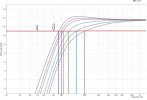
  • HP mit verschiedenen Q.jpg
    HP mit verschiedenen Q.jpg
    70 KB · Views: 91
People hi :)

Generally, a second order filter (-12dB/oct) is used for the high pass filter (most common cases except high-end equipment).

The 'connection' frequencies would be preferable to 60, 80 and 120 Hz depending on the diameter of the speaker of the accompanying speakers; The smaller the speaker, the higher the cutoff will be in order to 'relieve' its reproduction in low frequencies and consequently reduce the level of distortion while allowing louder listening levels (depending on these admissible power capacities, of course).
.

For professional sound recording with good monitoring speakers equipped with a good-sized driver for the bass reproduction, it is common for engineers to use the crossover frequency of 80 Hz because it allows better 'readability' and 'SQ' of the sound range that will be reproduced.

NB: if you look carefully at Amirm's reviews of the speakers, you will see that the distortion (especially in the bass) increases proportionally with the increase in the listening level expressed in dB SPL at 1m: you will therefore have to judiciously choose the 'connection frequency' for the high-pass filter in order to use the subwoofer to compensate for these defects because it is of course designed to produce bass (and not anything else).

'Physically' and due to the laws of acoustics, a small diameter speaker cannot correctly reproduce 'deep' bass with a few exceptions of certain 'special' creations but which are very poorly distributed and rather (very) expensive...

I said that but pretend I didn't say anything :p

See you soon... ;)
 
Last edited:
Hi.

I mentioned a filter at -12dB per octave: this translates into the shape of your curve in terms of attenuation.

When we calculate a connection value (60, 80 and 120 Hz), it is always applied at - 3dB, that is to say that you will have for example your curve which will pass through 60 Hz at - 3dB and which will continue its attenuation linked to the order of the filter used (- 12dB/oct for my example).

In your example, the attenuation represented seems rather to be of order 1 (- 6dB per octave), which is not enough: too low (as here) gives a 'boomy' sound and too much and too high (eg: 24dB/oct) will give the impression of a hollow or a void if the connection frequency of the subwoofer is not precisely adjusted: an attenuation of - 12dB/oct is a good compromise.
Now it's a third-order high-pass filter.
 
Hi.

You don't seem to read what I wrote about the filter order but that's okay: instead show us the appearance of the new corbs you get with your third order filter, thanks.

First, look at this ->

Slopes.jpg
 
Last edited:
OK but you have to keep 40Hz because good monitoring speakers are capable of it.

On the other hand, 120Hz is too high: with certain settings and speakers, the user risks obtaining 'muddy' bass, so you should use 100Hz at most ;)
 
Will the D1 Pro be released in France? On audiophonics for example. If yes: when could that be?
 
Back
Top Bottom