• Welcome to ASR. There are many reviews of audio hardware and expert members to help answer your questions. Click here to have your audio equipment measured for free!

No more Windows here, all Linux

DAW's are a curious bunch becuase they really have two functions. One is the basic audio editing/recording/whatever tasks that any DAW can do. The other is the creative workflow differences DAW's tend to exhibit and afford the user. The first bunch of functions is easy to adjust to, but the more creative focused workflow aspects simply cannot be recreated elsewhere. Once you get a daw that fits you don't change it becuase that usually means years or reduced quality work and un-fun music making while you try to get back up to speed.
Sounds just like the Photoshop trap for graphic designers. Some grudgingly put up with whatever Adobe decide to do this year while others decide it's finally gone too far and accept the pain involved in migrating to something like Krita.
 
There's also Reaper - closed and commercial, with a 60 day free trial period. Some report fewer problems than with ASIO, others more. It probably depends on the interface, and maybe your other hardware.

There seem to be 2 main pain points (other than generally getting used to linux) for people looking to switch:

ASIO is a windows thing. Linux has an emulation layer but it adds latency and also is a pain in the ass the setup and barely works half the time. I think you have to compile it yourself and I always got hung up on the documentation there, never got it working. I tend to want to prioritize making music vs. tweaking my tools and OS to work right at all. IME every interface I've used work, which is about 8-10 of them, a mix of usb and pci cards.

The plugins are annoying buy the main issue is really that most DAW's don't communicate with linux audio. This whole problem would be solved very quickly if Dev's just allowed their DAW's to see something like pulse or jack. Most of the DAW's already run perfectly fine in linux. It is kind of amazing how seemingly little work needs to be done to change the landscape here. Granted I am likely simplifying it but I can't imagine this task is hard compared to say, porting a DAW to another OS.

With that said, linux audio is a pain to use IME. I never know what API is actually being used, I never know when things are working properly until I get audio output. On windows I'm always dealing with windows audio and ASIO, that's it and it always works. If I come off a complainer it's becuase I genuinely don't understand how creative pro stuff on linux feels like it hasn't progressed much in 15 years. I want things to be better. Linux is so flexible and can be whatever you want, unless that thing you want is an easy to use and setup creative professional work environment.

There's an added frustration as well that ties into the state of basically everything. Our digital computing lives are getting worse straight up. It's pretty clear that we need to move software and hardware (if possible) away from the big players who make them. Their agenda is clear, reduced ownership, more rental, more subs, to just be more reliant on them in general. It's not sustainable long term at all, so when I see devs not bothering with linux, it kind of makes me feel like they're digging their own grave. I've talked about this with some DAW dev's and their response is always "whatever, who cares".
 
I've tried Linux on at least half-a-dozen occasions since the late '90 and as late as '25. Early versions were a hacker's delight but I wasn't a masochist. Later versions are far more user friendly for sure and pretty easy to setup. However I've never found any practical applications for Linux that couldn't be done with Windows programs, but lots that could NOT be done on Linux.

To be sure, I like to see an open OS that is an alternative to Windows but that could run essentially all Windows programs, but I suppose that won't/can't happen any time soon. Windows foibles are a pain but for me at least, tolerable.
 
I mostly browse and pay bills on a tablet.

I have SoundForge and photoshop on my computer, and wouldn’t want to buy them again.

The most used program is Access. I haven’t seen anything equivalent.
 
I've tried Linux on at least half-a-dozen occasions since the late '90 and as late as '25. Early versions were a hacker's delight but I wasn't a masochist. Later versions are far more user friendly for sure and pretty easy to setup. However I've never found any practical applications for Linux that couldn't be done with Windows programs, but lots that could NOT be done on Linux.
I'm fairly certain there were several Linux only tools on the Knoppix CD I used for my Certified Penetration Test Specialist (AKA Ethical Hacking) training back in the mid-2000's. Offensive hacking might be one of the few exceptions to the 'rule' :)
 
Sounds just like the Photoshop trap for graphic designers. Some grudgingly put up with whatever Adobe decide to do this year while others decide it's finally gone too far and accept the pain involved in migrating to something like Krita.
I was literally just explaining to my daughter (a first year Architecture student) that Krita is the free equivalent to Photoshop. She has to do some free-hand design work for her next module and I was setting up a digitizer tablet on her new laptop (a Lenovo Legion 5, which is a very nice bit of kit for the money).
 
To be sure, I like to see an open OS that is an alternative to Windows but that could run essentially all Windows programs, but I suppose that won't/can't happen any time soon.
I doubt it will ever happen. Wine runs many Windows apps, but not always without issue. Currently I have Rephase and VituixCAD running under Wine. They both run, but VituixCAD has some small annoyances under Wine. Still, it gets the job done.

Instead of getting Linux to run all Windows apps, I would like to see more Linux apps get to the point of where they are as functional and user friendly as their Windows equivalents. For my use case, LibreOffice is a drop-in replacement for Microsoft Office for word processing and spreadsheets. E-mail is another story, but now that I am retired I no longer need Outlook; Thunderbird suffices. But, I see a lot of complaining from Adobe users trying to run GIMP or Kdenlive. Will GIMP and Kdenlive ever catch up to their Adobe equivalents? I don't know. Periodically I use them and they work for me, but I don't do image and video editing professionally.
 
I just replaced Windows 10 on my old Surface Pro 3 with Linux Mint. Everything is working except for automatic screen rotation which I don't care about.
I recently switched from PCLinuxOS to Mint-Mate DE after nearly 25 years. Sadly it seems that distro is slowly being abandoned by it's head dev and there's been a revolving door of good folks on the dev team. :(
At the current point I'm quite happy with Mint for my needs which beyond general surfing, email, etc; mostly revolves around Audio apps. I have MakeMKV and DVD-Audio Extractor running without issue along with Kodi using it's pass-through config to stream Atmos perfectly to my Marantz AV20 PrePro.
I've always preferred Linux for it's security. In 25 years I've never worried about hackers, malware, and all the other nasties out there that have always made Windoz a dangerous internet journey.
 
It's GPL and available in most linux package managers. Ardour.org ask for payment if you want to download binaries from them, valid for whichever major version number is current, and updates to that major version. That's probably a lot more necessary for Windows and Mac users to get a convenient installer. The payment helps fund the project, so probably well worth paying if it's something you use extensively, even though you don't strictly have to.

There's also Reaper - closed and commercial, with a 60 day free trial period. Some report fewer problems than with ASIO, others more. It probably depends on the interface, and maybe your other hardware.

There seem to be 2 main pain points (other than generally getting used to linux) for people looking to switch:
  1. Audio interface support. A lot of interfaces don't have linux support at all, or only for the subset of functionality from pure 'class compliant' operation.
  2. VST support - mostly related to licensing enforcement of commercial VSTs. Most VSTs will run fine via yabridge, but some won't because the emulation isn't quite 100% (might be fixed at some point), and others never will unless the developers change their license enforcement. This is rather like Windows game support via Proton - most are fine, some have a fixable gap in emulation support, but those with kernel mode anti-cheat are stuck unless the developer stops requiring it.

I paid / donated $80 for Ardour. I like to support good projects. Instead of using an audio interface, I'm recording everything on a Tascam 24 track digital recorder and then using USB to copy the tracks over to my PC for Ardour. I understand the copy can been done faster with an SD card reader on my PC, but I don't currently have one and usb is fine. Just had to dig through my cable collection to find a usb mini B to usb A cable. (never through away old cables)
 
Will GIMP and Kdenlive ever catch up to their Adobe equivalents?
I think user experience satisfaction is mostly bound to how one got socialized early on. The young ones at our company grew up with Linux and Gimp etc and love it. When forced to work with Photoshop their heads explode and you'll hear constant cursing in the office, about "what a darn stupid workflow!".

I grew up with Photoshop and GIMP gives me constant pain.. My Photoshop version is having issues when running under WINE. I've set up a small sandboxed W11 VM with disabled network for this and some other stuff, most of which is hardware-related.

As for WINE in general, it works absolutely great for me, running about a dozen of Windows programs very well.
 
Will GIMP and Kdenlive ever catch up to their Adobe equivalents?
Most likely not. Let be honest, it's difficult to get a team of developers to focus on and put the time and enthusiasm into a project working for free. But get the right group together and line their pockets at the appropriate level and you can get most anything you want or a team leader (boss) asks of them. In most any endeavor , professional level tools are expensive but worth it.
Open source is great but it does have it's disadvantages.

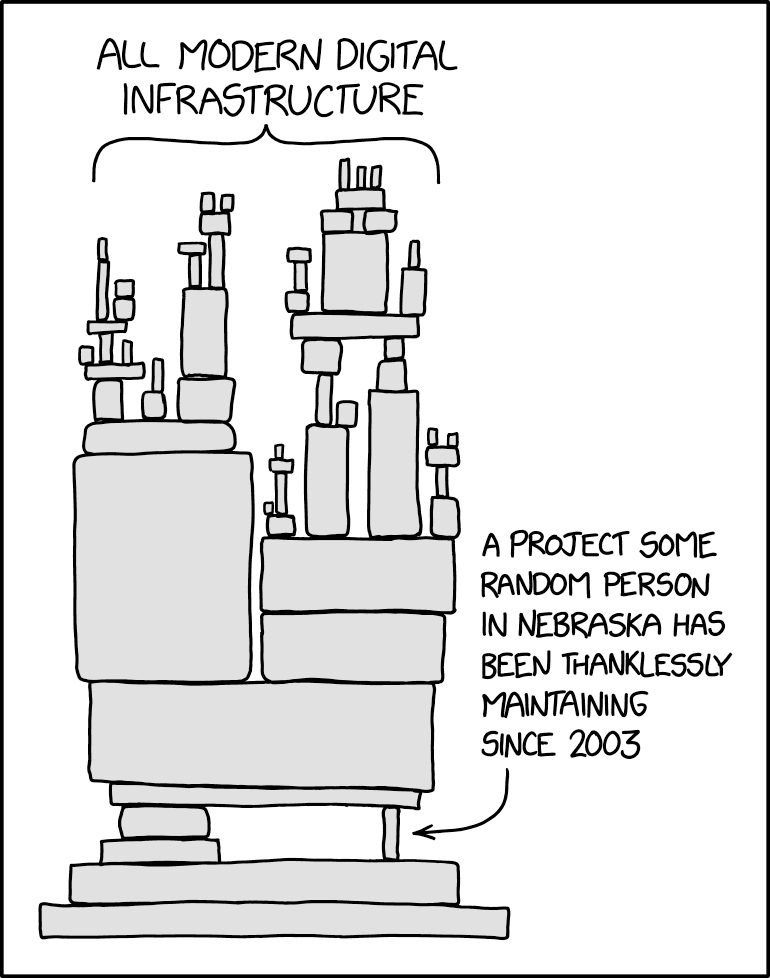
1775895818900.png


And now the open source maintainers are going to get hammered with bug reports from Project Glasswing... https://www.theregister.com/2026/04/10/project_glasswing/
 
Last edited:
Open source is great but it does have it's disadvantages.
Yes. It's hard to adequately finance, so the teams are volunteers, sometimes without much "targeted guidance" it seems.
And, the advantage of open code - anyone can examine and improve it, does not automatically guarantee that someone will really do it, especially timely. A good example is the old "dirty cow" debacle.

 
However I've never found any practical applications for Linux that couldn't be done with Windows programs
I suspect you're thinking of a normal desktop, not the load of embedded uses linux gets put to. You couldn't make something functionally equivalent to piCorePlayer with Windows for example - it just can't run on something as limited as a Pi Zero, or with a footprint measured in MB not GB. MS have Windows IoT which will run on the higher spec Pi models, but that's about as close as you'll get.
 
I suspect you're thinking of a normal desktop, not the load of embedded uses linux gets put to. You couldn't make something functionally equivalent to piCorePlayer with Windows for example - it just can't run on something as limited as a Pi Zero, or with a footprint measured in MB not GB. MS have Windows IoT which will run on the higher spec Pi models, but that's about as close as you'll get.
Funny you should mention PiCorePlayer on Linux. In fact I tried to set up LMS on a mini PC running Ubuntu but I couldn't get it working. Probably my own fault but I was able to get LMS going on both Raspberry and Windows.
 
ASIO is a windows thing.
I know. My point was that some people report Reaper does better on linux than on Windows, and vice versa for others.
Linux has an emulation layer but it adds latency and also is a pain in the ass the setup and barely works half the time. I think you have to compile it yourself and I always got hung up on the documentation there, never got it working. I tend to want to prioritize making music vs. tweaking my tools and OS to work right at all. IME every interface I've used work, which is about 8-10 of them, a mix of usb and pci cards.
I'm not sure what you're talking about here - JACK emulation in PipeWire perhaps? It sounds like you'd be better off with something like Ubuntu Studio which comes already set up for audio and video production, rather than trying to tweak a more general purpose desktop distro.
 
I know. My point was that some people report Reaper does better on linux than on Windows, and vice versa for others.

I'm not sure what you're talking about here - JACK emulation in PipeWire perhaps? It sounds like you'd be better off with something like Ubuntu Studio which comes already set up for audio and video production, rather than trying to tweak a more general purpose desktop distro.

Was referring to wineasio
 
In fact I tried to set up LMS on a mini PC running Ubuntu but I couldn't get it working. Probably my own fault but I was able to get LMS going on both Raspberry and Windows.
I have LMS running on my NAS using Docker (Synology now calls it "Container Manager"). If you ever feel the need again to run it on Ubuntu, that may be the way to go. I suspect the reason you could not get it running on Ubuntu was due to dependency issues (e.g., missing dependencies, incorrect versions, etc.), which is an area of Linux where issues too often pop up. It seems to be better, though, than it was a decade ago.
 
Most likely not. Let be honest, it's difficult to get a team of developers to focus on and put the time and enthusiasm into a project working for free. But get the right group together and line their pockets at the appropriate level and you can get most anything you want or a team leader (boss) asks of them. In most any endeavor , professional level tools are expensive but worth it.
Open source is great but it does have it's disadvantages.

The real issue is that most good coders / developers don't think like regular users and aren't as good at user interface design. Different ways of thinking. I was lucky enough to be good at both. Also, remember the SDKs for the UI parts on Linux were much more limited when some of these older apps like Gimp were created.

OS/2 was the same way, or maybe worse. The tools from IBM were awful and made it much harder to create good UIs. The original IBM manuals for doing software development on OS/2 took up a shelf about 4 feet long. The good old days.
 
Back
Top Bottom