• Welcome to ASR. There are many reviews of audio hardware and expert members to help answer your questions. Click here to have your audio equipment measured for free!

No more Windows here, all Linux

The proper comparison would be to a clean new install of Windows 10.
Official support for Windows 10 ended Oct. 14, 2025. It no longer receives free security updates or technical support, though there is a paid Extend Security Updates (ESU) program. The ESU program costs $30 and extends critical and important security updates (as defined by Microsoft) for one more year. But, who knows, if Microsoft determines there is a good enough revenue stream to be had by extending the ESU program, perhaps they will extend it longer to keep collecting the annual fee.
 
I think all OS have pros and cons.

It's hard to avoid Win11 or MacOS is you work in corporate these days, and MS Office is the lingua franca within enterprises.

One can use the web version of the MS Office apps in Linux, but the feature set is limited compared to the real desktop apps.

There's a zillion desktop Linux distros these days, just pick one - I go for Ubuntu but it's not because I think it's better, it's just what I have used since 2004 or so. I think it's a good balanced Linux version, light enough to run on a 10-year old computer like a charm, but with a solid and up to date software base.
 
Give up the fight, @PristineSound, you are trying to swim upstream, it won't cannot work here in the post!
As much as I despise the console-mode, I have tried so many versions -for so many decades- of Linux distros flavors.
But just in a few days of usage, I'd be snagged because some hardware (old or new) or software (old/new) would require me to chase that black cat in that black room, and I'd terminate my attempt.

In the last 6 months, I've tried to install 4 other Linux [notice that I am intentionally not naming names].
The first attempt could not make heads-or-tails out of my dual monitor setup, fed by a Ratheon6750XT (DP1.4).
Second attempt revealed that Dante Controller has no equal in the Linux world. (LoL 2 REW alternatives in Linux).
I've even tried USB-boot Linux and WSL.:mad:

Each attempt was botched with some glitch or another and I don't have the patience for a high maintenance Betty, as my desktop/server.
I find Windows and I get along just fine, and it is a tool that works for me, without having to defend to the Linux crowd.
If the hate for Windows makes others gravitate to Linux... chacun à son goût!

Not that Windows (of any flavor) is an OS poster child, but it's been workable for our needs.
I think I have come to the conclusion that throwing the baby out with the bathwater is not going to happen for me.;)

Linux is not the best choice for everyone's use case. Before I retired I tried to migrate over to it for work. I had recurring issues connecting to our Microsoft Exchange server - I would get it working in Evolution, and a couple of months later Microsoft would change some setting in the server that would screw up the connection and/or user authentication. I tried running some Windows only apps I needed in Wine, but that proved to be problematic.

Now that I am retired, I'm on Linux full time. My Windows machine just sits there collecting dust. I boot it up every few months to apply updates, but that is about it.

As far as Linux flavors go, it is very confusing for new users. Too many Linux enthusiasts push the narrative that everyone should switch to Linux, RTFM and learn the terminal. That is unrealistic. Those same types also too often recommend rolling releases to new users, which can result in a lot of frustration for new users, especially if they are using their computer for more than just e-mail, web browsing and LibreOffice. I have used Arch off and on for the last decade. It will go smooth for a while, then an update will come through that breaks something, e.g., regressions, broken dependencies, etc., though most of the issues probably would not too much affect the aforementioned people only using their computer for e-mail, web browsing and LibreOffice.

I always find myself coming back to Linux Mint with the Cinnamon desktop. In my experience, it just works. And, since it on a fixed release cycle, it has been much less problematic than Arch or any of the Arch based distros I have tried. If I want a version of an application that is newer than the one in the repository, I just install the version I want as a flatpak or appimage.

I don't know whether you tried Linux Mint Cinnamon, but that is the distribution/desktop I recommend to anyone new to Linux. But, if you are happy with Windows, then stick with it.
 
Official support for Windows 10 ended Oct. 14, 2025. It no longer receives free security updates or technical support, though there is a paid Extend Security Updates (ESU) program. The ESU program costs $30 and extends critical and important security updates (as defined by Microsoft) for one more year. But, who knows, if Microsoft determines there is a good enough revenue stream to be had by extending the ESU program, perhaps they will extend it longer to keep collecting the annual fee.
the ESU program for personal Windows 10 users(at least in my region), is completely free for one year. you just need a Microsoft account.
when I received the option to join the ESU from the Windows Update settings, I opened a "temp mail" (disposable email account) and registered a new MS account with it. that was pretty much it. I'm receiving security updates since
Me too! Did the same.
 
...I go for Ubuntu but it's not because I think it's better, it's just what I have used since 2004 or so.
That's honest enough, but it brings up another question that deserves another honest answer.
Would you be able to compare the amount of time (minutes/hours/days/?) for the 'maintenance' of [say] UbuntuOS versus WinOS?
Yes, I know, that's a loaded question of apple/oranges... but my guess is that every effort to maintain each, gives the edge to WinOS.
The exact hours for each is not essential, you can labor-hour estimate them since 2004 or for the last dozen years.

Honest answer: back then, I wasted many hours getting things to work. Back then there was a big community effort to get Linux to work as a desktop system, so yes, it was work, and most definitely back then only those willing to work in terminal for extended periods of time needed apply...

My more recent takeaway though: Now, Ubuntu updates are noticeable faster than Windows updates, which knock out your system for 15 minutes with some regularity. But Linux issues updates more often, if you like to keep your system up to the latest and greatest.

But maintaining an Ubuntu environment certainly is less plug and play, even these days, if you consider all the adjacent stuff.

I think these days it's more about the things you want to use your computer for. Photography or Video Editing or Music Server stuff probably is still much better suited to Win or MacOS because of the application ecosystem.
 
Last edited:
My experience is that LivePatch helps a little with higher cadence of updates with Ubuntu vs Windows. You can patch 5 clients for free...

1775770334490.png
 
My experience is that LivePatch helps a little with higher cadence of updates with Ubuntu vs Windows. You can patch 5 clients for free...

View attachment 523494

Isn't livepatch mostly to reduce needed restarts? That's great for servers but not sure if I even enable it on my desktop Ubuntu 24 system. (I have, see below)

There's also the free Ubuntu Pro stuff... they are over-complicating the support (i.e. the monetizing of the OS in Linux).

1775773423528.png
 
Tried linux again like I do every year. DAW's still don't really work on it because no dev will spend any amount of time getting their DAW to talk to linux audio api's. Been this way for 20 years.

Welp, guess I'll google it next year and hope something changed. Kinda surprising linux never really took off for audio stuff, you'd think it'd be the go to choice. Even our waves consoles at work run windows.

Bitwig Studio has a Linux version. ChatGPT ranks it high, but I'm not a music producer and I have no idea how it really compares to other DAWs. ChatGPT sometimes
hallucinates. Here is what ChatGPT says:


Bitwig1.png
Bitwig2.png
 
Tried linux again like I do every year. DAW's still don't really work on it because no dev will spend any amount of time getting their DAW to talk to linux audio api's. Been this way for 20 years.
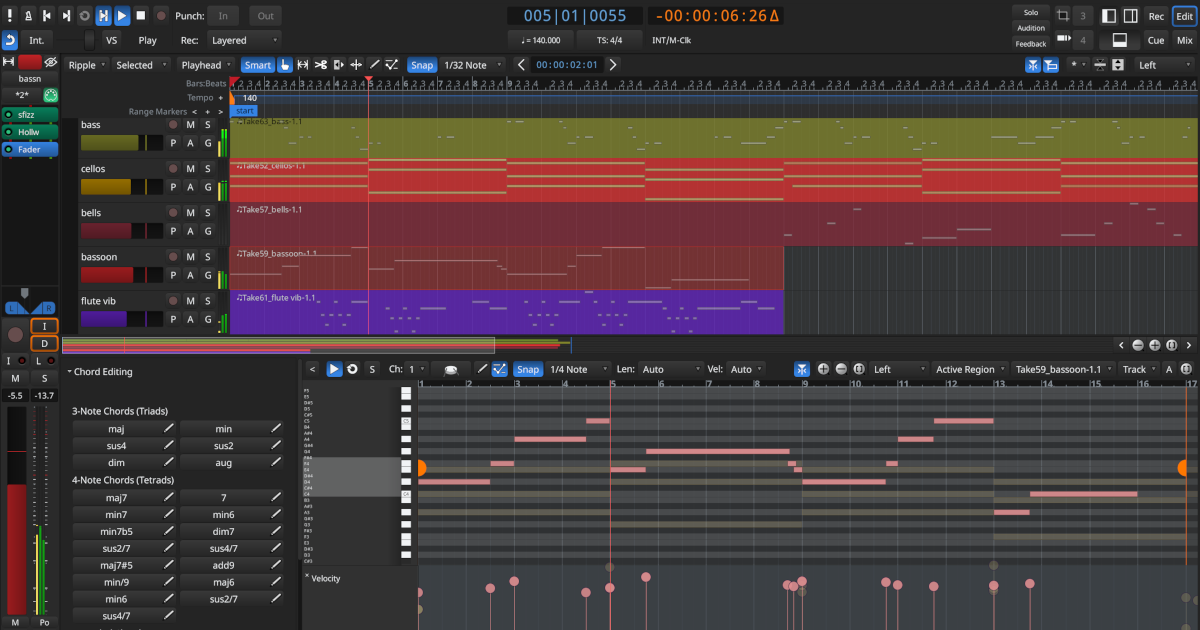
Did you try Ardour? I think it has a great future because it is open-source, free and was designed to be cross-platform, and the latter is one major asset.
 
Tried linux again like I do every year. DAW's still don't really work on it because no dev will spend any amount of time getting their DAW to talk to linux audio api's. Been this way for 20 years.

Welp, guess I'll google it next year and hope something changed. Kinda surprising linux never really took off for audio stuff, you'd think it'd be the go to choice. Even our waves consoles at work run windows.

Have you tried Ardour? I just installed it today and it seems to be working for me.

It isn't free, but seems to be well supported.


(I have no affiliation with them)
 
One can use the web version of the MS Office apps in Linux, but the feature set is limited compared to the real desktop apps.
There are some license tier oddities where you get to use the web version of certain apps but not the desktop version. I think I ran into a few capabilities that were only in the web version too.
 
Android, which is based on Linux.
That's why I asked for a definition of 'linux phone' before answering. But your answer leaves a further question - what do you mean by 'Android'? Is LineageOS still 'Android' if you haven't installed gapps? Or if you've gone for an alternative like MicroG? Does /e/ count? Or GrapheneOS?
 
Did you try Ardour?

Yeah and no offense it's not really a serious tool.

As for bitwig I didn't find it to be an acceptable replacement for ableton.

DAW's are a curious bunch becuase they really have two functions. One is the basic audio editing/recording/whatever tasks that any DAW can do. The other is the creative workflow differences DAW's tend to exhibit and afford the user. The first bunch of functions is easy to adjust to, but the more creative focused workflow aspects simply cannot be recreated elsewhere. Once you get a daw that fits you don't change it becuase that usually means years or reduced quality work and un-fun music making while you try to get back up to speed.

Oh well, all I can do is keep posting in my DAW of choices' linux thread hoping the devs will care more about giving users options and security instead of *checks notes* ... subscription models and built in AI... oh god....
 
Have you tried Ardour? I just installed it today and it seems to be working for me.

It isn't free, but seems to be well supported.
It's GPL and available in most linux package managers. Ardour.org ask for payment if you want to download binaries from them, valid for whichever major version number is current, and updates to that major version. That's probably a lot more necessary for Windows and Mac users to get a convenient installer. The payment helps fund the project, so probably well worth paying if it's something you use extensively, even though you don't strictly have to.

There's also Reaper - closed and commercial, with a 60 day free trial period. Some report fewer problems than with ASIO, others more. It probably depends on the interface, and maybe your other hardware.

There seem to be 2 main pain points (other than generally getting used to linux) for people looking to switch:
  1. Audio interface support. A lot of interfaces don't have linux support at all, or only for the subset of functionality from pure 'class compliant' operation.
  2. VST support - mostly related to licensing enforcement of commercial VSTs. Most VSTs will run fine via yabridge, but some won't because the emulation isn't quite 100% (might be fixed at some point), and others never will unless the developers change their license enforcement. This is rather like Windows game support via Proton - most are fine, some have a fixable gap in emulation support, but those with kernel mode anti-cheat are stuck unless the developer stops requiring it.
 
Back
Top Bottom