• Welcome to ASR. There are many reviews of audio hardware and expert members to help answer your questions. Click here to have your audio equipment measured for free!

NHT C3 measurements by SoundStage/NRC

MZKM

Major Contributor
Forum Donor
Joined
Dec 1, 2018
Messages
4,310
Likes
11,967
Location
Land O’ Lakes, FL
https://www.soundstagenetwork.com/i...carbon-fiber-loudspeakers&catid=77&Itemid=153
It’s the new carbon fiber edition (ugly IMO), but it’s just the finish so the performance should be identical. MSRP of the original is $1000/pair, it’s on Amazon currently for ~$750/pair but I’ve seen lower.

Reminder, measurements are valid down to ~100Hz

0/15°/30° Horizontal:
fr_on1530.png

Not liking that dip @15kHz, but otherwise pretty good

45°/60°/70° Horizontal:
fr_456075.png

Not liking that retained energy @~3kHz, but otherwise very good. Can sound a bit bright, would suggest side-wall treatment.

Listening Window (0°, +/-15° H, +/-15° V):
fr_listeningwindow.png

Very good except the recessed energy @5kHz, but that’s from the vertical performance, but I think +/-15° vertically is too much; for near-field, it’ll likely sound a bit more neutral.

THD (96dB @1m):
thd_90db.png

Very low (good)

My main grips is it‘s sensitivity is ~85dB and 4ohm, so not a first choice for home theater applications in a large-ish room.
 
Last edited:
It says $550 on their site. That seems like a bargain.

EDIT: it's price per piece :(
 
Last edited:
Those are some nice looking graphs... especially with the NRC resolution (or relative lack of smoothing) in comparison to most manufacturers which are often smoothed enough to make them useless.

NHT has consistently made some great speakers though IMO, so not all that surprising.
 
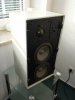
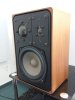
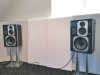
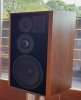
W 6,5"-8", M 2", T 0.75"-1" is a classic good configuration to make loudspeakers with quite smooth and wide directivity without needing to use waveguides, there were many German 1970s loudspeakers with such configuration which some of them I have and quite like in my vintage loudspeaker collection:

Braun L710.jpg braun-sm-1002.jpg Philips 587 MFB.jpg MB Quart 590 MCS.jpg

Few years ago I also designed my own 3-way passive closed baffle loudspeakers with 6,5", 2", 0,75" with Visaton drivers which measure and sound quite decently:
Thewas 3-way.png
 
https://www.soundstagenetwork.com/i...carbon-fiber-loudspeakers&catid=77&Itemid=153
It’s the new carbon fiber edition (ugly IMO), but it’s just the finish so the performance should be identical. MSRP of the original is $1000/pair, it’s on Amazon currently for ~$750/pair but I’ve seen lower.

Reminded, measurements are valid down to ~100Hz

0/15°/30° Horizontal:
fr_on1530.png

Not liking that dip @15kHz, but otherwise pretty good

45°/60°/70° Horizontal:
fr_456075.png

Not liking that retained energy @~3kHz, but otherwise very good. Can sound a bit bright, would suggest side-wall treatment.

Listening Window (0°, +/-15° H, +/-15° V):
fr_listeningwindow.png

Very good except the recessed energy @5kHz, but that’s from the vertical performance, but I think +/-15° vertically is too much for near-field, it’ll likely sound a bit more neutral.

THD (96dB @1m):
thd_90db.png

Very low (good)

My main grips is it‘s sensitivity is ~85dB and 4ohm, so not a first for home theater applications in a large-ish room.

Dip at 15 kHZ I'm definitely not worried about - in fact, it's impressive they maintain such wide directivity out to so high; few speakerz extend beyond 10kHz without a waveguide that would otherwise narrow the directivity. The benefits of using a 3 way design and a smaller than usual (3/4") tweeter. EDIT: Nope, they use a 1-inch tweeter. Even more impressive!

Looks like a great speaker, especially somewhere between 15-30 degrees off axis where the curve appears to be flattest.
 
Last edited:
At a glance they look like my measurements so that's good for all three of us (NHT, NRC, and me). :)

My listening window is flatter up top because it covers a wider horizontal angle (CEA-2034).

Someone wants to do a comparison, my measurements are here. Happy to send raw data too.

https://hometheaterhifi.com/reviews/speaker/bookshelf/nht-c3-bookshelf-speaker-review/

PS: Too bad they did this carbon fiber thing instead of listening to me and bringing back the old "sycamore" veneer from the Kantor era.
 
At a glance they look like my measurements so that's good for all three of us (NHT, NRC, and me). :)

My listening window is flatter up top because it covers a wider horizontal angle (CEA-2034).

Someone wants to do a comparison, my measurements are here. Happy to send raw data too.

https://hometheaterhifi.com/reviews/speaker/bookshelf/nht-c3-bookshelf-speaker-review/

PS: Too bad they did this carbon fiber thing instead of listening to me and bringing back the old "sycamore" veneer from the Kantor era.

Speaking of HomeTheaterHiFi measurements - is there a chance you re-measure Revel Performa M126Be as your colleague didn't really do it the right way?
 
W 6,5"-8", M 2", T 0.75"-1" is a classic good configuration to make loudspeakers with quite smooth and wide directivity without needing to use waveguides, there were many German 1970s loudspeakers with such configuration which some of them I have and quite like in my vintage loudspeaker collection:

View attachment 53939 View attachment 53940 View attachment 53941 View attachment 53945

Few years ago I also designed my own 3-way passive closed baffle loudspeakers with 6,5", 2", 0,75" with Visaton drivers which measure and sound quite decently:
View attachment 53946

Having followed this site for a while, it's pretty clear that an ideal system would consist of a 3 way bookshelf acoustic suspension speaker passive speaker ideally supplemented with a sub or subs depending on whether its a personal or room based system.

3 way will improve dispersion. Acoustic suspension eliminates midrange resonances from the use of ports and reduce group delay. Passive radiators do the same although at the expense of size and at least according to one source, some midrange resonance. It would be interesting to test some of these vintage 3 ways from an era where acoustic suspension was the norm. Good dispersion and flat frequency response are not new concepts. Toole's research only confirmed what many had suspected, that most people prefer speakers with good dispersion and frequency response.

It's easy to design a good speaker if you know what to aim for. Some changes don't really cost anything. For example, most speakers are vertically aligned drivers because it was found that this improved imaging. Previously, most speakers had drivers that were almost randomly placed.
 
Last edited:
Dip at 15 kHZ I'm definitely not worried about - in fact, it's impressive they maintain such wide directivity out to so high; few speakerz extend beyond 10kHz without a waveguide that would otherwise narrow the directivity. The benefits of using a 3 way design and a smaller than usual (3/4") tweeter.

Looks like a great speaker, especially somewhere between 15-30 degrees off axis where the curve appears to be flattest.

The C3 actually uses a 1" tweeter. The previous Classic Three used a 3/4" tweeter. I was very surprised that the C3 had wider dispersion over much of the treble than the Classic Three. Measurement comparison of both in my review - I used then and continue to use Classic Threes as rear speakers in the main system, so they were on hand.

NHT really undersells these speakers in their ad copy. Yes, they are more serviceable than Classic Three: separate midrange and tweeter faceplates - a good thing because those large foil midrange domes are fragile! However, they (IMO) measure considerably better and sound a little better too. I think they're a must listen in their price class.
 
Last edited:
Amazon regularly sells the standard version for $375 or so each and occasionally go lower (camel, camel camel is great for this). I’ve been super impressed with both on and off axis listening. There’s virtually no bad listening spot in my room. They do require a subwoofer though, even for music imo.
 
The C3 actually uses a 1" tweeter. The previous Classic Three used a 3/4" tweeter. I was very surprised that the C3 had wider dispersion over much of the treble than the Classic Three. Measurement comparison of both in my review - I used then and continue to use Classic Threes as rear speakers in the main system, so they were on hand.

NHT really undersells these speakers in their ad copy. Yes, they are more serviceable than Classic Three (separate midrange and tweeter faceplates - a good thing because those large foil midrange domes are fragile! However, they (IMO) measure considerably better and sound a little better too. I think they're a must listen in their price class.

Thanks for the correction! That is indeed even more impressive then.
 
The C3 actually uses a 1" tweeter. The previous Classic Three used a 3/4" tweeter. I was very surprised that the C3 had wider dispersion over much of the treble than the Classic Three.

A well-engineered phase shield does wonders.
 
I was lucky enough to get the C3 for US$255 apiece from Amazon the day after Black Friday last year. They replaced the Classic Three which I had been using since 2012 in my stereo setup.
 
  • Like
Reactions: SMc
I have had these speakers for a little over a year and find that my listening experience is consistent with the speaker's measured performance. I have the standard piano gloss black finish. IMO, the carbon fiber is not ugly but it is just not my cup of tea; I prefer the piano gloss black. Although there is no such thing as a perfectly accurate speaker, these come about as close as you will get. There was a suggestion above that these speakers can be a little bright. This has not been my experience. Interestingly, my previous speaker was a highly touted British brand that also had an aluminum dome tweeter. I found this speaker to be far brighter than the C3 and needed to install a resistor in place of the bi-wire jumper to keep the high end down to a tolerable level. This confirms the C3's flatness. The degree of brightness is also highly dependent on room acoustics and associated equipment. I do not find the C3 to be especially hard to drive, despite the 85db sensitivity rating. The 6 ohm impedance probably helps with this. However, I find that 100 watts per channel really make this loudspeaker sing. These are easy speakers to miss. Fortunately, I was familiar with NHT from back when we used to have a brick and mortar dealer here that sold them. I commend NHT for going against the grain and making a three-way acoustic suspension speaker with a flat frequency response, which is a rarity today.
 
Last edited:
I have the c3 for like a year. Sure they are very well detailed and the separation of sound is great. For some unknown reason i find them too analytical and sometimes boring to listen too. Maybe my denon 75-80 watts per channel isnt enough not sure. I find voices sometimes are hidden in the back of music and overall the mix of sound is bland and like i said too analytical. Im thinking of switching to totem rainmaker or emotivas and than totem hawk when i get the money. I dont find these speakers so musical but the quality of sound is really good nontheless. Wich the soundstage and immersion was better that's my complaint.
 
Back
Top Bottom