• Welcome to ASR. There are many reviews of audio hardware and expert members to help answer your questions. Click here to have your audio equipment measured for free!

New Neumann KH 310 II and KH 350 Rumors: Leaked Pricing & Info

I am currently looking for it, as far as I remember, a German website did the comparison before, I need to look deep for that. In worst case, comparing Anselm Goertz's max SPL measurements for Neumann and ATC can tell the story, however I want to find the direct comparison.


Let this be a placeholder until I find the real comparison.

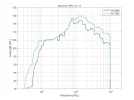
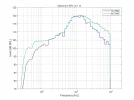
KH 420:

View attachment 556202
ATC SCM25:


View attachment 556203
Like you said, these are not comparable.

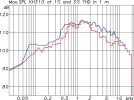
I posted a fuller set of S&R measurements for the ATC SCM25 and the KH310: https://www.audiosciencereview.com/...leaked-pricing-info.72465/page-6#post-2669027

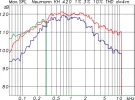
Here's a comparison using extraction of the max SPL plots. Even then, I don't think there's enough evidence because of the difference in use to be very firm in an opinion.
1788440058081.png

  • KH310: Sealed, 25cm x 38cm x 29cm, 13kg, 25mm tweeter, 75mm midrange, 210mm woofer, crossover points 650Hz & 2kHz
  • SCM25: Ported, 26cm x 43cm x 37cm, 25kg, 25mm tweeter, 75mm midrange, 164mm woofer, crossover points 380Hz & 3.5kHz

Edit: To be clear, in this post I'm talking about having a firm opinion of the midrange drivers in isolation, not the speakers. And honestly the speakers and the end result are much more important, and there Neumann is a clear winner.
 
Last edited:
Why would someone get the idea to compare the performance of a mid-dome driver in a 25-liter cabinet (ATC SCM25) to that of a mid-dome driver in a 45- to 55-liter cabinet (Neumann KH420)?

A measurement comparison of driver performance should obviously be done with the same external factors, or at least in similarly sized cabinets if real-life speaker performance is part of the comparison.
True. But those same Sound&Recording measurements also exist for the KH310, which is very comparable in all regards. @Curvature linked them just above.
 
Well that wasn't my impression from the ASR review
View attachment 556363
This is the ASR data in an interactive chart with thr speaker in a vertical orientation: https://www.spinorama.org/speakers/Genelec 8351B/ASR/asr-vertical/SPL Horizontal Contour.html

Horizontal orientation (so a wider baffle): https://www.spinorama.org/speakers/Genelec 8351B/ASR/asr-horizontal/SPL Horizontal Contour.html

It depends which trace you use to get to the beamwidth angle. Genelec uses smoothing and averaging in their graphs. Unless we have Amir or Erin measure the W371A, we won't know in detail what the directivity looks like. Ideally it would look like Ascilab's all the way down to the low bass using the -6dB trace.

 
Last edited:
This is the ASR data in an interactive chart with thr speaker in a vertical orientation: https://www.spinorama.org/speakers/Genelec 8351B/ASR/asr-vertical/SPL Horizontal Contour.html

Horizontal orientation (so a wider baffle): https://www.spinorama.org/speakers/Genelec 8351B/ASR/asr-horizontal/SPL Horizontal Contour.html

It depends which trace you use to get to the beamwidth angle. Genelec uses smoothing and averaging in their graphs. Unless we have Amir or Erin measure the W371A, we won't know in detail what the directivity looks like. Ideally it would look like Ascilab's all the way down to the low bass using the -6dB trace.

That's why I'd love to see a measurement of the system w371+8351b under different modes but I reckon that's not gonna happen :(
 
Last edited:
Not sure if i read the diagrams correctly, but it seems the 310 II has similar distortion in deep bass to the 310 (upper bass looks better though), and the 350 is similar to the 420. That confirms the suspicion that the 350 is more like a smaller and more modern 420.

1789045041811.png


1789044955276.png


1789044976984.png


1789045212973.png
 
Those isobars are beautiful.


350 hor.webp
350 ver.webp

Zz05OWYyMzdjZWRjMTIxMWYwOGIzZDRhNTkxYzY4NDNkNQ==.webpkh310 2.webp

Decent gain in SPL capability but nothing much in the sub bass range for the KH310 II. Might be even worse, but also possibly different measurement conditions.

kh350.webpkh 420.webp

KH 420 still significantly better, but KH350 plenty decent.
 
Last edited:
The crossover points are downright odd. Why restrict the mid to barely over an octave of bandwidth when it's arguably the best performing driver on the entire speaker?
 
The crossover points are downright odd. Why restrict the mid to barely over an octave of bandwidth when it's arguably the best performing driver on the entire speaker?
My guess is to get both directivities as perfect as this which is almost impossible for a non-coaxial 3-way design of such a size. I can fully understand your question as I am also a big fan of midrange domes but on the other hand I applause their approach to ignore in this case subjective intuitions and base their design purely on objective criteria, i.e. measurement data. Also the harmonic distortion data show also very values for the other two drivers, still would have been fun for us to compare it with a more conventional crossover tuning approach regarding all objective metrics like directivity and distortions (also multitone).
 
The crossover points are downright odd. Why restrict the mid to barely over an octave of bandwidth when it's arguably the best performing driver on the entire speaker?
Are xover points much different than their existing 3-ways? Maybe Neumann know stuff about their products we don’t?
 
Wondering if i should step up from current 310a/750/ma1 2.2 system to 350/870II 2.2. It could be a lot better in terms of SPL and should cost way more.
 
Are xover points much different than their existing 3-ways?
Yes. KH420 is 570/2000, KH310A is 650/2000. We've gone from almost 2 octaves to barely over 1.
My guess is to get both directivities as perfect as this which is almost impossible for a non-coaxial 3-way design of such a size.
I get that on the mid to tweeter, but why on the bottom end? It seems like an odd choice to have the woofer do more of the midrange when the biggest audible problem on the 310A was the woofer modulating the mids at even pretty moderate levels. Besides that we know the 3" mid is plenty capable of crossing around 500hz, I've seen DIYers do it with an ATC-style flange/WG on this driver with no appreciable distortion. The 350 has a big 420-style WG too, so it's not like it lost sensitivity down there...
 
I get that on the mid to tweeter, but why on the bottom end? It seems like an odd choice to have the woofer do more of the midrange when the biggest audible problem on the 310A was the woofer modulating the mids at even pretty moderate levels. Besides that we know the 3" mid is plenty capable of crossing around 500hz, I've seen DIYers do it with an ATC-style flange/WG on this driver with no appreciable distortion.
Well, the change isn't really big from 650 Hz (KH 310) or 570 Hz (KH 420) to 700 Hz and going significantly lower would compromise the SPL limit compared to the woofer without any real advantages like improved directivities. The way I know Markus Wolff he really considered every option, for example in the the times before acoustic fluid simulation he used to manufacture and measure more than 100 waveguide shapes for one loudspeaker.(!)
 
Well, the change isn't really big from 650 Hz (KH 310) or 570 Hz (KH 420) to 700 Hz and going significantly lower would compromise the SPL limit compared to the woofer without any real advantages like improved directivities. The way I know Markus Wolff he really considered every option, for example in the the times before acoustic fluid simulation he used to manufacture and measure more than 100 waveguide shapes for one loudspeaker.(!)
570 to 700 is quite a bit, it's from between C#5 and D5 to about F5, so between a major 3rd and a diminished 4th so a bit more than 1/3 octave. 650 to 700 isn't much.

I don't doubt that this was intentional, it just strikes me as odd to use arguably their best driver basically as a filler rather than for a wider band. And, again, the issue is not HD, all the drivers are very high performance in that regard.
 
Back
Top Bottom