• Welcome to ASR. There are many reviews of audio hardware and expert members to help answer your questions. Click here to have your audio equipment measured for free!

New Headphone Measurement Database by The Headphone Show

I have multiple headphones and multiple IEMs and use them daily in rotation. From my personal experience, having tried Oratory1990 EQ settings on all my headphones, they don't have consistent results on every headphone. I found that I'm happy with maybe 60%-70% of the results using the recommended settings, the remaining headphones end up too shouty in the ear gain region.
For the last week I have been using the headphones.com Graphworks system EQ that displays the measurements from 5128 or Gras 43AG-7 and the preference bounds, and I have had really good results. The one I just finished tweaking is my ATH-R50x from Audio Technica, and that one needs quite a bit of attenuation in the 3-5kHz region to sound natural. Oratory1990 Harman target EQ does not really address that part of the spectrum and it actually has a small boost at 3kHz.
On the other hand I'm really happy with the Oratory1990 EQ for the R50x's big brother, ATH-R70xa and the HiFiman HE400SE. Those two sound right with the recommended settings.

The headphones.com preference bounds provide a good resource for tuning by ear. It's a good confidence check and the EQ provides nice tools for multiple instant reference checks.
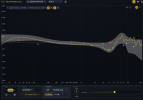
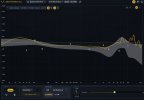
Attached are two screen shots. Gras 43AG-7 measurement of the ATH-R50x with Oratory EQ and the same measurement after a few rounds of tuning it by ear, using sweeping tones, pink noise and music. You can see where the biggest discrepancy is.
 

Attachments

  • r50x Oratory EQ.png
    r50x Oratory EQ.png
    391 KB · Views: 72
  • R50x By Ear.png
    R50x By Ear.png
    385.6 KB · Views: 74
I am always a little confused when you or others imply there is something new or invented for the preference bounds.
I am also a little confused that you can't even follow the conversation no matter how many times I have mentioned. You claimed that 5128 has useful target. 5128 does not. No listening test has determined a desirable target for it. Taking some random one that hp.com invented, and then adding bounds to it is the dictionary definition of house of cards.

You could also object to DF compensation, but that is done just to make measurements from different rigs more comparable.
No diffused target on any fixture has been shown to be remotely preferred. Messing with it as hp.com has done to get it to do so resulted in very poor ratings as I showed before:

index.php
 
You claimed that 5128 has useful target. 5128 does not.
I didn't make this claim.

All I am saying is, you can measure the preferred sounds in the Harman research on 5128 to see what they look like on 5128. This is useful for contextualizing the measurements of other headphones on the 5128. This does not mean we now have a single defined preference target for 5128. Per the Olive & Clark study, there indeed might be no such target possible for the 5128. I understand that.
No diffused target on any fixture has been shown to be remotely preferred.
This is also a complete misreading of what I am saying and what HP.com is doing in the new article. The measurements are being DF compensated for presentational and cross-rig comparison purposes, and the compensation can be undone. This has nothing to do with using DF as a neutral/preference target.
 
I'm really conflicted with this whole thread. The consumer in me appreciates and has benefited from HP/IEM reviews using the various Harman targets. I generally agree with that standardization mission. There are debatable pros and cons to how much of the work in that mission remains behind the scenes, confined to industry and academia, or is visible and directly promoted to consumers in order to drive monopolization via market demand. I perceive Amir's actions to be consistent with the latter category, and whether or not he realizes or even accepts it, he becomes a de facto spokesperson for that mission and for that standardized product. However, If I had any "ownership" in this mission, I would not want it promoted this way.

If the goal is educating average consumers, I would have preferred to see one comprehensive statement dismissing the methodology, industrial applicability, business affiliation, etc., and leave it there. Only refer back to the statement or add minor clarifications. Please no petty squabbling, multiple posts of point-by-point retorts, an evident desperation to win every inch of battlefield. I simply don't see how this approach furthers the mission. Instead, it gives oxygen to doubt or dilution of the standard you seek.
Understandable, I am (obviously) not Amir but I did try to answer a few questions here.:)
At Harman the curves they ended up with were seen as close enough.
The question became how to deal with frequency differences due to leakage and ear coupling, how to best add tone controls to account for individual preference and so on.

The preference reference is what sounds good to most people and while it is not the last word in what sounds good for everyone on every recording, It is a great reference for comparing relative difference between headphones.

If headphone.com thinks they know a better way to compare headphones they don't just get to say that, at that point the burden of proof lies with them.

Removing my own opinions from my previous post we get this, these are the facts as I understand them.
I see your point and I partially agree but If stating that once was enough we wouldn't have a 40 page discussion. ;)

For me personally, I shared my thoughts here to have them challenged and @listener650 did the same.
I can respect that and still disagree! :D

I think at the end of the day most people will only look at the reviews but I do appreciate all my interactions in this thread.
 
Last edited:
All I am saying is, you can measure the preferred sounds in the Harman research on 5128 to see what they look like on 5128.
One...more...time... There is no research from Harman to use on 5128. Limited testing was performed last year with a target they created, not hp.com, that did not show reliable listener preference.

Delete the word Harman and Research and you get that.

This is useful for contextualizing the measurements of other headphones on the 5128.
No. You have measurements with no way to interpret them. One shows more highs than the other. Which is right? You don't know. Both could be wrong. One or the other could be right. Just having measurements that are not correlated with listening tests is useless.

The measurements are being DF compensated for presentational and cross-rig comparison purposes, and the compensation can be undone.
Which has not been shown to be correct. Harman produced its own method in 2025 study, with mixed results. They, unlike hp.com, tried to find the target efficacy with listening tests.

It is entirely possible that no good target can be found for 5128.
 
If the goal is educating average consumers, I would have preferred to see one comprehensive statement dismissing the methodology, industrial applicability, business affiliation, etc., and leave it there.
Average consumer has not read or understood a word of the missive hp.com folks wrote. They may however, as you have been, able to deduce my much simpler/logical stance.

Only refer back to the statement or add minor clarifications. Please no petty squabbling, multiple posts of point-by-point retorts, an evident desperation to win every inch of battlefield. I simply don't see how this approach furthers the mission. Instead, it gives oxygen to doubt or dilution of the standard you seek.
Don't see how one has anything to do with the other.

Standardization is coming in the form of me continue to respect research, and referencing headphone and IEMs against a single target. As I have said, this has influenced the market, especially in the IEM world. With our strong influence in the market, I expect this to continue.

What gets discussed in this specialized thread only appeals to diehard headphone/IEM measurement folks. Not the broader market.
 
Just having measurements that are not correlated with listening tests is useless.
That's where MIRE could come in handy ... for each person individually... if done correctly with proper calibration.
Then at least the 'measurement' is related to those exact ears and headphone in the 'use conditions' to a set 'target'.
And from there on preferences can be added on top of the EQ to taste or 'recording tonality'.
Only for the die-hards I reckon.

The rest should just buy a headphone they like (in sound, fit, finish and use case).

Having multiple standards/targets is confusing for the public (the non-initiated that understand what measurements/targets/standards really mean).

The good thing is that when one finds measurements and targets that seem to correlate best (better than) other standards I think it is a good thing for that person to look at those.
 
From my personal experience, having tried Oratory1990 EQ settings on all my headphones, they don't have consistent results on every headphone.
This is one of the main reasons I like to have as many good quality eq options as possible for a product I buy.

For example, I tend to buy products that have been ideally covered by all of Oratory, Rtings, Toneboosters Morphit and Amir. Then, as a last resort, in case I somehow don’t settle for any of the ones I listed already, or just to experiment, I’d also like the product to be covered in peqdb.com and/or squiglink.

My Sundara, hd560s, Crin Zero have peq profiles by all or most of them, and with effectdeck or pragmaticaudio peq on ios, I can easily switch between all these profiles and enjoy them on my iphone. No manual eq guesswork needed, just a lot of listening fun with many different tunings.

I’d like to see a service that offers as many target curve eqs and eq ideas as possible for headphones and iems. Not just harman and a few other popular ones. That would be a very useful tool to me.
 
That's the thing though.... Suppose one has 4 'test fixture results' where EQ is going to be based on.
Multiply that by 5 different 'targets' and you have 20 (somewhat) different sounding options.
ALL of these are potentially incorrect on your head in a technical sense but 1, 2 or 3 of them might actually sound 'best' to you on certain recordings.

In the latter case your ears/taste becomes the deciding factor but all 20 options are potentially correct to a fixture + a target.

Confounding factors are that whatever 'good sounding' option you found on headphone A may not be what you prefer for headphone B.
Then there is the problem of substantial varying tonality in recordings. Simple tone control usually works wonders.
One can wonder who and with what monitoring that recording came to be.
You're making it sound like it's impossible to get a sound you like without manually adjusting for yourself or for the particular music and I for one simply don't believe that is completely true. You might need to adjust to get the absolute best possible sound for yourself, but not to get a good sound out of it that is almost there, close enough that you could just live with it that way.

Without being able to prove this, I think humans are more similar than dissimilar, including in hearing. If you take oratory + rting + morphit + amir's you have 9 different curves over 11 profiles and just that is usually enough for me to find something I like well enough to live with without needing to change anything on it.

But even 4 fixtures x 5 targets = 20 eq profiles sounds good to me. Where the same fixture is used and there are multiple measurements, I like to average them before eqing, if I can, like peqdb.com allows you to do, and make it easier on myself by reducing the number of profiles. Ultimately I'll just go through all of them and find the one or ones I like most in most scenarios and that's the most I can hope for and that works for me.

Proof that this works for me is here: https://www.audiosciencereview.com/...shootout-on-an-iphone-using-effectdeck.74150/ - Aizu was the curve/profile I preferred on my hd560s and I don't feel like I need to make any changes to the profile so far. Point is having options, good ones, increases one's chance of finding a curve/tuning/profile that just works on your headphone that you like or even more than one. If it works for me, maybe it works for others...

Maybe my point here is really, don't chase perfection as it does not exist and maybe good enough is the most that can be achieved in most people's cases like myself.
 
Last edited:
You're making it sound like it's impossible to get a sound you like without manually adjusting for yourself or for the particular music and I for one simply don't believe that is completely true.
The intention was to argue that it may take different combinations of fixture/target plots to find an EQ that is 'optimal' to the listener (where the plots seem to confirm what one perceives).
Not that it is impossible nor that the targets are far away (other than the Harman boost vs no boost).

In the end hearing between people is not very dissimilar BUT how headphones sound on your head can be (depending on quite a few factors).
The issue is the correlation between plots and how someone perceives the headphone.
This is basically what the whole discussion is about... How well does your perception of 'accurate' translate to one of the (in my example 20) EQ'ed plots.

Which headphone sounds like which plot when EQ'ed to a certain target on a certain fixture or in-ear mic.

This is a different discussion from a target that manufacturers want to approximate by tuning drivers/pads/porting/design.
 
Last edited:
I am always a little confused when you or others imply there is something new or invented for the preference bounds. If you EQ the K712Pro to the various headphones and the Harman target on Welti ears, you get "the actual sounds that the testers heard", because that is what Harman research did. These sounds themselves stay the same wherever you measure them. Then you could measure the most preferred of those sounds according to Harman research on any other rig and say that the measurements delineate an area where actually preferred sound profiles are likely to fall on that rig. If you object to the idea of preference bounds, then still the effort up to "measuring the same preferred sounds on a different rig" should still be a useful thing to do, as that lets you know "what preferred sound profiles look like on a different rig".
This is a hypothesis, not a conclusive study. You can hypothesize all day long but ultimately you need to do testing to either confirm or deny said theory. This is the basic scientific method.

I appreciate HP.com taking so much interest in this topic but you can't just throw around unconfirmed theories to the average headphone user and expect them to interpret them properly. IMO, HP.com have lost sight of their audience due to being so grossly involved in this theorising.

Know your audience. And remember that the scientific method needs to be followed.
 
One...more...time... There is no research from Harman to use on 5128. Limited testing was performed last year with a target they created, not hp.com, that did not show reliable listener preference.

Delete the word Harman and Research and you get that.


No. You have measurements with no way to interpret them. One shows more highs than the other. Which is right? You don't know. Both could be wrong. One or the other could be right. Just having measurements that are not correlated with listening tests is useless.


Which has not been shown to be correct. Harman produced its own method in 2025 study, with mixed results. They, unlike hp.com, tried to find the target efficacy with listening tests.

It is entirely possible that no good target can be found for 5128.
Harman tested EQed headphones on people and found out which ones the people preferred. These preferred EQed headphones sound the same on whatever rig you measure them. You can first replicate the sound profiles with the original rig, and you can then measure them on new rigs. These are the same preferred actual sounds, just captured by different rigs. And then you know "what the preferred sounds look like on the new rig".

The measurements literally ARE correlated with listening tests, because they are measurements of sound profiles replicated with the original rig that are known to be preferred in the Harman research. Again, the sound profiles replicated with the original rig themselves don't change just because you measure them on a different rig.

This is so straightforward and maybe you should not let prejudice guide you in how you think about it. It is like Harman found out which cars are the fastest. Then HP.com installs a new speedometer with messed up numbers on the fastest cars to see what readings the new speedometer gives for the fastest cars, to calibrate the speedometer for future readings. This calibration does not rely on the original study using the new speedometer. It just relies on the new study using the same cars as the original one.

The 2025 study shows that there might not be a single preference target for 5128, that I fully understand, I literally said so in the last reply. But you misunderstood the use of DF by HP.com in the new article. IT IS NOT USED AS A PREFERENCE/NEUTRAL TARGET. It is just used as compensation for data visualization, and can be trivially undone. I don't think the 2025 study says anything about data visualization techniques.
 
This is a hypothesis, not a conclusive study. You can hypothesize all day long but ultimately you need to do testing to either confirm or deny said theory. This is the basic scientific method.

I appreciate HP.com taking so much interest in this topic but you can't just throw around unconfirmed theories to the average headphone user and expect them to interpret them properly. IMO, HP.com have lost sight of their audience due to being so grossly involved in this theorising.

Know your audience. And remember that the scientific method needs to be followed.
That is not a hypothesis if you really understand the procedure performed.

The object to calibrate is the new rig, not a new preference target. They measure the exact same preferred sounds replicated with the original rig on the new rig. This tells us something about how the new rig responds to the most preferred sounds, because the measured things physically stay constant (K712PRO EQed to the same profiles on the same rig) between the studies.

Take my analogy that I used to reply to Amir:
It is like Harman found out which cars are the fastest. Then HP.com installs a new speedometer with messed up numbers on the fastest cars to see what readings the new speedometer gives for the fastest cars, to calibrate the speedometer for future readings. This calibration does not rely on the original study using the new speedometer. It just relies on the new study using the same cars as the original one.
This act of calibrating the new speedometer does not raise any new hypothesis.
 
Harman tested EQed headphones on people and found out which ones the people preferred. These preferred EQed headphones sound the same on whatever rig you measure them.
There is no such thing as "sound the same" in a measurement. Measurement is just pure data. If you mean that each fixture records the same thing from its microphone, this is flat wrong.
You can first replicate the sound profiles with the original rig, and you can then measure them on new rigs. These are the same preferred actual sounds, just captured by different rigs. And then you know "what the preferred sounds look like on the new rig".
You do not because different headphones produce differing measurements on each fixture deviating from a linear transform. This is why preference was different for curves created using this method in Harman 2025 research.

By your notion, I could just get rid of the fixture and use a paper cup and a $2 microphone to get my target.

The measurements literally ARE correlated with listening tests, because they are measurements of sound profiles replicated with the original rig that are known to be preferred in the Harman research. Again, the sound profiles replicated with the original rig themselves don't change just because you measure them on a different rig.
That is lay intuition that has been shown to be wrong. Once more:
1793822296277.png


The only targets that worked were the ones for the very same headphone. The others showed varied efficacy especially for 5128 averaged over a number of headphones. If what you said was right, they would all match the Welti ratings on the right.

This is so straightforward and maybe you should not let prejudice guide you in how you think about it. It is like Harman found out which cars are the fastest. Then HP.com installs a new speedometer with messed up numbers on the fastest cars to see what readings the new speedometer gives for the fastest cars, to calibrate the speedometer for future readings.
That's how the physics works. Each fixture has its own shape, pinna, inner canal and microphone. All of these acoustically interact in the small chamber with the headphone/IEM. We are not talking about a simple, one dimensional sensor like a speedometer. This is acoustics with three dimensions plus time.

The 2025 study shows that there might not be a single preference target for 5128, that I fully understand, I literally said so in the last reply. But you misunderstood the use of DF by HP.com in the new article. IT IS NOT USED AS A PREFERENCE/NEUTRAL TARGET. It is just used as compensation for data visualization, and can be trivially undone. I don't think the 2025 study says anything about data visualization techniques.
It doesn't matter. The diffused field measurements still rely on acoustic properties of the fixture. Using diffused field vs CHIRP signals doesn't mean you get magical properties where you can certify a new fixture as always having the same differential as another fixture. It is preposterous that you keep claiming this.
 
That is not a hypothesis if you really understand the procedure performed.

The object to calibrate is the new rig, not a new preference target. They measure the exact same preferred sounds replicated with the original rig on the new rig. This tells us something about how the new rig responds to the most preferred sounds, because the measured things physically stay constant (K712PRO EQed to the same profiles on the same rig) between the studies.

Take my analogy that I used to reply to Amir:

This act of calibrating the new speedometer does not raise any new hypothesis.
I'm aware of how this works. Sean Olive even did a similar study with IEMs on the 5128 where he translated the Harman IE 2019 target to the 5128 based on measurements of I think 11 IEMs to get an average error curve vs. the GRAS RA0045. The difference is, Sean actually performed a blind listening test with this translated target to confirm his translation was at least somewhat correct. Only then could he confidently present that data (vs. The HP.com IE targets no less).
 
The object to calibrate is the new rig, not a new preference target. They measure the exact same preferred sounds replicated with the original rig on the new rig. This tells us something about how the new rig responds to the most preferred sounds, because the measured things physically stay constant (K712PRO EQed to the same profiles on the same rig) between the studies.
Oh? It is not a preference target but informs you about preferred sound?

The object to calibrate is the new rig, not a new preference target.
No, the object is to get to a new preference target with a new fixture. There is no other goal that matters. We don't measure because we want to pass the time. We want to produce measurements whose results have been correlated with listening tests.
 
There is no such thing as "sound the same" in a measurement. Measurement is just pure data. If you mean that each fixture records the same thing from its microphone, this is flat wrong.
Or I should say, the same headphone EQ'ed to the same target on the same rig, is the same physical/sonic object. You measuring the same physical object with different instruments. That reveals the differences between the instruments. And we are interested in these differences.
By your notion, I could just get rid of the fixture and use a paper cup and a $2 microphone to get my target.
If all you have is a paper cup and $2 mic, doing that procedure still makes the setup more useful. It doesn't automatically give you verified predictive power, but you have some reference as to what the actually good look like on your setup.
If what you said was right, they would all match the Welti ratings on the right.
Not sure what I said would imply this. "knowing what the actually preferred sounds measure like on the 5128" is weaker than "knowing that whatever headphone that measures like this is going to be preferred", and the latter is what you need to draw this inference.
Oh? It is not a preference target but informs you about preferred sound?
informs us about how the rig responds to the actually preferred sounds, not how preferred a sound will be given any measurement on the rig. So indeed this is not a preference target or predictive preference bounds.

We can look at what HP.com says in the new article:
The goal with our new Preference Bounds is instead to take the listener preference data Harman collected seriously enough to preserve its context, and give people a full understanding of the title. We want to show our audience “what headphone sound profiles people like,” in the format they’ve come to expect from us.
Indeed nothing is claimed about predicting preference. Instead, it is just showing, "what the actually preferred sounds (as tested in Harman research) look like on new rigs".

No, the object is to get to a new preference target with a new fixture. There is no other goal that matters. We don't measure because we want to pass the time. We want to produce measurements whose results have been correlated with listening tests.
That is the real critique. We might say what we need is predictive power but doing this translation/calibration does not give us that. HP.com agrees too:
Some may argue that porting the 2018 filter transfer functions onto modern 5128 and GRAS fixtures is an interim step until new double-blind tests are conducted natively on these rigs, and we agree.
 
I'm aware of how this works. Sean Olive even did a similar study with IEMs on the 5128 where he translated the Harman IE 2019 target to the 5128 based on measurements of I think 11 IEMs to get an average error curve vs. the GRAS RA0045. The difference is, Sean actually performed a blind listening test with this translated target to confirm his translation was at least somewhat correct. Only then could he confidently present that data (vs. The HP.com IE targets no less).
If the state goal is to have a new predictive target curve, then what you are saying is true. But the stated goal is less ambitious than that. Quoting HP.com directly,
The goal with our new Preference Bounds is instead to take the listener preference data Harman collected seriously enough to preserve its context, and give people a full understanding of the title. We want to show our audience “what headphone sound profiles people like,” in the format they’ve come to expect from us.
So it is what I have been saying, the procedure "shows what the actually preferred sounds look like on the new rig".
 
If the state goal is to have a new predictive target curve, then what you are saying is true. But the stated goal is less ambitious than that. Quoting HP.com directly,

So it is what I have been saying, the procedure "shows what the actually preferred sounds look like on the new rig".
If the 2018 Harman study used a replicator headphone EQ'd to the response of these 4 preferred headphones, then you can only say that the preference bounds those headphones' frequency responses create are valid for the rig they were measured on. To extrapolate this to other measurement fixtures - especially the 5128 - ignores the HpTF which Listener himself was advocating for before this whole new "preference bounds" article came out.

We know that HpTF exists and therefore that a given headphone will not produce a linear translation from one measurement rig (or human) to another. Even the IEM error curve Sean Olive made for the 5128 isn't perfect because it only included DD and DD/BA hybrids, no all BA, EST, or planars. If we know this, how can we even begin to extrapolate preference bounds to a completely different measurement system with zero confirmation of the results?
 
Back
Top Bottom