
-
Welcome to ASR. There are many reviews of audio hardware and expert members to help answer your questions. Click here to have your audio equipment measured for free!
- Forums
- Audio, Audio, Audio!
- Amplifiers, Phono preamp, and Analog Audio Review
- Stereo and Multichannel Amplifier Reviews
You are using an out of date browser. It may not display this or other websites correctly.
You should upgrade or use an alternative browser.
You should upgrade or use an alternative browser.
"Musmys" E-406 clone amp, a HiFi newbie's review =)
- Thread starter khaliss
- Start date
The output stage is definitely bipolar, not MOSFET: the devices/PCB markings indicate NJW0281/NJW0302 complementary BJTs, with what appears to be six output pairs per channel / 24 output transistors total.
There is also a lot of local power-supply decoupling on each channel, including multiple 1000 µF / 63 V capacitors, alongside the huge central reservoir capacitor assemblies and a very large toroidal transformer. The PSU board uses substantial bridge rectifiers, power resistors and relay-based soft-start circuitry.
Still hard to tell if its heavily built or actually well engineered.
It's going to be a bitch to put back together.
zenon
Member
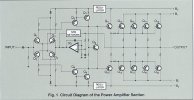
This is what the simplified schematic diagram of the Accuphase E-406 looks like.
Based on the photos provided by Discharge (whom I thank for them), one cannot draw a definitive conclusion that the unit is actually an Accuphase E-406 - unless the servo section is located on the underside of the circuit boards (where it isn't visible).
If I am right, the Chinese are once again slapping whatever names they please onto whatever products they please.
But if it brings pleasure to hobbyists, it makes no difference whether it’s an Accuphase clone or something else... It’s just that I’m a bit of an electronics geek - in addition to being a music lover - so this need to dig into the details is really just my own personal quirk
Attachments
OP

khaliss
Active Member
- Thread Starter
- #165
The output stage is definitely bipolar, not MOSFET: the devices/PCB markings indicate NJW0281/NJW0302 complementary BJTs, with what appears to be six output pairs per channel / 24 output transistors total.
There is also a lot of local power-supply decoupling on each channel, including multiple 1000 µF / 63 V capacitors, alongside the huge central reservoir capacitor assemblies and a very large toroidal transformer. The PSU board uses substantial bridge rectifiers, power resistors and relay-based soft-start circuitry.
Still hard to tell if its heavily built or actually well engineered.
It's going to be a bitch to put back together.
Thanks for sharing this... I have a BS degree in computer & electronics engineering, but that was ages ago and we didn't really touch on audio componentry/circuitry... so the terminologies & concepts being mentioned on this thread is out of my league LOL. But from the sound of it (& with some reading online), these are very good positives... given the level of hardware that was put in versus the priced we paid for this particular amp... & more importantly, the power & fidelity of the sound it reproduces (albeit I've only compared it to Emotiva BasX A1 monoblocks & Yamaha AS701 integrated, which are roughly in the same price range).
If it's giving me ~70% of what a real Accuphase amp (and spent 1/10th of the price) can output, then I think that's a pretty good tradeoff =)
Last edited:

This is what the simplified schematic diagram of the Accuphase E-406 looks like.
Based on the photos provided by Discharge (whom I thank for them), one cannot draw a definitive conclusion that the unit is actually an Accuphase E-406 - unless the servo section is located on the underside of the circuit boards (where it isn't visible).
If I am right, the Chinese are once again slapping whatever names they please onto whatever products they please.
But if it brings pleasure to hobbyists, it makes no difference whether it’s an Accuphase clone or something else... It’s just that I’m a bit of an electronics geek - in addition to being a music lover - so this need to dig into the details is really just my own personal quirk
The Accuphase E series are all integrated amps, whereas this is a power amplifier. I've never opened my E-306v and it'd look quite different anyhow, so personally can't draw any conclusions (other than my repeatedly voiced dislike of design piracy :-D).
OP
khaliss
Active Member
- Thread Starter
- #167
Thanks for the schematic diagram on the power amp section of the original Accuphase design. I had AI look at the schematic you posted of the original Accuphase E406 power amp section and compare it to what we've seen on the Musmys E406 just by visual inspection so far:Based on the photos provided by Discharge (whom I thank for them), one cannot draw a definitive conclusion that the unit is actually an Accuphase E-406 - unless the servo section is located on the underside of the circuit boards (where it isn't visible).
If I am right, the Chinese are once again slapping whatever names they please onto whatever products they please.
But if it brings pleasure to hobbyists, it makes no difference whether it’s an Accuphase clone or something else... It’s just that I’m a bit of an electronics geek - in addition to being a music lover - so this need to dig into the details is really just my own personal quirk
- Output Stage Density: The original Accuphase power section uses a heavy multi-pair push-pull BJT setup—5 parallel pairs per channel as shown on the diagram. So Musmys running 6 parallel Onsemi pairs per channel (24 devices total across the chassis) is actually sticking pretty close to that same high-current, low-impedance drive strategy rather than stripping it down to save costs(?)
- Front-End & DC Servo: The real Accuphase runs a dual-rail power supply setup along with an active op-amp DC servo injected back into the differential input stage to lock DC offset

fpitas
Grand Contributor
It does seem worth the money, even if you have to tinker with it to get great performance.the re
Thanks for the schematic diagram on the power amp section of the original Accuphase design. I had AI look at the schematic you posted of the original Accuphase E406 power amp section and compare it to what we've seen on the Musmys E406 just by visual inspection so far:
It’s clear the Musmys isn't a 1:1 trace or a direct "clone" in the strictest sense—especially given the massive difference in main reservoir capacitance and PSU board layout—but architecturally, it’s definitely taking heavy inspiration from the Accuphase parallel-BJT blueprint rather than just being a generic, off-the-shelf eBay amp circuit in a fancy chassis.
- Output Stage Density: The original Accuphase power section uses a heavy multi-pair push-pull BJT setup—5 parallel pairs per channel as shown on the diagram. So Musmys running 6 parallel Onsemi pairs per channel (24 devices total across the chassis) is actually sticking pretty close to that same high-current, low-impedance drive strategy rather than stripping it down to save costs(?)
- Front-End & DC Servo: The real Accuphase runs a dual-rail power supply setup along with an active op-amp DC servo injected back into the differential input stage to lock DC offset
OP
khaliss
Active Member
- Thread Starter
- #170
personally, I don't feel the need to tinker with it... it already sounds great to my ears, given what I paid for my setup, I'm just happy to sit back & enjoy! If at some point in the future I'm no longer satisfied, then I'm buying a real Accuphase (if I have the money for it then, LOL)It does seem worth the money, even if you have to tinker with it to get great performance.
One thing I’ve noticed in actual use is that the E406 feels extremely sensitive in my system. With the R26 feeding the C-2860+, I can barely use much of the preamp’s volume range unless I engage the R26’s -30 dB attenuator.
Looking at the published specs, that may be more about overall gain structure than the E406 alone.
The R26 can output around 5 Vrms balanced. The C-2860+ is specified at roughly 250 mV input sensitivity for 2 V output, which implies around 18 dB of preamp gain, and the E406 is claimed to have another 28 dB of gain.
That gives roughly 46 dB of analogue gain after a source that can already output 5 Vrms.
If the E406 really has 28 dB gain, 180 W into 8 ohm would require about 1.5 Vrms at its input. With ~18 dB of gain from the preamp, the C-2860+ only needs around 0.19 Vrms at its input to drive the power amp to rated output.
So a 5 vrms DAC is massively more than is actually required. The preamp volume control therefore has to throw away nearly 30 dB before you even get down to the level corresponding to full amplifier output, never mind normal listening levels.
Interestingly, the R26’s -30 dB attenuation almost perfectly fixes that mismatch. With it engaged, 5 Vrms becomes about 0.16 Vrms, which puts the whole system into a much more sensible gain range and makes the C-2860+ volume control far more usable.
There is still an unresolved issue with the E406 specs themselves: MUSMYS claims both 28 dB gain and 0.87 V sensitivity for rated output, but those figures don’t agree mathematically. At 180 W/8 ohm, 28 dB gain implies roughly 1.5 V sensitivity, whereas 0.87 V would imply about 32.8 dB gain.
So the E406 may still turn out to have higher gain than advertised, but my experience with the volume control doesn’t prove that by itself. The system already has far too much gain simply from combining a 5 Vrms DAC, an active preamp with significant gain, and a conventional power amp.
So it seems the C2860+ is innocent after all and not faulty...

Chr1
Major Contributor
- Joined
- Jul 21, 2018
- Messages
- 2,925
- Likes
- 3,091
I am definitely no electrical engineer, but I would question whether anyone nowadays would choose to copy a bad circuit design.
I very much doubt that these amplifiers will measure as well as modern SOTA Class Ds. Or the AHB2. However I don't think that they should be written off simply for appearing similar to an Accuphase. Again, my 2c.
I very much doubt that these amplifiers will measure as well as modern SOTA Class Ds. Or the AHB2. However I don't think that they should be written off simply for appearing similar to an Accuphase. Again, my 2c.
fpitas
Grand Contributor
Probably not. Nostalgia, is my guess.I very much doubt that these amplifiers will measure as well as modern SOTA Class Ds. Or the AHB2.
fpitas
Grand Contributor
They're definitely cool-looking in the old-fashioned power amp way. Big, heavy, and powerful. By contrast, my tiny Mini 300 horn amp seems to be very utilitarian lol.
fpitas
Grand Contributor
I have a Parasound A21 for the high power driving the midrange SEAS, and an ancient QSC RMX850 for bass.. Although if it either ever breaks, I'll probably go class D.Mini 300 is my daily driver too. Awesome wee amps. Good to have the heavy iron amps here too, if big power is needed!
Purely from my perspective: A way more sensible nostalgia (VU Meters), than folks who spend their money spinning vinyl!
Ahem. OT.
Apologies.
No youre spot on, I was drawn to them aesthetically (Good old hedonic reward processing) and the proposed specs/price were good enough that it wouldnt be the end of the world if I had to put aliexpress into a headlock to return it.
OP
khaliss
Active Member
- Thread Starter
- #179
your observations mirror mine... that's why I've set my Topping E70-Velvet DAC to output 4vrms (instead of 5) for XLR/balanced-out, and I have a Tube/EQ-preamp (Douk Audio T8-pro) in between the DAC & the C2860+ to attenuate the volume before it enters the Musmys preamp. Having the T8pro is nice (though it's pretty entry-level) so I can use it as "loudness" control (boost lower bass a little bit) during late-night/mellow listening.One thing I’ve noticed in actual use is that the E406 feels extremely sensitive in my system. With the R26 feeding the C-2860+, I can barely use much of the preamp’s volume range unless I engage the R26’s -30 dB attenuator.
Looking at the published specs, that may be more about overall gain structure than the E406 alone.
The R26 can output around 5 Vrms balanced. The C-2860+ is specified at roughly 250 mV input sensitivity for 2 V output, which implies around 18 dB of preamp gain, and the E406 is claimed to have another 28 dB of gain.
That gives roughly 46 dB of analogue gain after a source that can already output 5 Vrms.
If the E406 really has 28 dB gain, 180 W into 8 ohm would require about 1.5 Vrms at its input. With ~18 dB of gain from the preamp, the C-2860+ only needs around 0.19 Vrms at its input to drive the power amp to rated output.
So a 5 vrms DAC is massively more than is actually required. The preamp volume control therefore has to throw away nearly 30 dB before you even get down to the level corresponding to full amplifier output, never mind normal listening levels.
Interestingly, the R26’s -30 dB attenuation almost perfectly fixes that mismatch. With it engaged, 5 Vrms becomes about 0.16 Vrms, which puts the whole system into a much more sensible gain range and makes the C-2860+ volume control far more usable.
There is still an unresolved issue with the E406 specs themselves: MUSMYS claims both 28 dB gain and 0.87 V sensitivity for rated output, but those figures don’t agree mathematically. At 180 W/8 ohm, 28 dB gain implies roughly 1.5 V sensitivity, whereas 0.87 V would imply about 32.8 dB gain.
So the E406 may still turn out to have higher gain than advertised, but my experience with the volume control doesn’t prove that by itself. The system already has far too much gain simply from combining a 5 Vrms DAC, an active preamp with significant gain, and a conventional power amp.
So it seems the C2860+ is innocent after all and not faulty...
Last edited:
zenon
Member
In fact, the front-end largely determines how an audio amplifier behaves and sounds.Thanks for the schematic diagram on the power amp section of the original Accuphase design. I had AI look at the schematic you posted of the original Accuphase E406 power amp section and compare it to what we've seen on the Musmys E406 just by visual inspection so far:
It’s clear the Musmys isn't a 1:1 trace or a direct "clone" in the strictest sense—especially given the massive difference in main reservoir capacitance and PSU board layout—but architecturally, it’s definitely taking heavy inspiration from the Accuphase parallel-BJT blueprint rather than just being a generic, off-the-shelf Aliexpress amp circuit in a fancy chassis.
- Output Stage Density: The original Accuphase power section uses a heavy multi-pair push-pull BJT setup—5 parallel pairs per channel as shown on the diagram. So Musmys running 6 parallel Onsemi pairs per channel (24 devices total across the chassis) is actually sticking pretty close to that same high-current, low-impedance drive strategy rather than stripping it down to save costs(?)
- Front-End & DC Servo: The real Accuphase runs a dual-rail power supply setup along with an active op-amp DC servo injected back into the differential input stage to lock DC offset
I could wire up as many transistors in parallel as you like, but if they aren't driven effectively, the result will be poor.
In this case, we can only speculate about what the Chinese manufacturers did and what components they used (whether genuine or counterfeit).
But ultimately, the sound is what matters most.
Similar threads

- Poll
- Replies
- 86
- Views
- 21K
- Replies
- 93
- Views
- 14K


- Replies
- 47
- Views
- 4K
- Replies
- 79
- Views
- 22K