• Welcome to ASR. There are many reviews of audio hardware and expert members to help answer your questions. Click here to have your audio equipment measured for free!

Most beautiful speakers in the world ?

Status
Not open for further replies.
Screenshot_20260624_104653_Instagram.jpg
Screenshot_20260624_104726_Instagram.jpg
Screenshot_20260624_104734_Instagram.jpg
Screenshot_20260624_104708_Instagram.jpg
Screenshot_20260624_104744_Instagram.jpg
 
20260625_231105.jpg
20260625_230615.jpg
20260625_230526.jpg

These are the Jean-Marie Reynaud XO Modèle I
It's a 2-way unported design from the 1970's/1980's.
They are beautiful, if you like black boxes.
The grille fabric wraps the whole enclosure, armed robber style.
I'm not familiar with the history but there is a connection with Focal JM labs.
 
They are beautiful, if you like black boxes.

That’s certainly a necessary caveat.

I admit, I’m mystified by how anybody can derive beauty from speakers that look to me like all the phalanxes of cheap black box speakers filling the bargain basement electronic stores that used to line the downtown strip of my city.

1782435985513.jpeg


But… as this thread has proven…. eye of the beholder and all that.
 
Last edited:
@Pearljam5000,
The smaller, egg-shaped one looks cute, cuddly and pettable!

Supposedly, the ideal baffle shape is a perfect sphere. Why? No baffle diffraction. However, a sphere-shaped speaker has maximum internal standing waves. So the best compromise is an egg-shaped speaker - an oblate spheroid.

Question for those who know more than me: why can't you break up the internal standing waves in a sphere-shaped speaker with bracing?
 
Question for those who know more than me: why can't you break up the internal standing waves in a sphere-shaped speaker with bracing?
Eeeegadz,
The next question for those who know more (than @Keith_W, who knows more than @xanalog): What would be the 'room modes' inside of a sphere-shaped listening area?
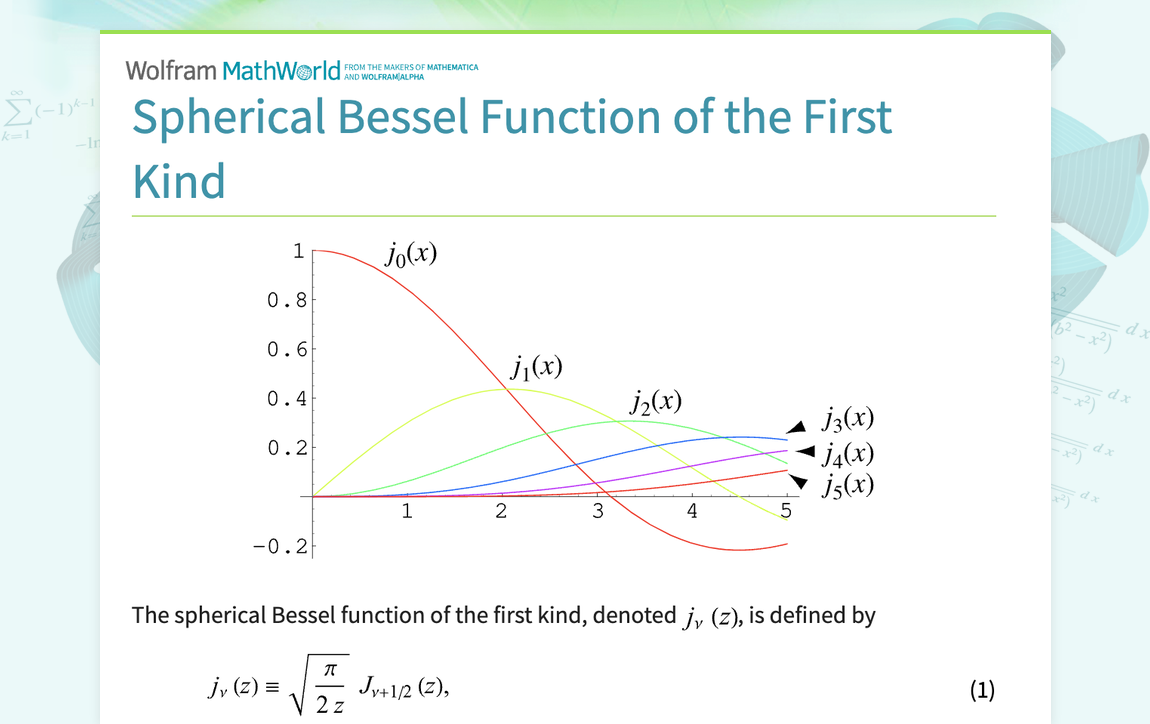
 
What would be the 'room modes' inside of a sphere-shaped listening area?
Spherical Bessel functions of the first kind:

 
However, a sphere-shaped speaker has maximum internal standing waves
Not quite. A spherical enclosure does not have distinct standing waves in the classical sense, since these arise mainly between opposing, parallel surfaces—and a sphere lacks precisely those.
A spherical cavity does not have classical axial, tangential, or oblique modes like a rectangular prism, since there are no parallel boundary surfaces. Instead, spherical natural modes occur, which are mathematically described by spherical Bessel functions and spherical surface functions. These, too, represent standing waves, but not between two opposing walls; rather, they are natural modes of the entire volume of air.
Overall, however, a sphere is still considered acoustically much more favorable than a rectangular enclosure because the problematic axial standing waves are largely eliminated.

Axial standing waves versus circular or spherical standing waves in commensurately shaped rooms? A difference in geometry but otherwise the same phenomena.
 
Supposedly, the ideal baffle shape is a perfect sphere. Why? No baffle diffraction. However, a sphere-shaped speaker has maximum internal standing waves. So the best compromise is an egg-shaped speaker - an oblate spheroid.

Question for those who know more than me: why can't you break up the internal standing waves in a sphere-shaped speaker with bracing?

A tricky question. A well constructed/specified spheroid should obviate bracing. Planar bracing defeats the internal spheroid void and creates segments, depending also on orientation and any hole placement/pattern. A diffuser patten as part of the spheroid’s internal surface could have structural properties and modify internal reflections. I’d play with that if I was a maths and materials wizard.
 
...What would be the 'room modes' inside of a sphere-shaped listening area?
Sorry for asking, it is stealing the post focus.
That topic belongs on its own separate (very deep) post.
The "golden ratio" (h/w/l) gave way to other (not so golden) ratios, which gave way to "Bolt Area", which gave way to "Bonello Criterion", which brought us to variety of acoustic modeling software (including REW' room sim). Which brought us the LasVegas Sphere's 'Holoplot Arrays', that supposed to perform some clever 'Active Wavefield Synthesis' to compensate for what its oblate geometry cannot.
 
Status
Not open for further replies.
Back
Top Bottom
