• Welcome to ASR. There are many reviews of audio hardware and expert members to help answer your questions. Click here to have your audio equipment measured for free!

MMM approach and a new calibration app (magic beans)

This software doesn't work. Don't waste your time or money. The only magic is that your money disappears.
I see you've posted this same response in various forums and in YouTube comments. We've found the issues with your measurements in your emails to our support department. You agreed we should address this publicly for transparency. For simplicity, I will continue responding in this forum post. https://www.avsforum.com/posts/64440603/

I'm still waiting for you to remeasure your LCR. I'm confident we can get your system sounding good.
 
I've read your previous responses. I don't disagree with what you've said or any of the well-established research. I think where you have doubt is how accurately an in-situ nearfield measurement using MMM reflects that of an anechoic on-axis or listening window response.

The answer lies somewhere in between. The effective range of an in-room measurements will always be limited to the higher frequencies. Below that, the room begins to take over. We agree about that. But above the room's transition region, nearfield measurements can be very reliable and should closely match that of an anechoic measurement. Here's the measurement of an Arendal 1723 Bookshelf S using a NF MMM compared to the measurement from the Klippel NFS.

View attachment 507533

This is not to say it's a replacement for anechoic measurements.

There are cases when the in-room nearfield response does not match the anechoic on-axis measurement in the higher frequencies.
I would argue that in-situ NF measurements have advantages over anechoic on-axis measurements for DSP corrections. For example, if a speaker is behind a screen, that will cause high frequency roll-off that isn't in the anechoic measurements. If the speaker is too close to a nearby surface such as a wall or desk, that affects the directivity, which is not there anechoically. Sometimes there's manufacturing variation or a tweeter that is defective. These are things we find often with our measurements. These are real-world things that need to be addressed, not theoretical ones.

So if I say that the ideal response is for the direct sound to be as neutral/accurate as possible, taking directivity into account so as not to overcorrect, and for the bass response to follow a smoothed version of natural bass rise for the room based on steady state measurements, would you disagree with anything said?
Thanks for taking the time to make your case in response to my concern. Where can I find a concise description of your method, not a video?

Cheers.
 
Thanks for taking the time to make your case in response to my concern. Where can I find a concise description of your method, not a video?

Cheers.
I don't have many videos about the method, only ones that discuss the issues with using generic target curves.

I have another discussing the benefits of using in-situ nearfield measurements.

This is a podcast I did with Brent Butterworth and Dennis Burger where I try to simplify the thought process behind MB. https://audiounleashed.podbean.com/e/not-that-kind-of-very-special-episode/

One reason I find it difficult to explain is because people are coming from different levels of experience and understanding when it comes to audio. Typically, on ASR, I can be more specific and cut to the chase. But on YT or FB, I have to first teach people about psychoacoustic theory and how our binaural hearing isn't the same as mic measurement. I typically have to undo their thinking about steady state target curves. They bring up "Harman target curves" but are unaware that Dr. Floyd Toole himself has stated that it was never meant to be a target curve, it's a result of good speakers in a room.

MB has been misrepresented by others as a way to remove the room, which is impossible with just DSP. The only way to remove the room is to place the speaker in an anechoic chamber. What MB does is it makes the direct sound as neutral as possible while respecting the directivity index. I know people find it hard to believe that we can get directivity data, but we can and do get reliable data above the transition region. The algorithm is able to detect the transition region and where it needs to change from correcting based on the direct sound to one based on the steady state response. Some aspects are proprietary, but the results speak for themselves. We offer an export that will show what we call the in-room directivity and in most cases, it correlates well with the ERDI from a spinorama above the transition region.

It's all pretty basic and straight forward to me and I think people overcomplicate things. Humans can focus in on the direct sound in a room. Research shows people prefer a speaker with a neutral direct sound and smooth off-axis sound. (No DSP, including ours, can change directivity of passive speakers.) OK, hopefully you have a speaker with decent directivity. So then the target is for the direct sound to be flat. But room correction software doesn't accept nearfield targets, they want MLP targets. So the resulting MLP response curve of a speaker corrected to flat nearfield is what? I don't know. It depends on the room's response, the dispersion pattern of the speakers, and the listening position relative to the speakers and the room. That's why every MLP response curve, aka target curve, is different.

Take any speaker and place in different parts of the room at different distances from the MLP. Take measurements at the MLP with speaker close to a side wall, maybe near a TV, behind an AT screen etc. The steady state response will change for each location even in the higher frequencies because we live in real world where people place speakers in sub-optimal locations. Now let's assume that speaker is perfectly flat anechoic and needs no EQ. By using the same MLP target curve for each location like most people do with their room correction software, they will essentially apply the incorrect EQ above the transition region because each position requires a different EQ to get it back to flat. Maybe if it's away from nearby surfaces, there will be no EQ needed in the higher frequencies. Sure, a single target curve can fix the response below the transition region where we can't really distinguish between the direct and reflected sound. That's fine. No issue there. It's the ruining of the high frequencies that I take issue with.

MB has a unified EQ export that corrects each speaker above the transition region based on making the NF flat, and a unified correction below the transition region based on an average of the room's response to determine when the bass rise starts and how high it naturally wants to rise. So basically, each speaker gets different MLP target curves above transition, but the same MLP target curves below transition when using the Unified EQ. The splice point is determined by the detected transition region.

The hard work was in making the app work on multiple platforms, integrating with as many devices as possible, and supporting people who need extra assistance with the calibration process. That's never ending.

 
Last edited:
How/where does the software determine at what point (frequency) it moves from using the MLP room affected measurements to just using the nearfield anechoic measurrements? Oh, and can we import actual (say klippel gained) anechoic measurements to the magic beans software, to replace the less accurate nearfield measurement made by the user?
 
How/where does the software determine at what point (frequency) it moves from using the MLP room affected measurements to just using the nearfield anechoic measurrements? Oh, and can we import actual (say klippel gained) anechoic measurements to the magic beans software, to replace the less accurate nearfield measurement made by the user?
There are certain aspects of the algorithm that remain proprietary. I can say that the transition region is not static and is determined based on the measurements. For example a smaller space will generally have a transition region that happens higher in frequency compared to a larger space. You will see that reflected in the target curves and corresponding corrections.

I mentioned in the previous post why in-situ near-field measurements can be preferable for correction purposes, and the link to the video explains why. The in-situ measurements are less accurate at describing the anechoic response, but the opposite is also true. For example, Spinorama can provide an estimated or predicted in-room response, but that's not as accurate at describing the in-room response compared to taking an actual in-room measurement. The difference is that one is optimal for correcting speakers in a room, and the other is optimal for designing speakers made to go into various rooms. I'll let you guess which is which.
 
This software doesn't work. Don't waste your time or money. The only magic is that your money disappears.
Are you certain you don't have crucial issues performing your measurements? Like your mic positioned too close to the speakers for the near-field measurements? (as opposed to typical MLP measurements)
 
Remeasure until it sounds good? How is that any different from simply tweaking target curves in, say, Dirac Live? The latter is less time-consuming, yet just as unpredictable.
If you click the link, you will notice the user was measuring from an incorrect distance for the nearfield measurement which overemphasized the tweeter's response. Specifically, the recommended distance for their center channel speaker needed 3ft as a starting distance (our moving mic measurement method moves the mic straight back from set starting distance.) Instead of 3ft, the person started at 1ft away from the tweeter. The app has instructions on how to properly measure so that the data is reliable.

I described how the app works in a previous post here which should answer that question. "Tweaking target curves" in Dirac is not the same as what MB does. The point is to determine the ideal target curve for each speaker. The process still requires good data in order to produce good results.
 
Last edited:
If you click the link, you will notice the user was measuring from an incorrect distance for the nearfield measurement which overemphasized the tweeter's response. The app has instructions on how to properly measure so that the data is reliable.
To obtain meaningful dispersion data, a speaker must be measured in the far field under anechoic conditions. Measuring close to the speaker in a room produces results that are compromised by interference between multiple drivers and the enclosure, as well as by early room reflections. Floyd Toole discusses the differences between near-field and far-field measurements – and the issues caused by being too close – in his book. In most cases, the far field begins at around 2m (6.6ft) or more, depending on the speaker’s design.
The point is to determine the ideal target curve for each speaker. The process still requires good data in order to produce good results.
I agree, and measuring without any gating at the distances you’re suggesting doesn’t provide the kind of data needed to determine an ideal target curve.
 
To obtain meaningful dispersion data, a speaker must be measured in the far field under anechoic conditions. Measuring close to the speaker in a room produces results that are compromised by interference between multiple drivers and the enclosure, as well as by early room reflections. Floyd Toole discusses the differences between near-field and far-field measurements – and the issues caused by being too close – in his book. In most cases, the far field begins at around 2m (6.6ft) or more, depending on the speaker’s design.

I agree, and measuring without any gating at the distances you’re suggesting doesn’t provide the kind of data needed to determine an ideal target curve.
Yes, it is a compromise and we don't claim that we are going based on CEA2034 guidelines. I do car audio SQ competition. In a car, the MLP isn't likely to be 2m-3m. And yet we are able to get some sibilance of driver integration from such a distance. How would you propose calibrating a system in car which doesn't allow for 2m? Anechoic data will only get you so far because you might have a driver firing directly into the dash which acts as a waveguide.

From what I've seen from the hundreds of measurements we've seen, these compromised nearfield measurements correspond very closely to the measurements were would expect from an anechoic measurement. The directivity data captured also looks very close.

Perfection is the enemy of progress, and for our use case, an imperfect, yet reasonable, reliable and repeatable method of capturing the direct sound beats the alternative of measuring from a distance of 10ft+ away and using gating. There's already been other forum posts here that show how the MMM can provide good NF measurements. Yes, reflections in a room will be captured in the direct sound, but for our use-cases that can be an advantage. We aren't trying to capture the anechoic response. If a speaker is near a side wall, yes that will affect the direct sound we capture and the direct sound you will hear. If a speaker is behind an AT screen, yes that will affect the direct sound we capture.

For a gated measurement of say 10ft away, how would you propose to determine the affect of air attenuation for example. The measurement from that distance has already been affected by the distance-based attenuation.

The goal of the nearfield measurement is focused more on getting a high direct-to-reverberant ratio, at the expense of getting a perfect anechoic response via gating. Both time gating and D/R ratio are important for how we perceive the sound as humans, to determine the direction and spectral quality of the originating sound, but for what we're doing with MB, the D/R ratio method has its own advantages. Remember it works in conjunction with something like Dirac which will still handle the time and phase alignment based on its own impulse response measurements.
 
Last edited:
Yes, it is a compromise and we don't claim that we are going based on CEA2034 guidelines. I do car audio SQ competition. In a car, the MLP isn't likely to be 2m-3m. And yet we are able to get some sibilance of driver integration from such a distance. How would you propose calibrating a system in car which doesn't allow for 2m? Anechoic data will only get you so far because you might have a driver firing directly into the dash which acts as a waveguide.
How is this relevant? A car space and a living space are entirely different in their acoustical properties.
From what I've seen from the hundreds of measurements we've seen, these compromised nearfield measurements correspond very closely to the measurements were would expect from an anechoic measurement. The directivity data captured also looks very close.
They may appear close above the transition region, but that’s also true for any measurement taken from farther away.
Perfection is the enemy of progress, and for our use case, an imperfect, yet reasonable, reliable and repeatable method of capturing the direct sound beats the alternative of measuring from a distance of 10ft+ away and using gating. There's already been other forum posts here that show how the MMM can provide good NF measurements. Yes, reflections in a room will be captured in the direct sound, but for our use-cases that can be an advantage. We aren't trying to capture the anechoic response. If a speaker is near a side wall, yes that will affect the direct sound we capture and the direct sound you will hear. If a speaker is behind an AT screen, yes that will affect the direct sound we capture.
That doesn’t add up. You say you want the near-field response (i.e. the anechoic response), but at the same time, you want the room response. Being this close to the speaker gives you neither. You can’t reliably determine the anechoic response, nor can you predict the far-field response. The sound field changes rapidly and unpredictably until you reach the far field. Klippel, for example, derives an anechoic response from near-field measurements, but this relies on sophisticated modeling and strictly defined measurement procedures.
For a gated measurement of say 10ft away, how would you propose to determine the affect of air attenuation for example. The measurement from that distance has already been affected by the distance-based attenuation.
Air attenuation is neglectable for distances we're seeing in regular living spaces.
The goal of the nearfield measurement is focused more on getting a high direct-to-reverberant ratio, at the expense of getting a perfect anechoic response via gating. Both time gating and D/R ratio are important for how we perceive the sound as humans, to determine the direction and spectral quality of the originating sound, but for what we're doing with MB, the D/R ratio method has its own advantages. Remember it works in conjunction with something like Dirac which will still handle the time and phase alignment based on its own impulse response measurements.
By modifying the gate time, you can control the balance between direct and reverberant sound.
 
  • Like
Reactions: OCA
How is this relevant? A car space and a living space are entirely different in their acoustical properties.
Because it's a worse case environment where DSP correction is still required. My method that you claim is technically incorrect has received numerous first place wins in SQ competitions. Maybe I'm just lucky.
They may appear close above the transition region, but that’s also true for any measurement taken from farther away.
That's not correct. A measurement from 10ft away does not closely match the on-axis or listening window response. It will likely match the early reflections response. This is easy to prove. Go compare the spinorama early reflections measurement to the predicted in-room response and you'll see they're nearly identical. Well, a measurement at 10ft away at the MLP is the actual in-room response. So no. The 10ft distance most likely have high frequency roll-off unlike the a nearfield measurement.

That doesn’t add up. You say you want the near-field response (i.e. the anechoic response), but at the same time, you want the room response. Being this close to the speaker gives you neither. You can’t reliably determine the anechoic response, nor can you predict the far-field response. The sound field changes rapidly and unpredictably until you reach the far field. Klippel, for example, derives an anechoic response from near-field measurements, but this relies on sophisticated modeling and strictly defined measurement procedures.
No, I never said nearfield = anechoic. We take the nearfield measurement because we want a high direct/reverberant ratio. Any nearby surfaces (less than 3ft) that modify the direct sound would be audibly indistinguishable from the speaker response anyway. So, yes we do want to capture that.

We do get a good picture of the room's response because we can see the difference between the nearfield and farfield measurements.

We are not trying to replicate a Klippel.
Air attenuation is neglectable for distances we're seeing in regular living spaces.

By modifying the gate time, you can control the balance between direct and reverberant sound.
I'm not against gated measurements. They have their place. But you're saying that nearfield MMM aren't useful and I would disagree.

Here's an in-room measurement I did of an Arendal 1723 monitor using the NF MMM.
Arendal 1723 Monitor MB NF vs ASR Klippel NFS.jpg


Here's an in-room NF LW measurement. I also took a sound power measurement and came up with the SPDI. I did this at the Kali Audio offices in front of their speaker designer, Charles Sprinkle. This was done using a cheap UMIK-1 and REW. I've overlayed it over the NFS measurement by Erin of the same speaker.

Screenshot_20260128-123402.png


So if your argument is that the nearfield in-room MMM is useless, I don't agree.
 
The basis of the Magic Beans method, AFAICT, is based on the (obviously not completely valid) assumption that the direct sounds as read by the moving microphone are correlated, but the reflected room sounds are not. Thus, when you take lots of averages, the tendency is for the correlated sounds to add up, while the uncorrelated ones tend to cancel each other. The resulting measurements will therefore have some amounts of rejection of the reflected sounds. The assumption of uncorrelated reflected sounds is more valid at the higher frequencies (when f >> Schroeder frequency), and much less so when f is low.

This paper describes a quasi-anechoic loudspeaker measurement method to effect an endfire beamformer based on the similar principle.
Are you referring specifically to the MMM in general, the nearfield MMM, the farfield MMM, or the MB method as a whole?

MMM in general does have some aspects of "noise rejection" just due to spatial averaging. My discussion with @markus was more about the usefulness of our nearfield measurements. I don't think it's so much about correlated vs uncorrelated sounds, although there might be some aspect of that, as much as it's just about signal to noise ratio. Measuring close enough to the loudspeaker so the drivers integrate allows us to capture a higher ratio of direct to reflected sound. Not saying the reflected sound has zero effect on the measurement. It does. Our NF MMM is a bit different in that we have a starting distance based on the driver layout distance and we move the mic straight back. In some way that does average some aspects of the speaker integration that varies with distance, but also the nearby reflections and frequency dependent cancelations above the transition region like you mentioned.

 
Because it's a worse case environment where DSP correction is still required. My method that you claim is technically incorrect has received numerous first place wins in SQ competitions. Maybe I'm just lucky.

That's not correct. A measurement from 10ft away does not closely match the on-axis or listening window response. It will likely match the early reflections response. This is easy to prove. Go compare the spinorama early reflections measurement to the predicted in-room response and you'll see they're nearly identical. Well, a measurement at 10ft away at the MLP is the actual in-room response. So no. The 10ft distance most likely have high frequency roll-off unlike the a nearfield measurement.


No, I never said nearfield = anechoic. We take the nearfield measurement because we want a high direct/reverberant ratio. Any nearby surfaces (less than 3ft) that modify the direct sound would be audibly indistinguishable from the speaker response anyway. So, yes we do want to capture that.

We do get a good picture of the room's response because we can see the difference between the nearfield and farfield measurements.

We are not trying to replicate a Klippel.

I'm not against gated measurements. They have their place. But you're saying that nearfield MMM aren't useful and I would disagree.

Here's an in-room measurement I did of an Arendal 1723 monitor using the NF MMM.
View attachment 507671

Here's an in-room NF LW measurement. I also took a sound power measurement and came up with the SPDI. I did this at the Kali Audio offices in front of their speaker designer, Charles Sprinkle. This was done using a cheap UMIK-1 and REW. I've overlayed it over the NFS measurement by Erin of the same speaker.

View attachment 507672


So if your argument is that the nearfield in-room MMM is useless, I don't agree.
Looks like we’ll have to agree to disagree.
 
Looks like we’ll have to agree to disagree.
I appreciate the pushback, and I'm always open to it. I think it's important to ask questions and have a healthy discussion. People have pushed back on some of our original methods and after some back and forth, we ended up implementing the changes they recommended.
 
Joe, maybe your could help me out here. I bought MB last week and I'm using it in my set up which consists of a 5.1 running off my PC using a Dirac Art plug in processor on J River. I have run my Dirac measurement with the following system: Center (Kef CTC 1001 SE), sides (Kef LS 50 Metas), L-R (Asci A6bs) and Subs (Dual SVS SB 2000s). After running Dirac measurements, in filter design, I set my minimum support levels on ART for the center and surrounds at 100 hz, and generated the D ART project. Also ran the near and far field measurements for Magic Beans. I originally tried to export target curves as Unified, but I found it was creating huge bass bumps for the center and surrounds, far beyond what the small woofers on those units could safely play at, so I did individual speakers, and it seems like the bass bumps terminated for the surrounds and center at the support levels I set. So are you seeing this as an issue from other MB users who have smaller surrounds?

And, I notice the export option includes Dirac, Dirac DLBC, and Dirac Double pass, but no ART. So does it make a difference which one I use to export the files to Dirac? And could you explains what Double pass does, and whether there is some instruction on how to use it?
 
Last edited:
Joe, maybe your could help me out here. I bought MB last week and I'm using it in my set up which consists of a 5.1 running off my PC using a Dirac Art plug in processor on J River. I have run my Dirac measurement with the following system: Center (Kef CTC 1001 SE), sides (Kef LS 50 Metas), L-R (Asci A6bs) and Subs (Dual SVS SB 2000s). After running Dirac measurements, in filter design, I set my minimum support levels on ART for the center and surrounds at 100 hz, and generated the D ART project. Also ran the near and far field measurements for Magic Beans. I originally tried to export target curves as Unified, but I found it was creating huge bass bumps for the center and surrounds, far beyond what the small woofers on those units could safely play at, so I did individual speakers, and it seems like the bass bumps terminated for the surrounds and center at the support levels I set. So are you seeing this as an issue from other MB users who have smaller surrounds?

And, I notice the export option includes Dirac, Dirac DLBC, and Dirac Double pass, but no ART. So does it make a difference which one I use to export the files to Dirac? And could you explains what Double pass does, and whether there is some instruction on how to use it?
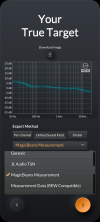
We have a dedicated Discord group for MB owners to provide more real-time support, but we can look at your stuff here if you prefer. First, we need to take a look at your measurements. Export your MBM (MagicBeans Measurement) file by selecting it on the drop-down.

Screenshot_20260813-203424.png

Unified EQ is our typical recommendation to get a unified bass response while still getting per-speaker target responses for the frequencies above the transition region. To prevent overdriving the speakers, that must be done within Dirac by using curtains or adjusting the target response to match the natural roll-off of the sub or speaker. It would be helpful if you could show screenshots of how the target curves look per-speaker on Dirac so we can see how things are setup on your end.

There is a write-up on Discord as to how to use the 2-pass method. I would rather link to the write-up instead of copy/pasting it here so we can make update the source rather than tracking down all the places online with outdated info.

The various Dirac export methods don't show ART because they just represent how speakers are grouped. Some systems force speaker grouping of heights and DLBC forces symmetric set grouping. You can just use Dirac Live (one-pass) as the export option for ART. 2-pass is more advanced, so let's get your 1-pass working well first.
 
Back
Top Bottom