• Welcome to ASR. There are many reviews of audio hardware and expert members to help answer your questions. Click here to have your audio equipment measured for free!

MINIDSP EARS PRO : professional test bench

daniboun

Major Contributor
Forum Donor
Joined
May 2, 2020
Messages
3,109
Likes
4,956
Location
France (Lyon)
Hi amigos

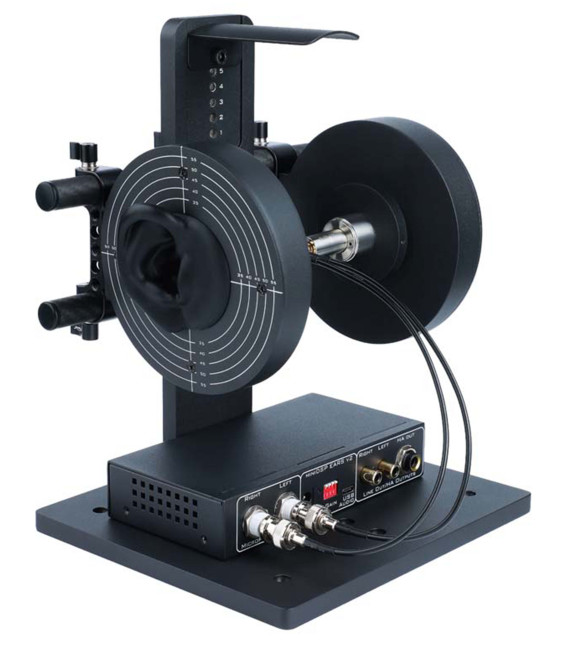
Just discovered this analyzer : this is a professional test bench for headphones designed to perform precise and repeatable acoustic measurements for R&D applications, production quality control and calibrated binaural recording.

I found the concept really interesting, and I wonder how it stacks up against the competition.

Getting started with EARS Pro


SPEC here :


Attachments

  • minidsp-ears-pro.jpg
    minidsp-ears-pro.jpg
    74.3 KB · Views: 43
I'm working on a *deep dive* review of this one, including establishing a diffuse-field transfer function specifically for this setup.

Preliminary results clearly show that this is a no-brainer choice for a standardized test setup if you can't afford a GRAS or similar.
Results taken with it will be largely comparable to a GRAS 45CA-8 / 45CC-15 (anthropometric pinna and 711 couplers)

It does not really take away any market share from GRAS however, since it's not TEDS compliant (microphone calibration can not be stored on the microphone directly), so for large-scale R&D environments / production line testing (GRAS's core market) it's not useful.
For the individual reviewer / small-scale manufacturer however it's the ideal choice - you won't need TEDS in such a setup.

Unlike the original miniDSP EARS, the miniDSP EARS PRO gets a full recommendation from me.
What all is involved with establishing a diffused field transfer function?
I am highly anticipating your deep dive.
 
I'm working on a *deep dive* review of this one, including establishing a diffuse-field transfer function specifically for this setup.

Preliminary results clearly show that this is a no-brainer choice for a standardized test setup if you can't afford a GRAS or similar.
Results taken with it will be largely comparable to a GRAS 45CA-8 / 45CC-15 (anthropometric pinna and 711 couplers)

It does not really take away any market share from GRAS however, since it's not TEDS compliant (microphone calibration can not be stored on the microphone directly), so for large-scale R&D environments / production line testing (GRAS's core market) it's not useful.
For the individual reviewer / small-scale manufacturer however it's the ideal choice - you won't need TEDS in such a setup.

Unlike the original miniDSP EARS, the miniDSP EARS PRO gets a full recommendation from me.
Of endorsements this product could get... I'd say this is up there. Good to know, although what should I do with my old miniDSP EARS? :|
 
what should I do with my old miniDSP EARS? :|
In German we say "Lehrgeld bezahlen" :)

What all is involved with establishing a diffused field transfer function?
Make a torso with anthropometric proportions (compliant with ITU P.58, the standard that describes acoustic manikins), mount the pinna from the EARS pro to it, take it to the austrian academy of sciences' acoustic research institute to measure the HRTF and calculate the diffuse-field transfer function from that.
I'm working with the University of Michigan for an accurate anthropometric torso.
 
I'm working on a *deep dive* review of this one, including establishing a diffuse-field transfer function specifically for this setup.

Preliminary results clearly show that this is a no-brainer choice for a standardized test setup if you can't afford a GRAS or similar.
Results taken with it will be largely comparable to a GRAS 45CA-8 / 45CC-15 (anthropometric pinna and 711 couplers)

It does not really take away any market share from GRAS however, since it's not TEDS compliant (microphone calibration can not be stored on the microphone directly), so for large-scale R&D environments / production line testing (GRAS's core market) it's not useful.
For the individual reviewer / small-scale manufacturer however it's the ideal choice - you won't need TEDS in such a setup.

Unlike the original miniDSP EARS, the miniDSP EARS PRO gets a full recommendation from me.
Dude, you’re a legend.
 
I'm working on a *deep dive* review of this one, including establishing a diffuse-field transfer function specifically for this setup.

Preliminary results clearly show that this is a no-brainer choice for a standardized test setup if you can't afford a GRAS or similar.
Results taken with it will be largely comparable to a GRAS 45CA-8 / 45CC-15 (anthropometric pinna and 711 couplers)

It does not really take away any market share from GRAS however, since it's not TEDS compliant (microphone calibration can not be stored on the microphone directly), so for large-scale R&D environments / production line testing (GRAS's core market) it's not useful.
For the individual reviewer / small-scale manufacturer however it's the ideal choice - you won't need TEDS in such a setup.

Unlike the original miniDSP EARS, the miniDSP EARS PRO gets a full recommendation from me.

I'll be following this. I've long wanted to get into headphone measurements (way back to 2011 when I started testing drive units with KLIPPEL hardware). The issue was always the cost of the test apparatus. I saw the EARS PRO a couple months ago via the Headphone Show video linked above. I've been considering jumping in and seeing your post here gives me more confidence that it's a good option.
 
I'm working on a *deep dive* review of this one, including establishing a diffuse-field transfer function specifically for this setup.

Preliminary results clearly show that this is a no-brainer choice for a standardized test setup if you can't afford a GRAS or similar.
Results taken with it will be largely comparable to a GRAS 45CA-8 / 45CC-15 (anthropometric pinna and 711 couplers)

It does not really take away any market share from GRAS however, since it's not TEDS compliant (microphone calibration can not be stored on the microphone directly), so for large-scale R&D environments / production line testing (GRAS's core market) it's not useful.
For the individual reviewer / small-scale manufacturer however it's the ideal choice - you won't need TEDS in such a setup.

Unlike the original miniDSP EARS, the miniDSP EARS PRO gets a full recommendation from me.
what was wrong with the original minidsp ears?
 
what was wrong with the original minidsp ears?
It had microphones and silicone ears, but the acoustic impedance did not match that of humans (it had no anatomically correct eardrum or ear canal, nor did it have a mechanical simulation of eardrum / ear canal as an alternative).
The EARS PRO does an acoustic simulation of the eardrum and ear canal - in between the rubber ear and the microphone there are two parallel air volumes connected to the "ear canal" via thin slits. These act as Helmholtz resonators, so above certain frequencies the slits effectively close off.
This means that at different frequencies, the whole assembly has effectively a different air volume inside (low frequencies see the full air volume of the main tube plus the two side volumes, and for high frequencies the slits close off and only the main tube's volume is effective).
Another way to say the same thing is: The acoustic load impedance of this assembly has different values for different frequencies - the values being chosen to align with the average human ear.
The exact parameters are defined in IEC standard 60318-4 (formerly called 60711, hence why this type of coupler is called a "711 coupler")
thank you king
 
Back
Top Bottom