• Welcome to ASR. There are many reviews of audio hardware and expert members to help answer your questions. Click here to have your audio equipment measured for free!

Methodical 4-Way Horn Integration in an Attic Room: Time-Alignment & DSP Calibration Workflow (CLIO, Hypex & Dirac Live)

MEGB1262

Member
Joined
Mar 27, 2022
Messages
62
Likes
63
IMG_1387.jpg

Hello ASR Community,
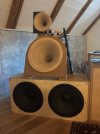
i want to share my latest DIY audio project, focusing less on the aesthetics and more on a strict, methodical measurement and calibration workflow

multi-way horn systems are notorious for integration issues, especially when placed in a challenging acoustic environment like an attic with angled ceilings and exposed wooden beams

to tackle this, I implemented a cascaded, three-step DSP and measurement strategy to achieve time-domain precision and a flat in-room response

here is the system overview and the exact technical approach I used:


step A:
time alignment via precision measurements (CLIO Pocket)

horns inherently suffer from massive geometric offsets, leading to significant group delay and phase degradation if uncorrected
  • Methodology:
    using CLIO Pocket, i captured the precise impulse response (IR) and phase of each individual driver
    super-tweeter Visaton TL16H
    210 mm tractrix wood horn with 18sound NSD1480N driver
    420mm tractrix wood horn with DCM414-16 driver
    dual-woofer kick bass with 2X 15 inch Celestion FTR15-3070C drivers
  • Execution:
    by analyzing the exact Time-of-Flight (ToF) differences in the step response, i have calculated the precise millisecond delays needed to perfectly align the acoustic centers
  • Results:
    image_2026-09-18_205223362.png

    the drivers here sum perfectly at the crossover regions without phase cancellation precise time alignment after setting the correct delay for the super tweeter to the 210 mm wood horn

 
step B
driver linearization with the 30 USD autoEQ upgrade of the miniDSP FLEX8DL used as main DSP audio controller

the 3 horns are driven with the separate Hypex FA123 plate amp and need to be coupled correctly to the kick bass

satellite autoPEQ for left Hypex plate amp driving the mid / mid-high / super tweeter horns
left side
image_2026-09-18_210417340.png

right side
1789758422126.png

the unsymmetrical settings comes from the room placement with the left side near the wall and the right side in the middle of the room and additional manufacturing tolerances for speaker drivers and mechanical tolerances of the wooden horns
 
for the kick bass chassis the autoEQ do not work well, here i have used a simple manual approach, same PEQ for left and right side
1789758827567.png


here the resulting frequency graphs for the satellte speakers
left side
1789759495310.png
right side
1789759289914.png
 
it's late today - to be continued
just to be a little more clear the result of the final Dirac Live! room correction, you see very clear that due to the quite different PEQ settings for the left and the right side the left channel has less volume
1789760095840.png

1789760384413.png


definitely i need to review this, the L / R channel volume level difference of almost 6 dB ist far too big for only rematching tolerances, i need to recalculate the autoPEQ setting for the left channel
 
Last edited:
Very cool DIY system!

With this type of system, is a flat in room response tonally correct? Your measurement shows a rising HF. How does it sound?
 
looks pretty rad.
 
Cool. You definitely don't need a super tweeter to complement NSD1480N though.
 
reviewed the autoEQ settings and found the problem

the autoEQ integration in the miniDSP device console looks easy to use but there are some pitfalls with the resulting differences in the volume level if you don't match exactlx the settings of the left and right side chassis

i have also changed the target curve of the Dirac Live! room correction

i can match the target curve to my own preferences anyway through the Roon Muse PEQ filters, here a simple example

1789821808951.png


here the results in the Dirac Live! project view

1789821918470.png


1789821971910.png
 
next step will be to verify with the CLIO Pocket measuring system what Dirac Live! is really doing with the audio signal

strange behavior to observe is the fact that clicking the Dirac bypass button in the device console or in the remote control leads to a major increase of the latency and not a decrease as expected

my assumption for this ist that the hardware architecture of the miniDSP implementation of Dirac Live! reroutes completely the signal path in the DSP so that with the Dirac bypass they have to go through the entire audio buffer for the mixed FIR filters with presumably 2048 samples at 48 kHz sampling frequency - makes a latency of 42,67 msec
 
here the device console in action, note that the volume level matches without the need of any correction from the DL room correction
1789825140797.png
 
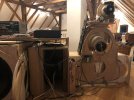
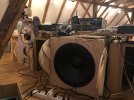
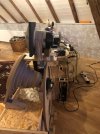
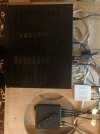
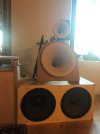
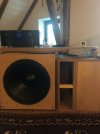
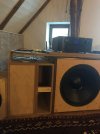
here some more pics of the sound system

IMG_1393.jpgIMG_1392.jpgIMG_1391.jpgIMG_1390.jpgIMG_1389.jpgIMG_1388.jpg
 

Attachments

  • IMG_1401.jpg
    IMG_1401.jpg
    114.1 KB · Views: 61
  • IMG_1400.jpg
    IMG_1400.jpg
    115 KB · Views: 59
  • IMG_1399.jpg
    IMG_1399.jpg
    124.8 KB · Views: 60
the front CB sub and rear CB sub forms a cardioid subwoofer setup together with the 2 N-dipole subwoofer with 4 21 inch drivers

the two 90 degree flipped fullrange speaker dipole arrays are good for the reverberant field improvement, here you can listen quite decently to the sound even standing behind the speakers
 
Cool system.
I had something not too dissimilar, both in a normal rectangular room and then an attic room.

I built Synergy Multi Entry Horns which work better for me in the space.
Single point source and coherent phase across the HF to LF.
Retained the same tapped horn subs for a 4 way.
 
Back
Top Bottom