• Welcome to ASR. There are many reviews of audio hardware and expert members to help answer your questions. Click here to have your audio equipment measured for free!

Measuring phono amps: what's going on here?

ddaudio

Active Member
Joined
May 25, 2023
Messages
105
Likes
117
I'm trying to measure an EAR 834P valve (tube) MM phono preamp.

It has very high gain: 49dB.

According to the Stereophile review, its input impedance is roughly 50 kOhms and output impedance is roughly 500 Ohms.

When doing a stepped sine THD vs level test in REW, to determine the input overload point, I'm getting some strange results.

1. Directly connected to the audio interface (input impedance specified at 12 kOhms - not sure if that is for balanced TRS or unbalanced TS, it can be used with both, I'm using TS - what difference would the two connection types make?):
* Overload point with a 1kHz sine wave is at 17mV (generated) which is 4.9V at the input.

2. Connected the 834P via the line in (24 kOhms input impedance) and tape out on a Rotel amp:
* Overload point is at 33mV generated, 8V at the audio interface input, which is the same as the measured input overload for this amp on its own, so difficult to tell if the phono stage is the limiting factor here - but obviously much better.

3. Connected the 834P via line in/tape out on another amp with a specified input impedance of 47 kOhms and specified overload point of 6.5V:
* Overload point is 16mV generated (4.5V at the interface input) - worse than the direct connection.

REW graphs below.

This is very odd to me: the results cannot be correlated to the input impedance seen by the phono stage, as the best result is at 22 kOhms, and both higher and lower impedances deliver much worse results.

What is going on here?

Generator level vs THD:
1791677997279.png


Input level vs THD:
1791678149250.png
 
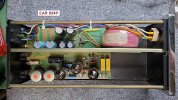
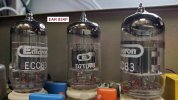
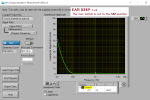
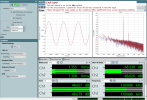
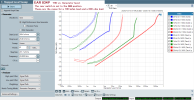
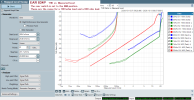
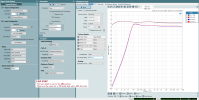
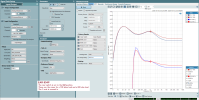
This shows the EAR 834P's output impedance, APx dashboard, and THD vs. level sweep.
 

Attachments

  • 0101_ear_834p_photo01.jpg
    0101_ear_834p_photo01.jpg
    198.5 KB · Views: 115
  • 0102_ear_834p_photo02.jpg
    0102_ear_834p_photo02.jpg
    107.1 KB · Views: 104
  • 0201_ear_834p_MM_Zout.png
    0201_ear_834p_MM_Zout.png
    42.9 KB · Views: 114
  • 0301_ear_834p_MM_DB.png
    0301_ear_834p_MM_DB.png
    136.9 KB · Views: 125
  • 0501_ear_834p_MM_thdgenlevelsweep.png
    0501_ear_834p_MM_thdgenlevelsweep.png
    120.5 KB · Views: 111
  • 0502_ear_834p_MM_thdmsrlevelsweep.png
    0502_ear_834p_MM_thdmsrlevelsweep.png
    119.4 KB · Views: 101
@nagster Thank you, that's really useful.

It is odd that I see the opposite - for me I see clipping happen at a lower generator level when running the 843P into the 47kOhm input impedance amplifier compared to the 22kOhhm amplifier.

Might I need new valves/tubes? (they're old).

Even stranger is that clipping happens somewhere between the results of those two amps even though its input impedance spec is lower than either at 12kOhm.

But that spec might be when using a balanced (TRS) input jack, and I'm using unbalanced TS. (The specs only show one input impedance for the line input, even though it can be used balanced or unbalanced).

I might get hold of a resistance box so that I can measure for myself. In the meantime, assuming it would differ, can anyone tell from the block diagram (attached) whether input impedance would change for TS vs TRS? I know there are no component values shown, but maybe someone can offer an opinion based on the design.

1791937506067.png
 
I am writing this hoping that Google Translate handles it well.
It appears there are many variables involved in your measurement setup.
I recommend verifying and establishing the electrical characteristics of each component individually before attempting to troubleshoot issues that arise when combining them.
First, please verify the electrical characteristics of your measuring instrument (audio interface) using the actual unit. Then, measure each DUT (Device Under Test) individually.
The key is to address and resolve each factor one by one.

My 834P seems to exhibit significant fluctuations depending on the load.

Also, are the baseline values you are using correct?
Have you verified the 12kΩ, 22kΩ, 24kΩ, and 47kΩ values on the actual units? If the baseline values are incorrect, your conclusions will be flawed.
Have you checked the output impedance? Is it flat, or does it vary with frequency?

If the vacuum tubes are excessively worn, they need to be replaced. This depends on the design and usage time, so please check with the manufacturer.
However, if there are no issues with the audio output, I do not think this is directly affecting the problem at hand.

When feeding an unbalanced signal into a balanced input terminal, the input impedance is often halved.
This is not a hard-and-fast rule; it depends on the design.
If precision is required—such as when using the device as a measuring instrument—there is no alternative to verifying it on the actual unit.
I hope your issue gets resolved.
 

Attachments

  • 0601_ear_834p_FR.png
    0601_ear_834p_FR.png
    154.2 KB · Views: 102
  • 0602_ear_834p_FR_zoomin.png
    0602_ear_834p_FR_zoomin.png
    173.5 KB · Views: 94
Thank you again. Yes, I need to get a resistance decade box in order to actually verify output/input impedances.

My original issue was after changing a high output MC cartridge (2.5mV @ 1KHz, 5cm/sec) to an MM cartridge (3.5mV @ 1KHz, 5cm/sec) loud piano passages were visibly distorting. I measured the input clipping point of the amp then in use with the 834P (an AV receiver, in fact) which turned out to be only 2.3V, obviously not a good match with the very high gain of the 834P. But in "Pure Direct" mode with no ADC/DSP used. the clipping point doubled to about 4.5V, which resolved my immediate problem.

But it got me interested in this whole question. I'll report back when I have made proper impedance measurements.
 
Clipping? Tubes?
It's 2026 - get proper kit and digital sources! (but I'm sure the hand-wringing is more satisfying than just listening to the music as it was intended :) )
 
I'm slowly digitizing hundreds of old classical LPs. For that a phono stage is required. And of course I want the best transfers possible within my means. Also, the science of the technology is interesting in its own right (this is, after all, Audio Science Review!). But I plead guilty to buying a tube phono stage 20+ years ago.
 
I'm slowly digitizing hundreds of old classical LPs. For that a phono stage is required. And of course I want the best transfers possible within my means. Also, the science of the technology is interesting in its own right (this is, after all, Audio Science Review!). But I plead guilty to buying a tube phono stage 20+ years ago.
For digitizing I use a Waxwing (and for listening too).
 
Back
Top Bottom