Talisman
Major Contributor
I had the chance to test Marshall's flagship Bluetooth speaker. I found it extremely disappointing; fortunately, I didn't have to pay for it.
Here is my review, based on personal observations and listening tests.

----------
What happens when 12 people with 12 different concepts sit around a round table to decide the features of Marshall's new flagship Bluetooth party speaker?
The Bromley 750 happens.
I want to get this off my chest right away. This speaker is the most beautiful and iconic Bluetooth party speaker they have ever made, and it fails miserably right where it should have shined: playing sound! This isn't due to cost-cutting, not because of low-quality drivers, nor inadequate amplification, but solely and exclusively due to engineering choices that are downright reckless in the conception of this model. If you have the patience to read this (substantial) review, I will explain everything in detail.

CONSTRUCTION AND AESTHETICS
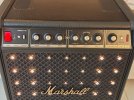
This speaker is nothing short of ICONIC. Looking at it casually, it genuinely looks like one of those legendary Marshall amplifiers you used to see next to rock bands in the '70s. A HUGE rectangular block, built exceptionally well, reinforced at the corners, with a pebbled leather-effect finish that screams ROCK from every pore.
The entire front section is inspired by the brand's rock mythology, featuring a rigid, wide-mesh front protective grille covering a tighter inner fabric mesh, with the large "Marshall" logo prominently displayed right in the center in its traditional font.
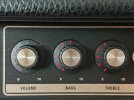
The control panel, despite being digital in nature, has an old-school analog look, complete with a red industrial-style power switch and a series of knobs to adjust various parameters. Naturally, despite their analog appearance, those physical knobs hide endless digital rotary encoders. The solution for displaying digital levels is a stroke of design genius: a series of tiny red LEDs arranged in a radial pattern around each knob shows the adjustment level, lighting up slightly brighter when a knob is turned. The effect is so spot-on that it integrates seamlessly into the '70s style—a masterclass in integrating modern elements into a classic design.
The bottom of the speaker includes a threaded PA (professional audio) socket for tripod mounting (we'll see later why this makes no sense).
One aesthetic element that betrays its nature as a lifestyle speaker is the LED array located underneath the front protective grille. Fortunately, the designers spared us a hideous strip of multicolored RGB LEDs and instead opted for "warm white VU meter" style LEDs that fit the product's aesthetic perfectly and don't ruin the vibe even when lit up—quite the opposite, in fact.
In short, from a build perspective it's built like a tank, and aesthetically, there's only one word: ICONIC.

FEATURES, INPUTS, COMPANION APP
Here we start seeing some interesting solutions aimed at blending the lifestyle spirit of a party speaker with the brand's DNA. Obviously, we have Bluetooth input, which is a bit limited by supporting only two codecs: SBC and AAC. For a premium Marshall speaker, I honestly expected at least support for aptX Adaptive and LDAC. A bit disappointing.
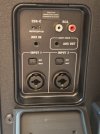
We find a total of 4 analog inputs: a classic RCA input, a 3.5mm aux jack, and two hybrid inputs accepting both balanced XLR (for microphones) and 6.35mm (1/4") TS/TRS jacks typical for musical instruments.
This set of inputs made me think of the typical busker or street musician, who can send a backing track over RCA or aux from a digital player while simultaneously adding vocals via a mic on one of the balanced inputs and a guitar or bass on the other. Each input has its own independent volume control for fine-tuning the vocal/backing track/instrument balance. Additionally, there is a shared Delay/Reverb control for the two inputs to customize the sonic imprint—a virtually perfect combination. The hybrid inputs feature a toggle button to switch amplification between microphone and instrument mode (microphones require significantly higher gain).
The Bass and Treble knobs work exactly as expected, coarsely yet effectively equalizing the sound.
A separate paragraph must be dedicated to the "Dynamic/Loud" knob. Turned all the way left to "Dynamic," the sound is like a "hi-fi stereo system"—full dynamic range, punchy bass, and body across the entire frequency band, but with a modest maximum volume (perfectly manageable indoors). As you turn the knob toward "Loud," the volume increases dramatically at the expense of sound depth, bass response, and dynamic range. To put it simply: the further you move toward "Loud," the more this audio speaker turns into a megaphone. We will evaluate this effect more thoroughly in the sound quality section.

SOUND QUALITY
"I really didn't want to write this section" QUOTE.
Grab a drink and sit down, because we have a lot to talk about.
When I mentioned the 12 guys at the beginning, each with a different concept, this is exactly what I meant.
On paper, the Bromley 750 boasts an impressive set of drivers: two 10-inch woofers for low frequencies, two 5-inch midrange drivers, and four tweeters (1-inch and 0.8-inch respectively) for mid-highs and highs.
So yes, you heard that right—an impressive 4-way design compared to the standard 2-way layout found in most party speakers. However, despite looking like a front-firing firepower monster, this speaker is not front-firing. It features 360° dispersion, meaning it was designed to spread sound all around rather than directionally from the front. While 360° sound is nothing new in the Bluetooth speaker landscape, it is unbelievably bizarre on a speaker of this caliber. Typical omnidirectional speakers are compact, which makes sense if a group of friends sits around a table with the speaker in the middle, or if it's placed on a shelf or couch. A small speaker can go anywhere, so omnidirectionality serves a purpose. But for a gigantic party speaker, what were Marshall's audio engineers thinking? That we would place this huge monolith right in the center of the living room during a kids' birthday party? Or that it would sit in the middle of the garden on a pedestal at a cocktail party? I hate to break it to you, but those scenarios only exist in marketing brochures. In the real world, speakers of this size are kept in a corner, angled toward the party, delivering sound without getting in everyone's way.
Want another gem about 360° dispersion when placing a speaker like this near a wall? When a 10-inch woofer pumping out 40 Hz at 95 dB is placed 30 cm from a wall, the effect is DEVASTATING. Room frequencies and environmental resonances become completely uncontrollable. Furthermore, throwing so many frequencies into the room from every angle—causing all sorts of reflections—means the sound arrives slightly out of phase in an enclosed space. The delays aren't large enough to be perceived as distinct echoes (unless you're in a cathedral), but they are enough to make the sound blurry, muddy, and ultimately extremely fatiguing over time.
After everything I've said about indoor listening, you might argue that outdoor performance will surely be fantastic! No, not at all. Because here is where Marshall's engineers made another set of absurd design choices.
As I mentioned, this speaker features a 4-way system, but I haven't told you how the drivers are arranged on the cabinet: the two 10-inch woofers are on the front and rear faces, as are the two mid-high tweeters. But the two midrange drivers—brace yourselves—are placed one on each side of the cabinet! And the high-frequency tweeters? Those are positioned on the top panel firing straight up into the air.
To summarize:
* If you stand in front of or behind the speaker: You get bass and mid-highs blasted in your face, with a massive hole in the midrange (vocals and instruments).
* If you stand on either side: You get some bass (the deepest, least directional frequencies) plus the full midrange, but no mid-highs, which are extremely directional.
* Depending on how tall you are (sitting or standing): You'll get a varying amount of "air"—meaning frequencies above 6000 Hz, which are reproduced solely by the top-firing tweeters.
In plain English, this means that while placing the speaker outdoors in the middle of a garden will technically send sound everywhere, it won't sound satisfying anywhere, because the structure of the frequency response has been ripped to shreds. This becomes blatantly obvious if you do what I did: I placed the speaker in the middle of my garden and walked around it while music was playing; the frequency response shifted continuously with every step I took.
This makes equalizing the speaker for a balanced sound practically impossible, because any tweak you make will only apply to one side while totally ruining another. To get decent sound from all angles, you have to settle for a compromise where music sounds truly good from NO angle whatsoever. By contrast, a front-firing speaker with wide dispersion can logically be placed in a corner with all frequencies aimed at the audience, equalized so that everyone hears a consistent tonal balance (as it should be).
In short, no matter how you look at it, acoustically this speaker is an inexplicable, nonsensical mess—the result of counterintuitive choices and an attempt to satisfy every conceivable request without ever focusing on delivering a quality musical experience.

CONCLUSIONS
I keep looking at it thinking, "What a shame, it's so beautiful!" But the reality is that Marshall, IN MY OPINION, has suffered a massive flop with the Bromley 750, obsessively perfecting aesthetics and design while missing the mark catastrophically on sound quality.
Here is my review, based on personal observations and listening tests.
----------
What happens when 12 people with 12 different concepts sit around a round table to decide the features of Marshall's new flagship Bluetooth party speaker?
The Bromley 750 happens.
I want to get this off my chest right away. This speaker is the most beautiful and iconic Bluetooth party speaker they have ever made, and it fails miserably right where it should have shined: playing sound! This isn't due to cost-cutting, not because of low-quality drivers, nor inadequate amplification, but solely and exclusively due to engineering choices that are downright reckless in the conception of this model. If you have the patience to read this (substantial) review, I will explain everything in detail.
CONSTRUCTION AND AESTHETICS
This speaker is nothing short of ICONIC. Looking at it casually, it genuinely looks like one of those legendary Marshall amplifiers you used to see next to rock bands in the '70s. A HUGE rectangular block, built exceptionally well, reinforced at the corners, with a pebbled leather-effect finish that screams ROCK from every pore.
The entire front section is inspired by the brand's rock mythology, featuring a rigid, wide-mesh front protective grille covering a tighter inner fabric mesh, with the large "Marshall" logo prominently displayed right in the center in its traditional font.
The control panel, despite being digital in nature, has an old-school analog look, complete with a red industrial-style power switch and a series of knobs to adjust various parameters. Naturally, despite their analog appearance, those physical knobs hide endless digital rotary encoders. The solution for displaying digital levels is a stroke of design genius: a series of tiny red LEDs arranged in a radial pattern around each knob shows the adjustment level, lighting up slightly brighter when a knob is turned. The effect is so spot-on that it integrates seamlessly into the '70s style—a masterclass in integrating modern elements into a classic design.
The bottom of the speaker includes a threaded PA (professional audio) socket for tripod mounting (we'll see later why this makes no sense).
One aesthetic element that betrays its nature as a lifestyle speaker is the LED array located underneath the front protective grille. Fortunately, the designers spared us a hideous strip of multicolored RGB LEDs and instead opted for "warm white VU meter" style LEDs that fit the product's aesthetic perfectly and don't ruin the vibe even when lit up—quite the opposite, in fact.
In short, from a build perspective it's built like a tank, and aesthetically, there's only one word: ICONIC.
FEATURES, INPUTS, COMPANION APP
Here we start seeing some interesting solutions aimed at blending the lifestyle spirit of a party speaker with the brand's DNA. Obviously, we have Bluetooth input, which is a bit limited by supporting only two codecs: SBC and AAC. For a premium Marshall speaker, I honestly expected at least support for aptX Adaptive and LDAC. A bit disappointing.
We find a total of 4 analog inputs: a classic RCA input, a 3.5mm aux jack, and two hybrid inputs accepting both balanced XLR (for microphones) and 6.35mm (1/4") TS/TRS jacks typical for musical instruments.
This set of inputs made me think of the typical busker or street musician, who can send a backing track over RCA or aux from a digital player while simultaneously adding vocals via a mic on one of the balanced inputs and a guitar or bass on the other. Each input has its own independent volume control for fine-tuning the vocal/backing track/instrument balance. Additionally, there is a shared Delay/Reverb control for the two inputs to customize the sonic imprint—a virtually perfect combination. The hybrid inputs feature a toggle button to switch amplification between microphone and instrument mode (microphones require significantly higher gain).
The Bass and Treble knobs work exactly as expected, coarsely yet effectively equalizing the sound.
A separate paragraph must be dedicated to the "Dynamic/Loud" knob. Turned all the way left to "Dynamic," the sound is like a "hi-fi stereo system"—full dynamic range, punchy bass, and body across the entire frequency band, but with a modest maximum volume (perfectly manageable indoors). As you turn the knob toward "Loud," the volume increases dramatically at the expense of sound depth, bass response, and dynamic range. To put it simply: the further you move toward "Loud," the more this audio speaker turns into a megaphone. We will evaluate this effect more thoroughly in the sound quality section.
SOUND QUALITY
"I really didn't want to write this section" QUOTE.
Grab a drink and sit down, because we have a lot to talk about.
When I mentioned the 12 guys at the beginning, each with a different concept, this is exactly what I meant.
On paper, the Bromley 750 boasts an impressive set of drivers: two 10-inch woofers for low frequencies, two 5-inch midrange drivers, and four tweeters (1-inch and 0.8-inch respectively) for mid-highs and highs.
So yes, you heard that right—an impressive 4-way design compared to the standard 2-way layout found in most party speakers. However, despite looking like a front-firing firepower monster, this speaker is not front-firing. It features 360° dispersion, meaning it was designed to spread sound all around rather than directionally from the front. While 360° sound is nothing new in the Bluetooth speaker landscape, it is unbelievably bizarre on a speaker of this caliber. Typical omnidirectional speakers are compact, which makes sense if a group of friends sits around a table with the speaker in the middle, or if it's placed on a shelf or couch. A small speaker can go anywhere, so omnidirectionality serves a purpose. But for a gigantic party speaker, what were Marshall's audio engineers thinking? That we would place this huge monolith right in the center of the living room during a kids' birthday party? Or that it would sit in the middle of the garden on a pedestal at a cocktail party? I hate to break it to you, but those scenarios only exist in marketing brochures. In the real world, speakers of this size are kept in a corner, angled toward the party, delivering sound without getting in everyone's way.
Want another gem about 360° dispersion when placing a speaker like this near a wall? When a 10-inch woofer pumping out 40 Hz at 95 dB is placed 30 cm from a wall, the effect is DEVASTATING. Room frequencies and environmental resonances become completely uncontrollable. Furthermore, throwing so many frequencies into the room from every angle—causing all sorts of reflections—means the sound arrives slightly out of phase in an enclosed space. The delays aren't large enough to be perceived as distinct echoes (unless you're in a cathedral), but they are enough to make the sound blurry, muddy, and ultimately extremely fatiguing over time.
After everything I've said about indoor listening, you might argue that outdoor performance will surely be fantastic! No, not at all. Because here is where Marshall's engineers made another set of absurd design choices.
As I mentioned, this speaker features a 4-way system, but I haven't told you how the drivers are arranged on the cabinet: the two 10-inch woofers are on the front and rear faces, as are the two mid-high tweeters. But the two midrange drivers—brace yourselves—are placed one on each side of the cabinet! And the high-frequency tweeters? Those are positioned on the top panel firing straight up into the air.
To summarize:
* If you stand in front of or behind the speaker: You get bass and mid-highs blasted in your face, with a massive hole in the midrange (vocals and instruments).
* If you stand on either side: You get some bass (the deepest, least directional frequencies) plus the full midrange, but no mid-highs, which are extremely directional.
* Depending on how tall you are (sitting or standing): You'll get a varying amount of "air"—meaning frequencies above 6000 Hz, which are reproduced solely by the top-firing tweeters.
In plain English, this means that while placing the speaker outdoors in the middle of a garden will technically send sound everywhere, it won't sound satisfying anywhere, because the structure of the frequency response has been ripped to shreds. This becomes blatantly obvious if you do what I did: I placed the speaker in the middle of my garden and walked around it while music was playing; the frequency response shifted continuously with every step I took.
This makes equalizing the speaker for a balanced sound practically impossible, because any tweak you make will only apply to one side while totally ruining another. To get decent sound from all angles, you have to settle for a compromise where music sounds truly good from NO angle whatsoever. By contrast, a front-firing speaker with wide dispersion can logically be placed in a corner with all frequencies aimed at the audience, equalized so that everyone hears a consistent tonal balance (as it should be).
In short, no matter how you look at it, acoustically this speaker is an inexplicable, nonsensical mess—the result of counterintuitive choices and an attempt to satisfy every conceivable request without ever focusing on delivering a quality musical experience.
CONCLUSIONS
I keep looking at it thinking, "What a shame, it's so beautiful!" But the reality is that Marshall, IN MY OPINION, has suffered a massive flop with the Bromley 750, obsessively perfecting aesthetics and design while missing the mark catastrophically on sound quality.