Follow along with the video below to see how to install our site as a web app on your home screen.
Note: This feature may not be available in some browsers.
Welcome to ASR. There are many reviews of audio hardware and expert members to help answer your questions.
Click here to have your audio equipment measured for free!
With the right high-sensitivity acoustics, this amplifier delivers joy to listeners.
And it's just a collector's item.
You throw away your nameless Chinese whistles in a year, and this Luxman in 25 years will cost several times more than now
With the right high-sensitivity acoustics, this amplifier delivers joy to listeners.
And it's just a collector's item.
You throw away your nameless Chinese whistles in a year, and this Luxman in 25 years will cost several times more than now
I agree somewhat, but there's just so many compromises when you go uber low wattage. I enjoyed it for awhile, but I think I'm ready to throw in the towel.
I have one of these amps. I like it (sorry). I use it with Klipsch Forte 3. When I play solo cello music it very much seems alive and present, things we couldn't really measure but as someone who plays the cello it doesn't sound wrong.
I have for fun tried it with my brothers Wilson Audio sofias and with my Dynaudio C1s. It sounds absolutely terrible with those speakers. Like hideous.
With the klipsch it also sounds better than a couple of cheap amps I have including a rotel a-11 and a Cambridge audio 640 something from 2008. I never play louder than 11oclock as it would be too loud in my small room/ house.
I have one of these amps. I like it (sorry). I use it with Klipsch Forte 3. When I play solo cello music it very much seems alive and present, things we couldn't really measure but as someone who plays the cello it doesn't sound wrong.
I have for fun tried it with my brothers Wilson Audio sofias and with my Dynaudio C1s. It sounds absolutely terrible with those speakers. Like hideous.
With the klipsch it also sounds better than a couple of cheap amps I have including a rotel a-11 and a Cambridge audio 640 something from 2008. I never play louder than 11oclock as it would be too loud in my small room/ house.
IT is not al about the sensitivity of the speakers. The phase behavior also plays a role. Users of tube amplifiers therefore choose their speakers based on that friendly behavior. see an article by DHTRob here: Tube friendly loudspeaks
I'm glad that @amirm measured this amplifier and shows that a name doesn't say everything. Luxman did start with tube amplifiers at some point in their history (other than brands like Accuphase). I'm curious whether those old models also performed so poorly on the measuring bench.
I have one of these amps. I like it (sorry). I use it with Klipsch Forte 3. When I play solo cello music it very much seems alive and present, things we couldn't really measure but as someone who plays the cello it doesn't sound wrong.
I have for fun tried it with my brothers Wilson Audio sofias and with my Dynaudio C1s. It sounds absolutely terrible with those speakers. Like hideous.
With the klipsch it also sounds better than a couple of cheap amps I have including a rotel a-11 and a Cambridge audio 640 something from 2008. I never play louder than 11oclock as it would be too loud in my small room/ house.
While I don't think I would like this particular Luxman amplifier, there is a place for tube amplifiers. I have a pair of 2-way speakers - SEAS Excel 5 inch magnesium cone midwoofer and the SEAS Millennium tweeter in a small sealed cabinet with a conventional crossover- that sound really great on a ~25 WPC tube amp I've got (Audioromy M828A, a P-P amp that uses 832 tubes) - I've tried these speakers on many other amps and there is something about the way they sound on this tube amp that "just works" - I believe that what I like about the sound is down mostly to the Ohms-law interaction of the speakers' impedance-vs-frequency characteristics with the amplifiers' highish output source impedance. This results in changes to the frequency response of the output of the amp - coloration - which to me sounds great. In addition, because tube amps generally clip in such a benign way, it's possible to get greater average SPL from the speakers than the modest 25 watt output of the amp would normally warrant, so I can get the SPL I want- which is pretty modest but sometimes louder than a 25 WPC amp would provide.. As far as "even-harmonic sweetening" goes, I don't know about that. I would say the coloration that I hear - the coloration that I LIKE - is due to the source-impedance related frequency response artifacts. The high quality, very transparent solid-state class AB, class A and class D amps I've tried did not please me as much as this little tube amp does. It's not magic, and I have done some blind A/B listening tests with a couple of people - including professional musicians - and the statistics of the "can you tell which amp is in the circuit" blind test were 100% for all the listeners that sat still for my experiment, so it is not placebo.
I LIKE the sound of this amp on these particular speakers more ( and most of the test listeners did as well ) - but that does not mean it is BETTER, MORE ACCURATE or whatever objective quality-related adjective might be used.
Could I obtain the same results with careful EQ and a solid-state amp? I'm not sure. I suspect that there is something dynamic about this impedance/power frequency-response artifact, rather than just a static boost / cut curve. Seems to change with signal content and signal level. That's just my opinion, I have no measurements to back that up.
This is a particular system I use for what is essentially HiFi background listening in an office room. My main system is powered by solid state amps, in that setup tube amps did not sound "good." (WHich is to say I did not like the sound with them.) Different speakers there, any "tube artifact" I heard through them during trials of various amps was not to my liking. In that system powerful transparent gain provided the experience I was after - solid state, in other words.

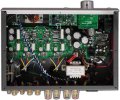
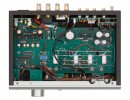
The SQ-N150 is noted for having a 1% distortion rate, in contrast to its predecessor's more favorable 0.3% distortion, according to the specifications sheet. The older model boasted additional components, including a choke and a higher quality volume control, indicating a less constrained approach to production costs.
Regarding their circuitry, the older SQ-N100 features the esteemed Mullard ultra-linear circuit, while the newer SQ-N150 utilizes a Pentode circuit. This distinction is significant when considering the heritage of classic amplifiers like the Marantz 8B, which essentially utilized a well-executed Mullard circuit. It's worth noting that Luxman, the manufacturer, has its roots as a transformer company.
From a personal standpoint, for those passionate about tube amplifiers, I would recommend the older SQ-N100 or SQ-N10 models. These models are nearly identical under the hood and, unlike the SQ-N150, they do not exhibit signs of cost reduction.
For anyone still following this thread I tried the SQ-N150 hooked up to the Revel Concerata2 F35 (90db sens) all day yesterday and really enjoyed the combination. Certainly non-fatiguing and nice for background music while working. Most of the time the F35's are powered by the Monoprice Monolith 2x amp with a powered Pre-Sonus subwoofer. That combination reminds me of that Maxell ad from years ago with the side view of the listener's hair being parted by the intensity of the sound. It's nice to have choices!