• Welcome to ASR. There are many reviews of audio hardware and expert members to help answer your questions. Click here to have your audio equipment measured for free!

Locking Banana comparison

...

Now, I am thinking that the best speaker cable is made of 12gauge, solid-core (4N), oxygen-free copper, with zero connectors.

KISS: (1)Skewer the end of the solid wire thru the binding-post hole, (2)tightly bend it around post CCW @270degree, (3)bind-down the post.
ummmmm....
I believe AWG12 stranded wire with a large number number of fine individual strands will have less AC resistance than the a solid wire same gauge. See Skin Effect.

This may or may not matter at audio frequencies.
 
Last edited:
See Skin Effect.

This may or may not matter at audio frequencies.
Skin effect is irrelevant at audio frequencies. The better reason to use stranded is that it's way more flexible and easier to work with. Also better for patch cable applications as you're less likely to end up with a broken wire due to bending and moving it around.
 
I believe AWG12 stranded wire with a large number number of fine individual strands will have less AC resistance than the a solid wire same gauge. See Skin Effect.
Only if the strands were insulated - see the Litz wire link in the wikipedia page you linked to. If the strands are uninsulated and tightly bundled then there isn't much resistance between strands, so the eddy currents won't be much lower than in a solid conductor of the same size.
 
Only if the strands were insulated - see the Litz wire link in the wikipedia page you linked to. If the strands are uninsulated and tightly bundled then there isn't much resistance between strands, so the eddy currents won't be much lower than in a solid conductor of the same size.
I've seen data showing that even tightly packed fine strands of bare wire produce Litz-like results. In any event, the debate rages on, and I do not care to indulge in it.
 
Per gemini:
A solid 12 AWG cable has an approximate resistance of 0.159 ohms per 100 feet.
A stranded 12 AWG cable has a slightly higher resistance, typically around 0.165 ohms per 100 feet.
Also remembering that there are no connectors (-8x/stereo) in the solid-core case, w/more permanent bonding to the binding posts.
Home usage is a 'fixed' installation, and our living room is that ideal location.
Solid-core OFC copper cables seem to run twice as costly as stranded cables.

In addition to the benefit of skin-effect, the stranded cable supposed to run cooler due to dead-air between the adjacent circular strands.:oops:
Combination yields a 'cool-skin' effect... if you are operating at hi-frequencies, hi-temperature and/or hi current environments.
 
Per gemini:
A solid 12 AWG cable has an approximate resistance of 0.159 ohms per 100 feet.
A stranded 12 AWG cable has a slightly higher resistance, typically around 0.165 ohms per 100 feet.
Apparently AI isn't the best source for technical info. You might want to dig a little deeper than quizzing an internet bot. The DC resistance of stranded 12 ga. AWG copper is 1.588 milliohms per foot, same as solid. (See chart on page HERE.)

DC isn't where one would expect see a difference between solid and stranded, because there's no skin effect with DC. However, music is an AC waveform, with the majority of current traveling along the skin, and the skin depth decreases as frequency increases.


Wire Skin Depth by Freq.jpg

Note that the diameter of 12 gauge is 0.0808 inches, making its radius 0.0404 inches. But the skin depth at 10KHz is less than that, and less than 0.02 at 20KHz, so a solid 12 gauge wire's impedance will be higher than stranded in that frequency range. As I said earlier, this may or may not matter with home audio. However, it is a fact.

Not even going to get into wire terminations with you. Do what makes you feel good and quit arguing.
 
Apparently AI isn't the best source for technical info. You might want to dig a little deeper than quizzing an internet bot. The DC resistance of stranded 12 ga. AWG copper is 1.588 milliohms per foot, same as solid. (See chart on page HERE.)

DC isn't where one would expect see a difference between solid and stranded, because there's no skin effect with DC. However, music is an AC waveform, with the majority of current traveling along the skin, and the skin depth decreases as frequency increases.


View attachment 469069
Note that the diameter of 12 gauge is 0.0808 inches, making its radius 0.0404 inches. But the skin depth at 10KHz is less than that, and less than 0.02 at 20KHz, so a solid 12 gauge wire's impedance will be higher than stranded in that frequency range. As I said earlier, this may or may not matter with home audio. However, it is a fact.

Not even going to get into wire terminations with you. Do what makes you feel good and quit arguing.

I very much doubt skin effect and such has any impact on analog audio signals.
 
Very likely not, but the phenomenon is real.
Of course it is. So is quantum entanglement. But it is utterly irrelevant in maintaining signal integrity in audio. I will not crack a joke about living near a power station ever again, because some people around here don't have a sense of humor with those things. :-D
 
Of course it is. So is quantum entanglement. But it is utterly irrelevant in maintaining signal integrity in audio. I will not crack a joke about living near a power station ever again, because some people around here don't have a sense of humor with those things. :-D
How dare you? Quantum entanglement is the most important aspect of high fidelity. :)
 
I had always been amazed how squirrels do that tight-rope walking on the AC power lines.:oops:
Then, I realized they just surf the peaks of the 60 Hertz, using the 'skin-effect'!
 
There's not one mention of BAF-type bananas in the discussion.
I purchased eight of these BAF-type[?] bananas and instantly got disappointed when they arrived.
Frankly, I decided against using them (a) as these have a wall-thickness which seemed too thin, for long term usage:
SpadeBanana1.jpg

I was also not going 'screw-around' with screwing one piece of a spade-lug to another (b), after screwing-in the cable to the other end.

My most recent 12awg cable build opted for these (c) banana plugs, which have two screws.
After tinning my cable end. Then, shoving it in the hole. I dogged-down the screw nearest the cable sleeve.
Next, I threw out the upper screw and used the hole for soldering from the end of bare wires inside.:)

SP10Posts.jpg

The arrows in the above capture are from a pair of binding posts, which I had not seen before. They look very robust!
The collets (red arrows) in the middle are free floating from the knurled binding parts.
Unfortunately, the spade-lug shown in (b) refused fit these binding posts properly.
 
I purchased eight of these BAF-type[?] bananas and instantly got disappointed when they arrived.
Frankly, I decided against using them (a) as these have a wall-thickness which seemed too thin, for long term usage:
The good ones use beryllium copper, also known as spring copper, which is ideal for this use and hold up well in the long term so long as you don't do anything daft. The bad ones use something cheaper which may not maintain spring tension, and the gold plating is often of poor quality. They're outwardly difficult to distinguish when new, so buy from a reputable supplier. Most other designs have a similar list of good and bad versions, typically with the spring part deforming on the bad ones, including your (c).
My most recent 12awg cable build opted for these (c) banana plugs, which have two screws.
After tinning my cable end. Then, shoving it in the hole. I dogged-down the screw nearest the cable sleeve.
Next, I threw out the upper screw and used the hole for soldering from the end of bare wires inside.:)
I thought this was going down the 'classic mistake' path of tinning the end before using a screw terminal instead of using a ferrule. Fortunately you saved the day with another dose of solder.
 
I'll tell you a kind of pro trick if you mess with actives and stuff.
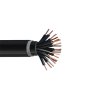
Scrap all speaker cables and go control cables. You can find them with as many cores as you like (usually 1.5 mm cross-section each,max for many cores, up to 4mm for fewer) and at reasonable prices.

At the moment I use a 21-core one (depends how I divide it, 5 cores for 4 connections usually)

1755516444178.jpeg

(they look like solid wires but are not, they are many strands)


Example:


Attachments

  • 1755516416037.jpeg
    1755516416037.jpeg
    40.4 KB · Views: 61
Last edited:
I'll tell you a kind of pro trick if you mess with actives and stuff.
Scrap all speaker cables and go control cables. You can find them with as many cores as you like (usually 1.5 mm cross-section each,max for many cores, up to 4mm for fewer) and at reasonable prices.

At the moment I use a 21-core one (depends how I divide it, 5 cores for 4 connections usually)

View attachment 470646
(they look like solid wires but are not, they are many strands)


Example:

Uh, why?
 
Biggest advantage I see: cheap and many strands/poles, practical for active 3-ways and stuff. Just a single cable instead of three. Quite practical a solution.
Gauge seems too small to use each one individually unless the lengths are extremely short. I was assuming he was using multiple strands shorted together to make an effectively larger cable. But we come back around to the question of why.
 
I thought this was going down the 'classic mistake' path of tinning the end before using a screw terminal instead of using a ferrule. Fortunately you saved the day with another dose of solder.
LoL! I like creating my own mistakes and don't like the classics (of any kind)! ;)
But that idea of using those ferrules (over bare strands) is a great idea... especially if you are allergic to the smell of solder burnt skin.
(they look like solid wires but are not, they are many strands)
Hey @Sokel, I am not going to skoleD you about skin-effect, :oops:...but aren't the individually insulated bunch wires defeat the purpose of multi-stranded speaker cables?
 
Gauge seems too small to use each one individually unless the lengths are extremely short. I was assuming he was using multiple strands shorted together to make an effectively larger cable. But we come back around to the question of why.
Cross section can be whatever you like, cores starts from 0.5mm and can go up at 4mm where you can mix and match easily as they are numbered.
But if you ask, it means you don't need it.
Hey @Sokel, I am not going to skoleD you about skin-effect, :oops:...but aren't the individually insulated bunch wires defeat the purpose of multi-stranded speaker cables?
I have measured any potential effect in any possible way, I haven't seen anything weird.
With RCL meter who can measure low resistance they seem pretty immune either core by core or measured in parallel.
Same when crossed by el. cables, signal cables, etc, they are supposedly immune as they are made for use in high industrial environments where control is crucial.

Cores are multistranded and lightly twisted with each other.
Strange thing is that as thick as it is as a whole is quite manageable, not a flex champion by all means though.
But stays exactly where you put it.
 
Last edited:
Biggest advantage I see: cheap and many strands/poles, practical for active 3-ways and stuff. Just a single cable instead of three. Quite practical a solution.
How do you know which cable is which at each end without ending up with 30 labels on the same cable, since it's not color coded (at least not in that pic)? :-)
 
Back
Top Bottom