• Welcome to ASR. There are many reviews of audio hardware and expert members to help answer your questions. Click here to have your audio equipment measured for free!

Live vs Reproduced Sound - your thoughts?

Live v. Reproduced Sound
  1. Indoors, home sized rooms. Of course, nearby walls or low ceilings can be a problem, and were in 3 out of 4 of the rooms I've had a "good" sound system in since 1959. Yes, absorbers and diffusers helped, but the sound still didn't sound very close to "live" in my 3 out of 4 "problem rooms."
  2. Outdoors, even when electrically amplified music was used, and even when the speakers were not my favorite (e.g., multiple Altec A7s), the famous bands who played (for free) in Golden Gate Park, or at the "T" intersection of Haight and Stanyan streets, or in Provo Park in Berkeley, or at the Bandstand at Lake Merritt in Oakland, sounded rather good, and live. No nearby walls. Watching the musicians doesn't hurt. It didn't seem to matter how many of the listeners were naked or stoned.
  3. Indoors, live orchestra. Maybe 100 players. At a fair distance, there is usually little imaging, except when obvious source instruments are used (cymbals, other percussion, particularly orchestra bells, as the Steve Weiss company puts it, "piercing melodic voice required to cut through any ensemble). Once, listening hard, while sitting in the balcony, the bells were the only thing that seemed to image. But, it sounded "live," just not as detailed as it might have been.
  4. Indoors, Cinema. Perhaps the widest range of quality of all. a) Old-fashioned optical tracks are the worst. They usually had terrible frequency response, very high distortion, and noise. Except for one system, used to exhibit Walt Disney's Fantasia (1940). See Scientific American, January 1941, by Peck. They used the highest quality optical sound film (they said), and up to 45 sound locations in each of the 13 theaters that could be equipped for this early stereo multichannel display. A sound (violins) could follow a shooting star as it crosses the proscenium arch and exits through the upper left wall, as it loses SPL, CUT TO "our" POV as we [the audience] then ride along [with? on?] the shooting star. Much later, choir members are heard coming down the theater aisles and entering a cloistered area composed of trees. T
    1784957432388.png
1784957432388.png


The dynamic range was extraordinary, thanks to automatic volume controls that turned the volume up or down to suit the storyline or musical needs. b) Magnetic soundtracks were warm and excellent. They often used 6 mag tracks on 70mm film to either side of the image
1784960230338.png
 
Last edited:
Went to the hallway and I could have sworn that it was me again playing inside the room, if only I did not know I was standing over here. :)
But have you ever heard in the hallway music that you. really in the room, are playing in the room? :cool:
 
But answer it I will
:)

Since it keeps with the theme of this thread…

I certainly have never advocated for vinyl (or tube amp) distortion, but I have explained why I personally seem to enjoy a bit of added distortion in my systems.

Adding distortion usually involves some sort of trade-off, and I’m OK with some of the trade-offs.

On my system… whether it’s due to my particular turntable/cartridge set up or distortions accrued from the process by which vinyl records are made…Vinyl playback distortions seem to add a sort of textural edge to the sound which translates to me as sounding a bit more vivid and solid - more palpable. As somebody else has put it, vinyl can seem to paint a slightly more solid picture of the sound.

To me that’s valuable because I highly value a sense of density and palpability. Stereo playback imaging lacks the density of the real thing. It sounds diaphanous, see-through, relative to real sounds. Adding additional speakers like a centre channel can help improve the sense of density, but I’m talking about my two channel playback.

So anything that that makes stereo playback sound a little bit more “there” is something I really appreciate, even if it is a subtle difference.

It’s one reason why I’ve gone and re-bought vinyl versions of some music I own on CD. I hear a trade-off of ultimate resolution, timbral nuance, lack of noise and sometimes bass quality… those advantages go to what I hear from digital. But a good vinyl record gets really close in those areas, close enough for me, that I can appreciate that added texture as well. (Whereas somebody else listening to the same comparison on my system may latch onto the superior aspects of the digital presentation and prefer the digital playback. I’ve had that happen).

Finally, I generally own records that are in very good condition and so to my ears, they effectively play back mostly without obvious noise - certainly rarely noticeable while music is actually playing. And when there are bits of noise - I don’t expect perfection from vinyl! - I seem good at mentally filtering it out in terms of my attention so it’s no big deal. I listened to a whole album last night and I can’t remember noticing any noise at all.

ETA: another way I can add some more of that texture/density is by manipulating room reflections, from wall surfaces, etc.
I find that as I cut down wall reflections using absorption (eg thick curtains) I gained more subtle detail and more timbral nuance and information about the specific reverbs and recorded acoustic from a recording.
Whereas if I allow more liveliness in the room the sound loses some subtlety but it’s like the “ room hash” adds some texture and solidity to the sound. I don’t know if others have the same experience.
Thanks. Although I really meant I was kidding.

One other thing I wanted to contribute to this thread/conversation is my (very personal and subjective) utter disdain for recorder live performance. For someone who doesn't like all the noise and the things I listed earlier, recorded live music (and to keep it precise and simple - this doesn't include recording a "live artist in the studio", but recording a live performance in some venue) has the worst of both (or all) worlds. It is not entirely true to the original recording, it always varies to some extent, it has all or most of the noise, but you're NOT actually there. I can't find positive sides to this. This in my eyes the weakest of the playbacks - it's not live, but it's not studio.

Having said that, of course I do love some (rare) live recordings, but I've noticed the ones I like are closer to the controlled live recordings like MTV Live albums (Nirvana, George Michael, Alice in Chains etc.) or those cute short sessions you can hear on NPR Tiny Desk Concert, like this one:
 
Last edited:
What I think people mean when thy use live music as their reference for what they want to achieve with their sound system, is the driving force of feeling the rhythm of the music in their bodies, and hearing the dynamic timing and play between the musicians. While recorded music productions are normally more polished, the live music qualities mentioned above will often go missing for different reasons.

A loudspeaker's characteristics important to me are the ability to play cleanly and dynamically, which at least helps to preserve a bit of that live music driving force, and audio productions that are semi-live recorded in the studio will often sound more “musical” as some of that natural timing is kept between the musicians instead of a “click track perfection”.
 
Although a live performance can't really be translated into living room listening I often prefer live recordings with applause and attendees reactions. This gives me some kind of live event dynamics, not all perfect but make me foot tipping.
 
  • Like
Reactions: mpw
Although a live performance can't really be translated into living room listening I often prefer live recordings with applause and attendees reactions. This gives me some kind of live event dynamics, not all perfect but make me foot tipping.
Agreed. I very much enjoy a good large screen video concert with surround sound - not the same as being there, but perhaps in some ways better - more intimate views of performers, often higher quality audio (not the PA at the live venue), my choice of timing and beverages . . . and a pause control. At the price of streaming, disc or kaliedescape it is a bargain.
 
To me there is nothing like seeing live music.
(emphasis mine)
Going to big concerts like the ones you describe is definitely more about visual and social stimulus than musical. There's a reason you/we say "seeing" instead of "hearing".
 
Thanks. Although I really meant I was kidding.

One other thing I wanted to contribute to this thread/conversation is my (very personal and subjective) utter disdain for recorder live performance. For someone who doesn't like all the noise and the things I listed earlier, recorded live music (and to keep it precise and simple - this doesn't include recording a "live artist in the studio", but recording a live performance in some venue) has the worst of both (or all) worlds. It is not entirely true to the original recording, it always varies to some extent, it has all or most of the noise, but you're NOT actually there. I can't find positive sides to this. This in my eyes the weakest of the playbacks - it's not live, but it's not studio.

Having said that, of course I do love some (rare) live recordings, but I've noticed the ones I like are closer to the controlled live recordings like MTV Live albums (Nirvana, George Michael, Alice in Chains etc.) or those cute short sessions you can hear on NPR Tiny Desk Concert, like this one:
How about Bill Evans live at the Village Vanguard ? What about Pink Floyd live at Pompeii ?
 
Agreed. I very much enjoy a good large screen video concert with surround sound - not the same as being there, but perhaps in some ways better - more intimate views of performers, often higher quality audio (not the PA at the live venue), my choice of timing and beverages . . . and a pause control. At the price of streaming, disc or kaliedescape it is a bargain.
If you get close enough you don't need a large video screen, please no surround sound , maybe at IMAX. I have seen the Pat Metheny group with Lyle Mayes live many times, no large screen, incredible sound quality. Saw The Who at the Hard Rock cafe in Hollywood Fl. one of the best concerts I have seen, no Large screens to PA just stacks of Fender Tube Amps. GrateFul Dead at Boston Garden with their wall of sound systems, fantastic sound quality. Used to see lots of Jazz at the Boston Workshop Jazz club, no compliant's there.
 
(emphasis mine)
Going to big concerts like the ones you describe is definitely more about visual and social stimulus than musical. There's a reason you/we say "seeing" instead of "hearing".
You are correct hearing and seeing !!
 
Agreed. I very much enjoy a good large screen video concert with surround sound - not the same as being there, but perhaps in some ways better - more intimate views of performers, often higher quality audio (not the PA at the live venue), my choice of timing and beverages . . . and a pause control. At the price of streaming, disc or kaliedescape it is a bargain.
Yes, much better if video is available. There it is almost to be there where the act is. I like this very much. In this case the audio quality must not be superb.
 
Agreed. I very much enjoy a good large screen video concert with surround sound - not the same as being there, but perhaps in some ways better - more intimate views of performers, often higher quality audio (not the PA at the live venue), my choice of timing and beverages . . . and a pause control. At the price of streaming, disc or kaliedescape it is a bargain.

Same here. My favourite way to listen to music in surround is on my home theatre system, and projection screen… music videos, and especially live performances.
The visuals seem to make the sound better.

I’m very jealous that you have the kaleidescape system. I’ve been dreaming of that system for years and I hope to pick up their new cheapest option. I have a large collection of physical movies, but I’m done collecting movies on physical media.

Btw, one of my favourite ways to exploit the big projection picture and surround sound is actually watching high quality image and sound walk-throughs of audio shows around the world. I’ve always loved going to audio shows to see and listen to all the wild gear, but I can no longer get out to those.

However, being a home theatre fanatic I designed my room with a very large projection screen and black velvet masking.
The screen is set against a pitch black velvet covered wall, and I’m able to blackout the room with black velvet curtains, pulled across all the walls when desired. It really helps the room feel like it disappears visually and all I’m left with is the giant image floating in space which enhances the sense of “ looking through a window” dimensionality.

Some of the high-quality audio show videos on YouTube are extremely sharp and clear with great contrast… there’s a real sense of almost peering right into the rooms at various systems. Put that together with a good audio recording and there is an amazing sense of being at the show and prowling through the corridors and into the various rooms. With the surround sound, you get that immersive spacious feeling when you’re in the big spaces, and the sound narrows as you go down a corridor and enter a hotel room and then widens out again as the camera enters the room and you hear and see the system.

Of course I’m only hearing what the microphone heard - no substitute for what it actually sounded like - but a good recording can really portray a convincing sense of hearing relative differences between the different systems and different rooms… the sound and acoustics changes substantially between systems … and so it creates a really fun impression of attending a show.
 
This subject has occurred in bits and pieces on threads over the years, but I wanted to throw the question out on a dedicated thread:

What are your views on live versus reproduce sound? Can reproduce sound ever seem truly live? If so, how and if not, why not? And do you care at all about any semblance of sonic realism?

I’m interested both in personal impressions - what do you notice most about the difference between live versus reproduced sound?

As well as any technical discussion on the subject.

I understand that lots of people here don’t even seek sonic realism and don’t think it’s generally possible. But I’m interested in those reasons as well.

I’ve always been fascinated by the difference between live versus reproduce sound. I did my own informal live versus reproduced, listening tests, many years ago with various speakers in my room.

But I couldn’t achieve anything scientific. It still felt somewhat illuminating though (when some recordings of an instrument, her voice were compared directly to their live counterpart in the same room, some loudspeakers more than others struck me as sounded closer to the real thing).

Early on in the 90s I had a chance to listen to the big, reference Genesis1 loudspeakers (at lyric hi-fi in New York as I remember).

I was able to sit down all by my lonesome in the big room with these huge beasts and play all sorts of my CDs.

I’ll never forget the impression they made on me with a number of orchestral pieces. I had never experienced high-end speakers producing that combination of realistic scale and imaging, detail and impact.

With my eyes closed the sensation of peering into a life-sized orchestra was more vivid than I had ever experienced. (I was attending live Orchestra performances regularly at that time).

And yet hearing sound reproduction so much closer to the real thing in terms of scale and detail made what was missing jump right out to me: timbral realism. It was missing the colour of the real thing.

I would liken it to experiencing a huge Ansel Adams black and white photograph of an Orchestra. It was so finally detailed I could scan the orchestra for every instrument. But like the black-and-white photograph, it was missing the rich sense of timbral colours I was used to hearing when I would close my eyes and listen at a live symphony.

Another way of putting it: it was like every instrument in the symphony had been replaced by a plastic replica, so even though I could identify each instrument there was this bland, homogenized “ everything is sort of made out of the same plastic material” timbral impression.

I left wondering if this revealed a sort of line in the sand for reproduce the sound. How can a system with a very small number of transducers recreate a sound field that originally involved hundreds of vibrating sources?“Maybe it’s just too much to ask a handful of speaker drivers to reproduce the true range of timbre one hears from real symphonies or real sounds? If the sound is coming from just a few driver materials, then maybe that’s why there is a certain sameness to the sound.”

That made a bit of intuitive sense.

But then it seemed to break down because I realized that, of course our eardrum acts essentially like a speaker driver in reverse; it receives the sum of all the sound pressure waves arriving at the ear.

And somehow, from that decodes all the different instruments.

(and even though a lot of of the decoding complexities happens further down in the cochlea, it’s still a case that the eardrum sums the pressure waves before that point as I understand it).

So there isn’t in principle anything wrong with the concept of a single vibrating membrane, or several - speaker drivers of some sort - reproducing the combined waveform of a symphony or anything else. Because of course, why would we even be able to record and playback symphonies or any other instruments the way we already can.

The devil obviously is in the details in terms of how sound reproduction, from microphones to real world loudspeakers, actually fail to fully reproduce “ the real thing.” (And of course, the inherent limitations in stereo reproduction).

In any case, especially ever since that experience many years ago, I’ve always felt sensitive to the perception that recordings played through most loudspeakers sound homogenized relative to the original sounds or similar sounds in real life. And it’s been one of my guiding lights to seek out sound reproduction that… at least in my perception…sounds as “timbrally varied and surprising as possible.”

In most systems once I’ve heard a few tracks of drum symbols and drums and trumpet or sax, I think “ OK… got it…. That’s how those instruments are going to sound generally speaking through these speakers across many recordings.” There are no more surprises.

What do other people think about this? Does anybody else share my perception of recordings and/or audio systems homogenizing and reducing timbral richness and variety?

Any other ways you find reproduction sound tends to fall short?
I've got countless live performances recorded on beta, dat, hard drives, many with my mics and the soundboard as two different sources, which I matrixed after sometimes. The mic recorded shows bring me back more than the soundboard recordings, worth the reliving. Unamplified acoustic performances were great when we were allowed to mic the stage.

Having said that, there are some bands that I can only listen to their studio works, it just invokes a different feeling,
 
If you get close enough you don't need a large video screen, please no surround sound , maybe at IMAX. I have seen the Pat Metheny group with Lyle Mayes live many times, no large screen, incredible sound quality. Saw The Who at the Hard Rock cafe in Hollywood Fl. one of the best concerts I have seen, no Large screens to PA just stacks of Fender Tube Amps. GrateFul Dead at Boston Garden with their wall of sound systems, fantastic sound quality. Used to see lots of Jazz at the Boston Workshop Jazz club, no compliant's there.
If you allow, I got the feeling perhaps you misunderstood a few points. @Floyd Toole wasn't talking about large screens in concert, but a big screen at his home. When you say you saw Metheny with no large screens, it sounds like you thought @Floyd Toole needs a big screen AT THE VENUE.

Another thing is this surround. Don't dismiss it up front. There is something really beautiful you can achieve with surround. It's up to the one mixing the channels, of course, but when properly done, it can be wonderous.

You can use surround to give one a rather gimmicky sense of being on the podium in the middle of musicians. And then there's this method of using surround to provide a better sense of 3D. You still have a feeling you're sitting in the audience, not on the stage, but you can get a "palpable" sense of one musician being in front of another or precisely to the left or right, exactly where he is. This can be achieved with surround with stunning results.
 
How about Bill Evans live at the Village Vanguard ? What about Pink Floyd live at Pompeii ?
Of course. Take your pic. I just wanted to make an exception for certain live performances and to make a point that, considering what I don't like about live performance, that expectedly, the ones I WILL like are the ones that are in heavily controlled conditions. The thing I like about Pompeii is that there was no audience.
 
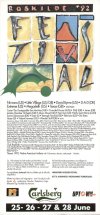
Festivals like Lollapalooza—or Roskilde in Denmark. It’s a whole package deal that involves more than just watching bands; there’s the sense of community, camping, partying, and so on. Of course, it’s impossible to replicate that kind of feeling when listening to a home hi-fi system. Still, it’s a quintessential part of youth.

Now that I’m middle-aged—or a bit beyond that—I wouldn’t have the energy to keep up the pace needed to get the most out of running around a festival site. But back then... damn, I saw so many great artists and bands during the years I went to the festival.: :D
koncertliste-1992.jpgkoncertliste-1990.jpgScreenshot_2026-07-27_124158.jpgScreenshot_2026-07-27_124219.jpgScreenshot_2026-07-27_124231.jpg

Otherwise, smaller clubs where things feel intimate and you’re close to the musicians can be really nice.

As for big concerts in general—when you end up far away from the artists, a massive, spectacular light show (like Pink Floyd’s Pulse concert) is pretty cool. Though, as you get older, watching a concert like that Pulse at home on a big TV or projector with a good surround sound system is nothing to sneeze at, either. :)
That aspect has already been addressed in this thread
Agreed. I very much enjoy a good large screen video concert with surround sound - not the same as being there, but perhaps in some ways better - more intimate views of performers, often higher quality audio (not the PA at the live venue), my choice of timing and beverages . . . and a pause control. At the price of streaming, disc or kaliedescape it is a bargain.
...I see. :)

Fire up the TV/projector and watch:

(Referring to two different Floyds—actually mostly a coincidence, believe it or not.;):))
 
Last edited:
My favorite live music is small venue amplified. A great bar, a small performance hall, or an outdoor amphitheater/shed.
Generally an audience size of less than 500 peeps, maybe a 1000 tops. And able to get close.

Best sound is when I'm close enough to stage that the backline is the predominant sound source, with only the vocals and electronic instruments like keys coming though the PA.

But this needs a good soundman to balance PA with backline, and muso's that keep their stage volume in check for clean sound, etc.
Which seems to happen not as often as hoped. And I end up walking out of a fair % of shows. I'm a real sound-quality nut.

Likewise I have a hard time with large-scale amplified, unless tickets are prime. And then i usually have a hard time with the audience.
I come for the music, not a screaming fan experience... lol.

If only I liked classical, where the audiences are so relatively nice....but I've almost fallen asleep in every symphony I've attended ..lol.

Anyway, when an artist comes to a small venue and I like the show, I immediately go home and compare their studio (or live) recordings on my system..
By memory with all its problems for sure...but still it works.

I have a system that's a bit more powerful, clearer, and with deeper/stronger bass extension, that I'm likely to run into in the size performances I've been describing. 99.9% would say massive overkill for home

Comparing the same songs I heard at the show to their studio recordings, my system usually sounds better overall.
I've got the dynamics and SPL and bass.. What's often missing though, is the stage separation of separate backline speakers/amps..
If out in the audience where the PA is the main source of sound, I almost always prefer the recording at home...
when talking solely about sound quality and recreating the impact of live.
 
I recorded some instruments and vocals in the same spot in my listening room, between and somewhat behind the loudspeakers.

Then I would play the recording back on the speakers and I would have the person playing the instrument or whose voice I recorded standing where the phantom image seems to be coming from. (which tended to be pretty close to where they were recorded). And then switch between the live versus reproduced to compare.
Perhaps relevant here... when I was learning to record myself playing acoustic guitar I noticed something interesting. The recordings were made in the study/music room and I used the same room and computer for post. Normally I prefer not to use headphones and use them only when needed. But I found that I disliked the sound of the recordings on the monitors and liked it with the headphones. I figured it's because with the monitors I was listening to the room effects doubled.

The room's modes are captured in the recording with the mics and the same room modes are again applied in playback because it's the same room. With the headphones one of those is removed.

I used X-Y SDC fairly close, about 10" (25cm), for recording. With just a few more inches, say 14" total, the room sound is too much even. Hence I guess there's a good amount of room sound in the recording. With playback at the desk I am about 2'8" (80cm) from the boxes.

When I read this post of yours I was reminded of this experience. I don't recall reading discussion of a "room-doubling effect" but given how many bedroom/study recording studios there are I suppose it must be commonly experienced.
 
Last edited:
Back
Top Bottom