• Welcome to ASR. There are many reviews of audio hardware and expert members to help answer your questions. Click here to have your audio equipment measured for free!

Lewitt LW6

makes sense, besides the dotted line is the LW6 on your fixture I assume ?
The dotted line shows the frequency response on the GRAS 45CA-10 that we have in the R&D lab, yes (with the anthropometric KB501X pinnae and the damped RA0402 couplers).
But since this fixture does not 100% match the acoustic load of a human, a headphone (specifically high acoustic impedance headphones, e.g. closed-backs) will physically produce a different sound pressure on it compared to when the same headphone is placed on humans.
That's why tuning a headphone isn't as simple as just brute-forcing the frequency response (as measured on e.g. the 45CA-10) to the Harman Target.

For the final round of tuning we compared different filter settings:
  1. a setting that would 100% match the headphone to the Harman Target when measured on the 45CA-10
  2. a setting that was derived purely by ear by our product manager
  3. a setting that matched the target response when measured on humans
  4. no EQ setting at all
Setting no. 3 was preferred unanimously in a double-blind test by every single test person.
Funny enough, setting no. 4 was the 2nd highest rated!

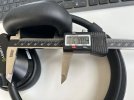
Good to read there is enough adjustability of the headband and room inside the pads (internal height >60mm and depth >25mm ?)
I don't know the depth from the top of my head - but it of course varies depending on how wide your head is (wider heads create higher clamping force, which compresses the pads more)
Internal height is 67mm.
 

Attachments

  • IMG_6365.jpeg
    IMG_6365.jpeg
    624.8 KB · Views: 105
  1. a setting that matched the target response when measured on humans
  2. no EQ setting at all
Setting no. 3 was preferred unanimously in a double-blind test by every single test person.
Were these humans the same people? Or did the blind test include people not used in that study? Also, what did you do with variations between human measurements? Average them?
 
Might be useful to also drop this bit from one of Konstantin's presentations about measurements in real ears. The "Commercial Closed" headphone is the LW6.

1791143196439.png


Measurements from the Headphones Show.

Not sure why my screen cap erased the trend line in the second graph.

Updated MIRE data below, including my data for the LW6 as well.
HpTF.png
 
Last edited:
This I will buy. Looking forward to get some user's experience but it already seems like I'm looking at my christmas' present.
 
I would too, if I didn't already have the HDB 630 with its onboard EQ and its "low enough for casual gaming" latency.
 
Were these humans the same people? Or did the blind test include people not used in that study?
Not the same people but a subset of them:
We do measurements on our full test panel, but for listening tests we only use those that show an interest in headphone listening (most people on our team have a background in music production or broadcast studios, but there are some that are not interested in listening tests at all

Also, what did you do with variations between human measurements? Average them?
Truncated average, yes. We saw grouping between people who do and who don't wear glasses, but for the listening tests we asked the test subjects to take off the glasses (to be fair, all the trained listeners took off the glasses on their own without being prompted)
 
Interesting. Very curious to try them. I used to use some old and newer Sennheiser RS headphones, and the older ones (RS 180 IIRC) had Kleer decently low-latency streaming (but the actual headphones were not great). The newer ones (RS 185?) used something else and it made them less usable (also didn't sound great). Would like to jump back into wireless.

It's just that, at that price, I would've expected a charging stand. Having to plug a cable into them like some kind of animal feels rather anachronistic at this point. Maybe v2 will have that.
 
Last edited:
Interesting. Very curious to try them. I used to use some old and newer Sennheiser RS headphones, and the older ones (RS 180 IIRC) had Kleer decently low-latency streaming (but the actual headphones were not great). The newer ones (RS 185?) used something else and it made them less usable (also didn't sound great). Would like to jump back into wireless.

It's just that, at that price, I would've expected a charging stand. Having to plug a cable into them like some kind of animal feels rather anachronistic at this point. Maybe v2 will have that.
A dock, at least as an accessory.
 
does this headphone have good air energy above 10khz? I like headphones with that. I think it helps staging and image. I will try and find a demo, maybe it is possible since this company seems to be based here in Vienna.
 
does this headphone have good air energy above 10khz? I like headphones with that. I think it helps staging and image. I will try and find a demo, maybe it is possible since this company seems to be based here in Vienna.
then better to go demo than ask for that here
 
does this headphone have good air energy above 10khz? I like headphones with that. I think it helps staging and image. I will try and find a demo, maybe it is possible since this company seems to be based here in Vienna.
The LW6 has on-board parametric EQ which includes a high shelf filter. You can add however much "air" you want.
 
does this headphone have good air energy above 10khz? I like headphones with that. I think it helps staging and image.
You can adjust this by 20 dB with the built-in EQ (parameters get stored on the headphone, so the EQ remains regardless of what input you use on the headphone)

1791296433776.png


I will try and find a demo, maybe it is possible since this company seems to be based here in Vienna.
Give me a call and I'll give you a guided tour in our HQ :)
We're near U3 Johnstraße.
Open invitation to anyone who's local :)
 
Last edited:
Got my pair today, I would also call them essentially perfect
Really outstanding job they've done with these. They really don't have any of the closed back sound I've come to expect from even "good" closed back headphones
 
Got my pair today, I would also call them essentially perfect
Really outstanding job they've done with these. They really don't have any of the closed back sound I've come to expect from even "good" closed back headphones
What other closed backs have you got for comparison? I'm very interested in this for some reason despite having too many closed headphones already!:facepalm:

Perhaps to do with the novel tuning approach and generally liking Oratory's EQ on my headphones.
 
Waiting for my pair arriving Tuesday. I was considering the DCA E3's but after the amazing reviews, I have to give these a shot. This will be closed back #15 so fingers crossed the is the end game. Just need to find some black gaffer tape to put over the Nvidia Lewitt logos. ;)
 
Disclaimer first: I work for Lewitt.
Don't ask me to help you set up the headphones though - I work in R&D, not in customer support :)

I don't think I'll add this to the repository - it is already tuned to hit the target as close as is reasonably possible. Any further adjustment will be based not on the average but on the individual - that's not something I can help with in an EQ preset.
We expect people need to adjust:
  • the bass, which mostly depends on how well the headphone seals against the user's head (people with glasses and/or long hair will need to turn the bass up)
  • the high frequencies - this partly depends on the shape of your ear canal and partly on the amount of hearing loss you have (if you're over 30 then you most likely will have some hearing loss at high frequencies)
  • Low-mids (200-300-400 Hz) - on some people where the earpads don't fully seal there's an additional resonance at around 300 Hz, they might need to reduce that with the EQ
  • Upper mids (3 kHz) - at the ear canal resonance we notice some variation across different users. This again is expected for a closed-back headphone. Users may need to increase or decrease this region by maybe 2-3 dB
For all of the above, the headphone by default is tuned to fit the average user (no glasses, no long hair), so if that's you (no glasses, no long hair on the side of the head) then chances are the stock tuning will fit you well and you'll only have to adjust for personal preference.


These questions all revolve around the same topic:


On our test panel there's:
  • men and women
  • different hair length (bald, short hair, medium hair, very long hair)
  • different beard length (shaven, stubble, full glory)
  • different ear sizes (from very small to annoyingly large - seriously, our CTO hurts his ears on basically every pair of headphones, that's how big they are. But it also means that if they fit him, they'll fit virtually everyone)
  • with and without glasses
  • different ages
  • different ethnicity
We can't account for everything, but within the limitations set we got a representative test panel here.

We did test the headphone on people with glasses as well, yes, so we can quantify how much bass is lost on average with/without glasses. Making the LW6 more leakage tolerant than other closed back headphones was a design goal - and we can prove that we achieved it :)

I'll definitely publish an EQ setting that compensates for the average amount of bass lost when wearing glasses!


Indeed! That's why we relied much more in real-ear tests (microphone in real ear) than on test fixture tests (e.g. Gras 45CA or B&K 5128) for the acoustic tuning of the headphone.


It can be quite tricky if the DSP limits the amount of filter bands you have - you then need to get creative with overlapping filters instead if just throwing peak filters at the graph and let the optimizer adjust gain, frequency and Q-factor.

I did work on the tuning, but it's not "my" headphone - it's the work of everyone who worked at Lewitt in the past years. Two ex-Focal engineers did the driver design and part of the electronics, An ex-Sennheiser engineer worked on acoustics design as well. It was quite the team effort!

I haven't tested them on the PS5!
But these headphones go much louder than conventional wireless headphones - they're classified as professional headphones, not consumer headphones, which means they are not subject to the 110 dB limitation of consumer headsets. The max SPL is just over 120 dB on the LW6 - so loudness will not be an issue on them even if the PS5 cuts the volume in half for some reason.
The headphones have a loudness guard feature where they will automatically reduce volume if the sound pressure exceeds a certain value (value can be set by the user, the feature can also be deactivated if you want to break your eardrums. Not recommended). And yes, the headphones do show the current SPL in the app (peak and RMS) so you can check how loud you're currently listening. It's accurate to within about 3 dB.

Thank you so much for all the hard work you and the team you are part of put into this!
I am sure I will get to try them at some point in the future and will gladly give some feedback when I do. :D


The classification/limitations set to headphones was actually a problem I ran into in the past. (mid 2000 I think)
This was for a headphone from Japan, so perhaps there was a communication issue, but we were not allowed to import them into the EU due to their high sensitivity.

At *that point I had already tested a lot of headphones and the only headphone that sounded right to me was the HD600/650 with some shelf filtering, basically tone controls.
Most headphones at any price sounded straight up broken to me back then so I simply gave up on investigating further at that time.
Looking at the research done at Harman years later gave me a pretty clear picture as to why that was the case.

Luckily the industry is going in the right direction and it puts a smile on my face to read how much work went into this.
I understand this might not happen but I do hope some of the research that went into this will be shared/published at some point in the future.:)

With best regards
-Ype

Edit: I see you already gave a talk at canjam and shared some more insights in that thread about it. :D
 
Last edited:
@oratory1990 as a side-note, might be hard to say though - does Lewitt plan to support these (esp. batteries and pads) 3 years+ into the future? Those are not cheap enough to consider throwing them away after the batteries kick the can eventually.
As for earpads, yes, additional stock of the earpads will be produced once they are no longer needed for the first batches of mass production.

As for the battery, the exact method of replacing them is still being discussed internally (whether we produce an instructional video on how the user can replace it by themselves, whether we'll go the authorized service center route) but that is being talked about.

Using them for 8 hours per day 5 days a week will give you about 4.5 years before the battery capacity even drops below 80%, so it's not an immediate problem.
But we will be supporting those headphones for a long time, yes. Being a pro-audio manufacturer first and foremost, our projects are generally long-lived compared to consumer audio products, meaning we don't churn out a successor product every year.
Edit: I see you already gave a talk at canjam and shared some more insights in that thread about it. :D
Correct, the "closed headphone" in this presentation is LW6 (very close to but not the final tuning, we still implemented some impedance-lowering features to reduce the amount of variation from person to person a bit)
 
Back
Top Bottom