

-
Welcome to ASR. There are many reviews of audio hardware and expert members to help answer your questions. Click here to have your audio equipment measured for free!
You are using an out of date browser. It may not display this or other websites correctly.
You should upgrade or use an alternative browser.
You should upgrade or use an alternative browser.
Let's share diagrams (and photos) of our total physical audio system and the whole signal path, with a few words and/or links
- Thread starter dualazmak
- Start date
May I ask what 1:4 RCA switch are you using? Thanks.When you are so nerdy and have built a system that should be able to do EVERYTHING, and it ends up that you can't even find your way around the system's nooks and crannies after the entire build-out WITHOUT looking at the diagram, then you have to simplify things so that it makes more sense and potentially also a shorter and better signal path.
So that's what I've done recently - also out of consideration for my wife who can't be blamed for getting lost in it every now and then when she should be listening to CD, Streaming or something completely different.
A rod for one's own back!!
These two pictures are the signals ways - before and after simplification. Changes are marked with purple dotted rings.
View attachment 544619View attachment 544620
marin.weigel
Member
Let me add some measurements of my above set-up, in case anyone's interested ...
Attachments
-
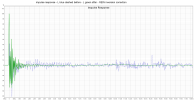 2022-09-22-5-L-impulse-bfore-after.png121.9 KB · Views: 110
-
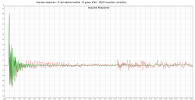 2022-09-22-5-R-impulse-bfore-after.png120.7 KB · Views: 103
-
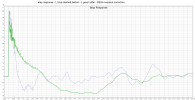 2022-09-22-5-L-step-bfore-after.png103.7 KB · Views: 98
-
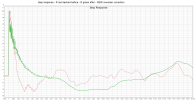 2022-09-22-5-R-step-bfore-after.png102.3 KB · Views: 95
-
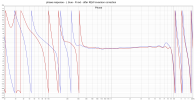 2022-09-22-5-LR-phase-after.png181.8 KB · Views: 109
-
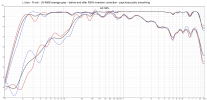 2022-09-22-5-overview.png155 KB · Views: 93

Fidji
Addicted to Fun and Learning
- Joined
- Feb 17, 2019
- Messages
- 629
- Likes
- 1,222
What is the benefit of Rotel [why not simple power amp]?

The PC is a Kubuntu linux PC with Roon server installed. I also subscribe to Qbuz. Most of the time I listen to Radio Paradise, which is a great way to discover new music. Most of my music files are FLAC files ripped from CD's. I have about 25 LPs. The phono cartridge is a MC Ortofon Quintet black.
There are six additional acoustic panels out of picture - two absorbers on the ceiling and four diffusers on the back wall, all by Gik. Practicing live-end, dead-end.
There's a UMIK-2 attached to the PC to take REW room measurements. I'm working on generating room EQ files on REW that can be used on the PC to correct room anomalies. I currently use Dirac on the miniDSP to do room correction. The room is 9' x 18' (2.7m x 5.5m).
I'm very happy with the Yamaha gear, they're all built very well and sound great. The Benchmark DAC is new. I aquired it because the CD player has digital inputs, so you can use it's ES 9018 DAC for other purposes. But the CD player's USB input requires an ASIO driver, whch is not available on linux, hence the Benchmark DAC.
The FreeBSD file server holds all my music files, as well as all my videos, documents, pictures, etc.
All the cabling comes from Blue Jeans cable. Most of the connections are balanced, including the phono connection.

Keith_W
Master Contributor
Wall to wall carpet + 4 Persian rugs on top of it? You must like Persian rugs!

The Kantas dip to 2.7 ohms, so they needed plenty of Class A/B power, balanced XLR inputs, and a home theater bypass which ruled out using a separate power amp, since none offer that. The Rotel also includes a decent DAC, although the Oppo's is still superior. Since the Oppo is a universal player capable of playing 4K Blu-rays, SACDs, and DVD-Audio discs (all of which I have a large collection of), it made sense to keep it as the primary source. It also provides a cleaner, dedicated HDMI audio-only output. Most importantly, the Rotel lets me completely isolate the stereo and home theater systems while still sharing the front main speakers.What is the benefit of Rotel [why not simple power amp]?
Last edited:

I finally got around to cataloging my system.
note: Stuff like this is so much easier and funner with ai than it would have been even 6 months ago. It is so eery to talk to a 'person' who fundamentally understands what you're telling them at a logical level better than probably anyone you've ever met in your life, including yourself sometimes. I've had most of these automations and devices for years now, but over half a decade, open source stuff evolves and you end up with several broken integrations and configurations. Ai just fixed that all for me once it understood the logic map of the system. Then took that and fixed the homeassistant and roon boxes that I have.
Astute eyes might point out my redundant DAD loop, but it allows me to have a pretty foolproof volume control solution. I think Nyquist would argue that the bandwidth-limited signals before/after aren't just close, but identical. I probably sacrifice much more error by adjusting volume in the analog domain and hence reducing SNR substantially downstream. In practice, tubes are only used for additional gain when listening to quieter classical/opera recordings.
If @amirm or anyone else ever comes over with an Audio Precision analyzer, I will disable the DAD loop and use the volume on ADI-2 PRO!
Hope you enjoy the multimedia experience
Full system viz
Last edited:

Sjkrabbe
Active Member
I was just one I had used in other use cases. Nothing fancy but transparentMay I ask what 1:4 RCA switch are you using? Thanks.
OP

- Thread Starter
- #470
So,,, have you achieved these "house curves" with no subwoofer?Let me add some measurements of my above set-up, in case anyone's interested ...
Even though the psychoacoustic smoothing always gives really nicely smoothed "house curves", it always hides almost all the "room acoustic modes".
Only if possible, therefore, would you please share not-too-much-smoothed curves at your listening position (ref. my post #1,009 on my project thread) representing various room modes?
In the end of Dr. Toole's wonderful post here, he wrote:
Don't worry about little ripples. When I see exceptionally smooth high-resolution room curves I strongly suspect that something wrong has been done. The measurement microphone is no substitute for two ears and a human brain.
And in his post here, Dr. Toole kindly wrote responding to my inquiry:
If properly done both swept tone and noise analysis should give identical answers. It is a choice. The principal difference is in the heating of the drivers in sustained tests at high sound levels - power compression. Low frequencies require longer averaging times.
Last edited:
OP
- Thread Starter
- #471
Can I ask about your "TWIN VU METERES"?I finally got around to cataloging my system.
note: Stuff like this is so much easier and funner with ai than it would have been even 6 months ago. It is so eery to talk to a 'person' who fundamentally understands what you're telling them at a logical level better than probably anyone you've ever met in your life, including yourself sometimes. I've had most of these automations and devices for years now, but over half a decade, open source stuff evolves and you end up with several broken integrations and configurations. Ai just fixed that all for me once it understood the logic map of the system. Then took that and fixed the homeassistant and roon boxes that I have.
Astute eyes might point out my redundant DAD loop, but it allows me to have a pretty foolproof volume control solution. I think Nyquist would argue that the bandwidth-limited signals before/after aren't just close, but identical. I probably sacrifice much more error by adjusting volume in the analog domain and hence reducing SNR substantially downstream. In practice, tubes are only used for additional gain when listening to quieter classical/opera recordings.
If @amirm or anyone else ever comes over with an Audio Precision analyzer, I will disable the DAD loop and use the volume on ADI-2 PRO!
Hope you enjoy the multimedia experience
Full system viz
View attachment 546009
Are they IEC 60268-17 compatible ones, especially compatible with ballistic behavior standard/specification (ref. here)?
Just for your possible reference and interests, you can find my DIY-built IEC 60268-17 compatible 12-VU-Meter Array here on my project thread with links to my "dancing VUs" videos.
Last edited:
OP
- Thread Starter
- #472
Wonderful setup!View attachment 545775View attachment 545776
The PC is a Kubuntu linux PC with Roon server installed. I also subscribe to Qbuz. Most of the time I listen to Radio Paradise, which is a great way to discover new music. Most of my music files are FLAC files ripped from CD's. I have about 25 LPs. The phono cartridge is a MC Ortofon Quintet black.
There are six additional acoustic panels out of picture - two absorbers on the ceiling and four diffusers on the back wall, all by Gik. Practicing live-end, dead-end.
There's a UMIK-2 attached to the PC to take REW room measurements. I'm working on generating room EQ files on REW that can be used on the PC to correct room anomalies. I currently use Dirac on the miniDSP to do room correction. The room is 9' x 18' (2.7m x 5.5m).
I'm very happy with the Yamaha gear, they're all built very well and sound great. The Benchmark DAC is new. I aquired it because the CD player has digital inputs, so you can use it's ES 9018 DAC for other purposes. But the CD player's USB input requires an ASIO driver, whch is not available on linux, hence the Benchmark DAC.
The FreeBSD file server holds all my music files, as well as all my videos, documents, pictures, etc.
All the cabling comes from Blue Jeans cable. Most of the connections are balanced, including the phono connection.
I am very much fascinated not only by the exciting audio gears but also by your signboards;

Your gorgeous audio setup vividly reminds me of my intensive auditioning session for YAMAHA C-5000 + M-5000 + NS-5000 at Yamaha's dedicated audio room/cottage near Hamamatsu City (ref. my post here).
Last edited:
OP
- Thread Starter
- #473
From a little bit different perspective, I too use "integrated amplifiers" in my multichannel multi-amplifier full-active audio setup...The Kantas dip to 2.7 ohms, so they needed plenty of Class A/B power, balanced XLR inputs, and a home theater bypass which ruled out using a separate power amp, since none offer that. The Rotel also includes a decent DAC, although the Oppo's is still superior. Since the Oppo is a universal player capable of playing 4K Blu-rays, SACDs, and DVD-Audio discs (all of which I have a large collection of), it made sense to keep it as the primary source. It also provides a cleaner, dedicated HDMI audio-only output. Most importantly, the Rotel lets me completely isolate the stereo and home theater systems while still sharing the front main speakers.
In my post #931 on my project thread, I wrote;
Here in this post, please let me emphasize again about the pros and merits of relative gain (i.e. tone) control not only in digital domain but also in analog domain using pre-amplifiers or integrated-amplifiers (in my setup). I recently wrote again in my post #56 on a remote thread like these;
Yes, as for safe and flexible tone controls (or I can say "relative gain controls among the multiple SP drivers"), my stance (policy) at least, is that we are encouraged to utilize the "best combination" of "DSP configuration in digital domain" and "analog domain tone controls using HiFi-grade preamplifiers and/or integrated amplifiers".
We need to note (and to respect for) that analog domain tone controls (relative gain controls among the multiple SP drivers) give no effect nor influence at all on the upstream DSP configuration (XO/EQ/Gain/Phase/Polarity/Group-Delay). I believe that this is a great merit of flexible tone controls in analog domain. We know well, on the other hand, in case if we would like to do the "tone/gain controls" only within DSP configurations, such DSP gain controls always affect more-or-less on "XO" "EQ" "phase" and "delay" of the DSP settings which will leads you to possible endless DSP tuning spirals every time; within DSP configurations, XO EQ Gain Phase and Delay are always not independent with each other, but they are always interdependent/on-interaction.
Just for your possible reference, my DSP-based multichannel multi-SP-driver multi-amplifier active system has flexible and safe analog level on-the-fly relative gain controls (in addition to upstream on-the-fly DSP gain controls) for L&R subwoofers, woofers, midrange-squawkers, tweeters, and super-tweeters, all independently and remotely. My post here shows you a typical example case for such safe and flexible on-the-fly analog-level tone controls. This my post (as well as this post) would be also of your interest.
Of course, I know well that I (we) can also perform such relative gain control using DAC8PRO’s 8-channel output gain controllers. I do not like, however, to change the DAC8PRO’s output levels frequently on-the-fly (while listening to music) due to safety and inconvenience concerns; I like to keep DAC8PRO’s analog out gain level always at constant -4 dB which should remain to be usually “untouchable” in my case.
One of the very unique aspects/features of my multichannel audio rig is that I fully utilize four HiFi-grade “integrated amplifiers” plus L&R active subwoofers, each of them have its own gain (volume) controller for safe and flexible relative gain (tone) control in analog domain even on-the-fly i.e. while listening to music.
In this perspective, my posts #438 and #643 should also give you better understandings. Furthermore, my posts #317(remote thread), #313(remote thread) would be also of your reference and interest.
marin.weigel
Member
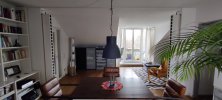
No subwoofer - note, the speakers are floor to ceiling full-range-line-sources and have the combined surface area of a 15" woofer each, while room excitation is more evenly effected over a larger dimension (see picture from standing behind listening position).So,,, have you achieved these "house curves" with no subwoofer?
Even though the psychoacoustic smoothing always gives really nicely smoothed "house curves", it always hides almost all the "room acoustic modes".
Only if possible, therefore, would you please share not-too-much-smoothed curves at your listening position (ref. my post #1,009 on my project thread) representing various room modes?
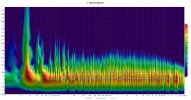
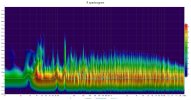
To best depict resonances and decay, I'll add spectrograms.
Attachments
OP
- Thread Starter
- #475
Thank you for your quick response to my inquiries and the nice photo of your listening room as well as new REW wavelet diagrams representing "room modes".No subwoofer - note, the speakers are floor to ceiling full-range-line-sources and have the combined surface area of a 15" woofer each, while room excitation is more evenly effected over a larger dimension (see picture from standing behind listening position).
To best depict resonances and decay, I'll add spectrograms.
It looks you really prefer all flat response from 20 Hz to 20 kHz at your listening position, but many people including myself rather prefer descending response 20 Hz to ca. 9 kHz having down slope of ca. 5 dB - 10 dB over 20 Hz to 9 kHz. The optimal "slope" (or not) would be greatly dependent on your personal preference, music genre, and room acoustics, of course. I believe you can easily control, even on-the-fly (while listening to music) with your wonderful system.
Do you "fine tune" such downward "house curve" (at your listening position) depending on the music gerne, or would you just keep your "flat" response all the way?
Furthermore, I have looked web page of VISATION FRS 8M which indicates "Frequency response: 100-20000 Hz". It is really impressive for me that using REW optimization procedure, you have achieved flat response all over 20 Hz - 25 kHz with no distortion, right? How do you assess or hear distortion (or not) in FRS 8M in rather difficult and important Fq zone of 20 Hz - 100 Hz? Especially, just for example, listening to "low bass" dominant music sources such as large pipe organ sounds (ref. #641 on my project thread).
Last edited:
marin.weigel
Member
You're welcome!Thank you for your quick response to my inquiries and the nice photo of your listening room as well as new REW wavelet diagrams representing "room modes".
A floor to ceiling full-range line-source acoustically behaves quite different in comparison to quasi point sources, that's why.It looks you really prefer all flat response from 20 Hz to 20 kHz at your listening position, but many people including myself rather prefer descending response 20 Hz to ca. 9 kHz having down slope of ca. 5 dB - 10 dB over 20 Hz to 9 kHz. The optimal "slope" (or not) would be greatly dependent on your personal preference, music genre, and room acoustics, of course.
Due to its dispersion characteristics, the whole room is pretty evenly energized with nary a sign of standing waves anywhere.
Yes, I could.I believe you can easily control, even on-the-fly (while listening to music) with your wonderful system.
No further fine tuning needed for any genre.Do you "fine tune" such downward "house curve" (at your listening position) depending on the music gerne, or would you just keep your "flat" response all the way?
I do add some mild bass enhancement when playing background music.
Since installing CamillaDSP v4 this year, I do tinker with it's RACE processor to even enhance the realism of the acoustic recording space.
The only drawback is that it only works for a very narrow listening window right in the middle between the speakers, but that's not a problem when I'm alone and relaxing in my hammock sweet spot.
With CamillaDSP's computing precision, I can easily use my cut-only inversion filter without audible consequences.Furthermore, I have looked to web page of VISATION FRS 8M which indicates "Frequency response: 100-20000 Hz". It is really impressive for me that using REW optimization procedure, you have achieved flat response all over 20 Hz - 25 kHz with no distortion, right? How do you assess or hear distortion (or not) in FRS 8M in rather difficult and important Fq zone of 20 Hz - 100 Hz? Especially, just for example, listening to "low bass" dominant music sources such as large pipe organ sounds (ref. #641 on my project thread).
CamillaDSP's input is always resampled to 44.1 kHz, since I can't distinguish higher sample rates reliably anyways (ABX tested).
The lowest octave is sorely missing, but that's good news for the neighbors.
I might just tackle that omission as my retirement DIY project in less than three years ...
Other than that, at my typically highest listening levels at around 80 dBSPL RMS avg, together the fifty 3" chassis, each able to handle 30 W continuous and 50 W peak, are cruising within their comfort zone (max plus/minus 2.5 mm stroke), even with that massive equalization applied.
OP
- Thread Starter
- #477
Hello, @marin.weigel,
Thank you indeed again for your detailed responses to my frank inquiries. Your above descriptions are really invaluable info and reference not only for myself but also for many people onboard on this exciting thread, I believe.
In addition to my above suggestion of "huge pipe organ" sound, for you and many people onboard here, let me suggest another example of bass-enriched music track which you can find in my post here #20 having the specific link to YouTube music clip; " Track-06 “LOST WITHOUT YOUR LOVE” in CD “CONFIDENTIAL” by Peter White (acoustic guitar), CK 89090 COLUMBIA Sony 2004".

Thank you indeed again for your detailed responses to my frank inquiries. Your above descriptions are really invaluable info and reference not only for myself but also for many people onboard on this exciting thread, I believe.
So, you mean you notice considerable lack of 16 Hz - 45 Hz zone sound, right?The lowest octave is sorely missing, but that's good news for the neighbors.
I might just tackle that omission as my retirement DIY project in less than three years ...
In addition to my above suggestion of "huge pipe organ" sound, for you and many people onboard here, let me suggest another example of bass-enriched music track which you can find in my post here #20 having the specific link to YouTube music clip; " Track-06 “LOST WITHOUT YOUR LOVE” in CD “CONFIDENTIAL” by Peter White (acoustic guitar), CK 89090 COLUMBIA Sony 2004".
I'll check it out. The box the meters came in was from a brand called Coleman. I didn't like those meters as much, so I put in the Sony ones that I found at a swap meet years ago. The meter box had a high/low setting. The volume control on the upstream dac that feeds them allows me to precisely trim the max sweep.Can I ask about your "TWIN VU METERES"?
Are they IEC 60268-17 compatible ones, especially compatible with ballistic behavior standard/specification (ref. here)?
Just for your possible reference and interests, you can find my DIY-built IEC 60268-17 compatible 12-VU-Meter Array here on my project thread with links to my "dancing VUs" videos.
marin.weigel
Member
I do get solid low 30ies, especially so with the RACE processor engaged in the sweet spot, just like what can be seen in your latest recommendation's spectrogram - so it is truly about the lowest octave from 32 down to 16 Hz.So, you mean you notice considerable lack of 16 Hz - 45 Hz zone sound, right?
... let me suggest another example of bass-enriched music track which you can find in my post here #20 having the specific link to YouTube music clip; " Track-06 “LOST WITHOUT YOUR LOVE” in CD “CONFIDENTIAL” by Peter White (acoustic guitar), CK 89090 COLUMBIA Sony 2004".

benchmarkmannen
Member
- Joined
- Jun 21, 2026
- Messages
- 67
- Likes
- 160
Similar threads
- Replies
- 26
- Views
- 3K
- Replies
- 72
- Views
- 5K
- Replies
- 13
- Views
- 747
- Replies
- 3
- Views
- 1K