• Welcome to ASR. There are many reviews of audio hardware and expert members to help answer your questions. Click here to have your audio equipment measured for free!

KEF Q100 Speaker Review

One of the mods is the use of this Spanish visco-elastic damping material inside: two layers of Tecsound SY70 as first in my main loudspeakers (sandwich with fiber-glass) many years ago.

[PDF] https://lotus.soprema.fr/www/reftechsop.nsf/($AllByUNID)/5E5A87A76E0804A1C125871E00545B0E/$File/TDS_INSES0002.d.ES_TECSOUND SY.pdf
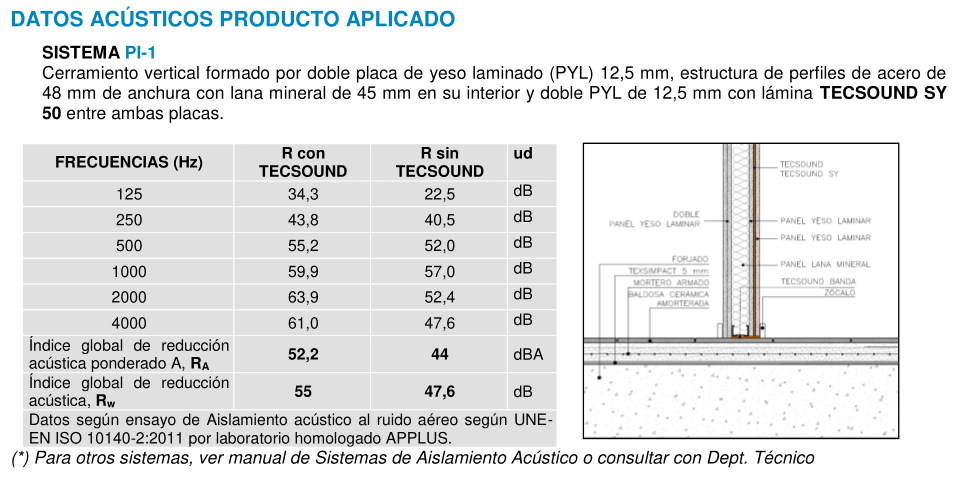
Portapapeles01.png


Portapapeles02.png
 
I think the q100 cabinet needs a brace or two and damping (not damping alone). Side walls make a very hollow sound when knocked.
 
Well, with two layers of Tecsound SY70 is OK.

The coaxial speaker is wonderful but KEF saved on the rest by failing in the bass-reflex design. Maybe one day I will build some new boxes with that fantastic coaxial speaker but yesterday I was delighted, excited, listening to well-heard recordings -> they have never sounded so good.

Johnny Cash - American III, Solitary Man and Tom Waits - Alice. Vinyl -> 24/96 FLAC.
 
HI,

Here the Optimizer output:
No EQ Spinorama, Score: 5.04
View attachment 85282
The EQ design, EQed score: 6.33
The LW is boosted so caution applies when play loud to avoid bottoming and destruction of the speaker.
As for the LS50 the speaker do appreciate a slope to achieve its best score.

Code:
Type     Freq      Gain     Q
PEQ      94.5,     2.33,   2.02,...
PEQ     749.0,    -2.10,   5.34,...
PEQ     947.5,    -1.95,   6.73,...
PEQ    1265.5,    -1.89,   5.98,...
PEQ    1675.0,     1.38,   2.09,...
PEQ    3501.0,     1.10,   2.01,...
PEQ    4981.0,    -1.30,   2.97,...
PEQ    6800.0,    -1.35,   3.44,...
PEQ   11265.0,    -1.02,   2.70,...
View attachment 85281

The updated Kef Q100 EQed Spinorama:
Really similar to the LS50
View attachment 85284
The Regression/ Tonal, the ON is pretty flat now
View attachment 85286
The zoom on ON-LW-PIR
View attachment 85285
Probably better listened to slightly off-axis around 10degView attachment 85294
And the radar comparing the EQ version and the No EQ version:
Decent gains
View attachment 85283
the rest of the data is attached
Sorry to jump in so late. Do you have a score with EQ and a subwoofer? I have a pair of Q100s in storage that I’m thinking about using in a secondary system. Thanks.
 
Sorry to jump in so late. Do you have a score with EQ and a subwoofer? I have a pair of Q100s in storage that I’m thinking about using in a secondary system. Thanks.
Hi,

All the scores are in the title of the spinoramas graphs.
I reran the optimizer just to be sure...
Both APO config files are attached.

Kef Q100 No EQ Spinorama.png


Kef Q100 EQ Design.png
Kef Q100 Original EQ Spinorama.png
Kef Q100 New EQ Spinorama.png
Kef Q100 Zoom.png
Kef Q100 Regression - Tonal.png
 

Attachments

Thought I would show the impact of the KEF provided port plug. It is a low density closed cell foam, I tested at 0, 20, 40, and 60 degrees to keep the graphs legible. Darker colours are with the plug inserted. Apologies for the 250Hz gating, weather did not permit outdoor measurements.

As you can see, the 1100-1500Hz region is smoother due to the lack of port resonance. The speakers sounded noticeably better with female vocals, but there was significant bass loss below 90Hz, as expected. A good candidate for near-field use with a subwoofer and mild EQ.
port plug overlay.jpg
port plug GD overlay.jpg
 
It seems to me that one of these budget coaxial speakers would be the perfect platform for someone with a DIY bent to undo all the makers cost based decisions by building a matrix like heavy cabinet of the same volume. Maybe even buy a similar size flared port from a better speaker as a part and then see what you have. Unless the driver itself is much lower spec the results might be surprising. Not volunteering, no woodworking skills, but it is an idea.

Why not recase the speaker in it's entirety? Just form a mould and pour it in concrete, then let us know how it works out :cool:
 
Thought I would show the impact of the KEF provided port plug. It is a low density closed cell foam, I tested at 0, 20, 40, and 60 degrees to keep the graphs legible. Darker colours are with the plug inserted. Apologies for the 250Hz gating, weather did not permit outdoor measurements.

As you can see, the 1100-1500Hz region is smoother due to the lack of port resonance. The speakers sounded noticeably better with female vocals, but there was significant bass loss below 90Hz, as expected. A good candidate for near-field use with a subwoofer and mild EQ.
View attachment 213406View attachment 213407
How do these Q100's compare to newer Q150?
 
If I lived in NA, maybe I would try No Rez


View attachment 166161
For those in Europe/Netherlands: https://www.amazon.nl/-/en/HASKYY-Aluminum-Anti-Bump-Insulation-Adhesive/dp/B0C1NWZVTN
I got 2mm 3.7kg/m² bytulrybber ( non foam ) which came recommended by a local speaker builder and will add recycled mixed material ( shredded clothing ) felt on top of this, and leave the Kef installed wad of black polywool in front of the port as it is now for sake of the view
1746216972042.png
 
For those in Europe/Netherlands: https://www.amazon.nl/-/en/HASKYY-Aluminum-Anti-Bump-Insulation-Adhesive/dp/B0C1NWZVTN
I got 2mm 3.7kg/m² bytulrybber ( non foam ) which came recommended by a local speaker builder and will add recycled mixed material ( shredded clothing ) felt on top of this, and leave the Kef installed wad of black polywool in front of the port as it is now for sake of the view
on second thought - remembering my talk with local speaker builders recently who mentioned they always used fibreglass in theirs I did some digging and find it is much more efficient than felt or polywool. They said they used pantyhose when putting it in bass reflex enclosures but pantyhose isn't that effective in containing fine particulates I don't think but I found heat recovery ventilation system filterfabric is inexpensive and will take well to stapling pouches out of. Also Knauff Naturoll glasswool has a better binding agent that won't be as irritating to work with. Then again John Heisz video on fibreglass damping was interesting as there was little difference in measurement results between bare fibre or having put the glass fibre in a polypropylene bag which would contain fibres quite well as well :p
 
Last year I wrote: "In my cabinet modifications, I have used PRESSED fiberglass (the dust is annoying to handle) and rock wool. I personally prefer pressed fiberglass for the final sound. In any case, it is much better than the absorber used in the Linton and many other cabinets."

The first time I used it was over thirty years ago. Danny Richie also prefers fiberglass (he uses unpressed, pink fiberglass -I have a picture I can not find- in his big, old-school speakers).

Portapapeles_05-04-2025_01.png
 
Last year I wrote: "In my cabinet modifications, I have used PRESSED fiberglass (the dust is annoying to handle) and rock wool. I personally prefer pressed fiberglass for the final sound. In any case, it is much better than the absorber used in the Linton and many other cabinets."

The first time I used it was over thirty years ago. Danny Richie also prefers fiberglass (he uses unpressed, pink fiberglass -I have a picture I can not find- in his big, old-school speakers).
Yes, looking over vintage speakers here this past day I find most all non ported used fiberglass!
I imagine workplace safety rules became stricter at some point. Working with materials like this these days in workplaces require more expensive ventilation systems with filtration and ppe for workers and perhaps the bean counters decided 'you can't hear the difference anyway' between it and polywool.
Also probably due to ported systems become more pervasive and consumer concerns over fiberglass etc.
 
Back
Top Bottom