• Welcome to ASR. There are many reviews of audio hardware and expert members to help answer your questions. Click here to have your audio equipment measured for free!

Kali IN-8 V2 REW Measurement in an Untreated Room — need advice for Speaker Placement & Acoustic Treatment

BZ22

Member
Joined
Jul 25, 2024
Messages
53
Likes
17
Hi everyone,

I'm setting up my small home studio and could really use some guidance on the next steps.
Here's my situation:

Room: 4.20 m x 3.55 m x 2.50 m, completely untreated for now
Gear:
  • Measurement mic: Behringer ECM 8000
  • Interface: RME BF Pro FS
  • Speakers: Kali IN-8 2nd Wave
I measured at approximately 70–75 dB -.
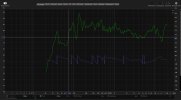
But looking at the measurement (1/12 smoothing), it looks exactly how I subjectively perceived it.
I noticed the peak at 136Hz immediately and put a -5dB EQ on it right away.

I've been experimenting with speaker placement and have everything centered in the room now, but I haven't been able to achieve any noticeable improvement.
I came across another thread where someone got significantly better results in an untreated office space:
[https://www.audiosciencereview.com/forum/index.php?threads/kali-in-8-v2-in-room-response.62840/]

The IN-8s are still within their return window, so switching to different speakers is still an option.
Budget would be up to ~€2,000 for the pair.

I'd appreciate any advice on how to approach acoustic treatment in a meaningful way for my specific situation — and what i should prioritize.

Thanks in advance for any input. Feel free to be brutally honest.


REW Files L + R
https://drive.google.com/file/d/1mb71g8V7Fl_Vk-k7hFgTDkeQqg11uAmY/view?usp=drive_link R Speaker

https://drive.google.com/file/d/1qkyvX3nvNaXMHY8C38UT77FGsyFBl7q5/view?usp=drive_link L Speaker
 

Attachments
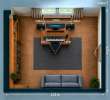
  • studio-floorplan-v8.png
    studio-floorplan-v8.png
    1.8 MB · Views: 202
  • Measurement IN-8 2nd wave untr room 13 09.jpg
    Measurement IN-8 2nd wave untr room 13 09.jpg
    297.2 KB · Views: 189
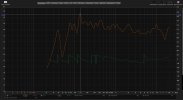
  • further away from wall.jpg
    further away from wall.jpg
    292.6 KB · Views: 185
Last edited:
I came across another thread where someone got significantly better results in an untreated office space:

The scale of their graph makes it look better than it is, notice that its 20-130db.

Doesn't look so nice when it's scaled properly does it?

not so nice now is it.png


Your responses look like what one would expect in your space with no treatment.

That made me wonder what I might be missing. The IN-8s are still within their return window, so switching to different speakers is also an option. Budget would be up to ~€2,000 for the pair.

Your problems are with your space, not the speakers.

You'll want to measure Left and Right speakers separately, not together. If you measure them both at the same time you'll pick up a bunch of interactions between the speakers themselves that will skew your results.

EQ can make a pretty big difference, and largely required for most spaces. Most folks will take multiple measurements of a speaker, create an average of the responses in REW, and then apply corrective EQ to that average. There is much nuance to this process but there are plenty of people here to help out.
 
The scale of their graph makes it look better than it is, notice that its 20-130db.

Doesn't look so nice when it's scaled properly does it?

View attachment 558428


Your responses look like what one would expect in your space with no treatment.


Your problems are with your space, not the speakers.

You'll want to measure Left and Right speakers separately, not together. If you measure them both at the same time you'll pick up a bunch of interactions between the speakers themselves that will skew your results.

EQ can make a pretty big difference, and largely required for most spaces. Most folks will take multiple measurements of a speaker, create an average of the responses in REW, and then apply corrective EQ to that average. There is much nuance to this process but there are plenty of people here to help out.

Thanks for your response and clarification.
I also measured the left and right speakers, and they were nearly identical.

I also measured with a little EQ applied — +7 dB around the missing 53 Hz region and -5 dB at the 136 Hz peak.
It definitely smooths out those two areas somewhat, but I’m still not entirely sure about EQ and the low end.
I definitely need to learn more about EQing studio monitors.

For now, I think my next step is acoustic treatment and finding the optimal listening position.
 
Last edited:
Please take a look at the REW eBook in my sig. It's free.

You haven't shown us any measurements indicating that you need acoustic treatment, or what type of treatment you need.
 
@Keith_W Thanks!
do my measurements look like they were performed incorrectly?

I made a few more changes to the room and listening position.
2 eq bands also helped a little.
 

Attachments

  • less reflections 13 09.jpg
    less reflections 13 09.jpg
    439.1 KB · Views: 64
  • RT60.jpg
    RT60.jpg
    351.2 KB · Views: 65
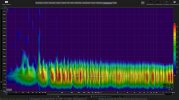
  • spektrogramm.jpg
    spektrogramm.jpg
    304.3 KB · Views: 61
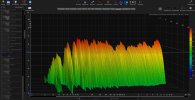
  • Waterfall.jpg
    Waterfall.jpg
    466.6 KB · Views: 56
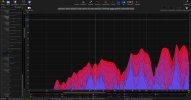
  • Decay.jpg
    Decay.jpg
    374.1 KB · Views: 65
Last edited:
@Keith_W Thanks!
do my measurements look like they were performed incorrectly?

I made a few more changes to the room and listening position.
It helped a little.

We need to see L and R by themselves, not combined as I previously stated. You may think they were identical, but I can assure you they were not. Combined measurements are pretty much never done other than to show the issues they cause. I did mention this already.

The windowing on the response graph is too large. You want to limit to to about 50db. The scale should look similar to the graph I posted.

Alright, I’ll come back at some point. Thanks!
 
Last edited:
Alright, I’ll come back at some point. Thanks again!

To make things a bit easier, you can always save the measurements and upload the REW file, its in a .mdat format. This would let us see things in the detail we might desire.

A single measurement point tells us only so much. If you can, take maybe 5-10 measurements per speaker in a 1-2ft sphere around the listening position. That will tell us more and be useful for a quick demonstration on REW's eq functions.
 
@LiveTek

You're actually right, I should have included the REW files right away, sorry lol

REW Files L + R
https://drive.google.com/file/d/1mb71g8V7Fl_Vk-k7hFgTDkeQqg11uAmY/view?usp=drive_link R Speaker

https://drive.google.com/file/d/1qkyvX3nvNaXMHY8C38UT77FGsyFBl7q5/view?usp=drive_link L Speaker


difficult to properly judge the IN-8s at this point because of the room, but these tracks for example sound super clean: https://open.spotify.com/intl-de/track/130jVrPu0cOYu2yygFESca?si=03d1e3237bbd4edd
 
Last edited:
I would highly recommend Keith W's REW guide he shared, I'll try not to just repeat what's in there but I'm sure I will. I just want to try and iterate on how the response problems your seeing are pretty much all from the environment and you can save money on new speakers.

Data looks good for a small untreated space. Peaks are typically easy to EQ and your peaks are low in magnitude. Nulls are usually impossible to fix with it. The two major issues are the overall reduced bass with a nice dip at 60hz. The null at ~110 is likely from the front wall. You can move these issues around with placement but one or the other, or sometimes both will always be there. One solution is subwoofers, which let you place the bass radiation in an ideal spot. Small rooms have a tough problem where the density of reflections in the lower frequencies is higher than that of larger rooms, so much so that it tends to just nuke the bass all together in the places you actually want to sit.

With that said, my assessment is just from single measurement point which isn't great at telling us what the bass is doing. Since the bass response can change quite a bit with small changes to the LP, it's often advised to take multiple measurements in an area around the LP and create an average.

Your response really isn't bad at all.

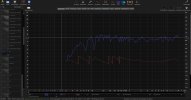
pre eq.jpg


And this is what it can look like after EQ. That's how people get those hyper linear response graphs. Treatments help but EQ is a lot more powerful IMO.
(This would probably be a tad bright for some, it's just an example)
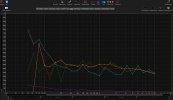
post eq.jpg


I can't make too many comments on treatments. I follow the typical guidelines as thick of absorption as you can afford where you have space. I always do corners and my side walls with thick treatment and that's usually all I feel is necessary. As for treating bass issues with treatments, not a great solution as they just aren't very effective at absorbing the massive bass waves. There are some solutions involving multiple subwoofers (which I find to be the best bass I've heard in a room) if the budget allows. Often it does not, so we just treat where we can, apply some well tailored EQ, and live with the compromises. I typically use a combo of headphones and speakers to dial in low end.
 
Before I forget, please also download the accompanying document "Acoustic Measurement Standards for Living Rooms" by Nyal Mellor. It will tell you what to aim for. Those eBooks heavily reference it.

And yes, it does look like you will benefit from some room treatment. The book shows you how to calculate your ideal RT60 for your room volume and application, and how to take that measurement. It also clearly explains why RT60 is unreliable below a certain frequency. There is an accompanying Powerpoint presentation from a talk I gave about high frequencies, how to determine reflections from looking at the ETC, and what to do about it. Happy reading.
 
I would highly recommend Keith W's REW guide he shared, I'll try not to just repeat what's in there but I'm sure I will. I just want to try and iterate on how the response problems your seeing are pretty much all from the environment and you can save money on new speakers.

Data looks good for a small untreated space. Peaks are typically easy to EQ and your peaks are low in magnitude. Nulls are usually impossible to fix with it. The two major issues are the overall reduced bass with a nice dip at 60hz. The null at ~110 is likely from the front wall. You can move these issues around with placement but one or the other, or sometimes both will always be there. One solution is subwoofers, which let you place the bass radiation in an ideal spot. Small rooms have a tough problem where the density of reflections in the lower frequencies is higher than that of larger rooms, so much so that it tends to just nuke the bass all together in the places you actually want to sit.

With that said, my assessment is just from single measurement point which isn't great at telling us what the bass is doing. Since the bass response can change quite a bit with small changes to the LP, it's often advised to take multiple measurements in an area around the LP and create an average.

Your response really isn't bad at all.

View attachment 558498

And this is what it can look like after EQ. That's how people get those hyper linear response graphs. Treatments help but EQ is a lot more powerful IMO.
(This would probably be a tad bright for some, it's just an example)
View attachment 558499

I can't make too many comments on treatments. I follow the typical guidelines as thick of absorption as you can afford where you have space. I always do corners and my side walls with thick treatment and that's usually all I feel is necessary. As for treating bass issues with treatments, not a great solution as they just aren't very effective at absorbing the massive bass waves. There are some solutions involving multiple subwoofers (which I find to be the best bass I've heard in a room) if the budget allows. Often it does not, so we just treat where we can, apply some well tailored EQ, and live with the compromises. I typically use a combo of headphones and speakers to dial in low end.

Wow, that’s amazing what you’ve done! Would you mind showing me what EQ settings you used?

Regarding the low end, it seems like the only real solution for my small room would be a lot of thick bass absorption?!
I saw in another studio where someone had installed a gigantic bass trap across the entire ceiling and their room was even smaller than mine.
I’m still a little reluctant to get a subwoofer, but it would be an option.

For now, I’m going to start by treating the first reflection points and then work my way through the room.
And also read through the valuable information from @Keith_W I’m sure I’ve done a lot of things wrong.

Also placed some temporary absorption but I’m already really happy with how it sounds right now.

Thanks so much!
 
Last edited:
one more question. Since it’s recommended to take multiple measurements, is it safe for the speakers to run all those REW sweeps (75db)?
I’ve seen some people say that it can potentially damage the speakers?
 
Last edited:
Regarding the low end, it seems like the only real solution for my small room would be a lot of thick bass absorption?!

Your common broadband treatment doesn't really do anything to the bass. Companies will still sell you "bass traps" but toss them in your space and measure and be underwhelmed. I would say porous absorbers are good from ~100-150hz and up, maybe higher than that, and that's if they are like 6" thick.

You can play around with this porous absorber calculator and see what thickness treatments (and the air gap behind them) can do.


one more question. Since it’s recommended to take multiple measurements, is it safe for the speakers to run all those REW sweeps (75db)?
I’ve seen some people say that it can potentially damage the speakers?

These speakers will play into the 90+db range and be fine, they have been tested at 96db. They have limiting built in and will likely prevent any damage from being over-driven if they can. If you have a calibrated meter, or say an iphone with NIOSH app, 75db reading is just fine and there is no risk.

I saw in another studio where someone had installed a gigantic bass trap across the entire ceiling and their room was even smaller than mine.

Sure, one can do that. It's just not at all practical for most people and gets expensive quick.

I’m still a little reluctant to get a subwoofer, but it would be an option.

Unfortunately, if you wish to have bass without all the nulls, you will most likely have to invest in a subwoofer, ideally two or more. This isn't to get big boomy loud bass, it's to get even bass at your listening position at all. The idea being that typically one sub or main speakers tend to activate only a few room modes (room resonances so to speak), leaving you with peaks and nulls throughout the bass response. Instead of trying to reduce mode activation, multisub aims to activate as many as you can delivering a much smoother overall response over a much larger coverage area.

You don't NEED subwoofers to have good low end response, but I mention it because treating the bass with physical acoustic treatments tends to cost about as much, if not more than subwoofers and it won't even be nearly as good as multisub. I just don't want you buy a bunch of bass traps and be like "hey the bass is still not great". That said, there's a lot more than just bass issues that need treatment. I would still put up as much as you can.
 
Wow, that’s amazing what you’ve done! Would you mind showing me what EQ settings you used?

I am reluctant to share them as they probably don't sound good, it was a demonstration to show that everyone has room problems and it's not the end of the world.

EQ correction is not too tough. Measure. Pick your target curve you want, let REW do the hard work and figure out what it needs. You're not going to get it right on the first few go arounds and there are automated suites if you're interested in a less hands on approach. They can be quite handy for production work since if you want the EQ on your master, you have to manually set it up in an EQ. Dirac Live has a vst plugin, and IK arc has their own hardware and vst plugin, just some options.

There are probably better guides but this is what I found. Just skip to the "Equalize Speaker Response".

 
Back
Top Bottom