Jean.Francois
Active Member
- Joined
- May 31, 2022
- Messages
- 278
- Likes
- 1,030
Hello,
Released in June 2026, Night Blooms is the latest collaboration between Jeff Goldblum and the Mildred Snitzer Orchestra. A follow-up to Still Blooming (2025), this album continues the actor and pianist s exploration of the Great American Songbook, blending elegant jazz arrangements with a relaxed and intimate atmosphere. Featuring Melody Gardot, Charlie Puth, Cynthia Erivo, dodie, Haley Reinhart, Ariana Grande, Maiya Sykes, and Scarlett Johansson, Night Blooms alternates between newly recorded standards and Late Night Sessions that revisit tracks from the previous album with fresh interpretations.

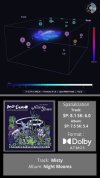
I must admit that I was genuinely surprised from the very first listen of the Dolby Atmos version. I was expecting a soundstage that was primarily front-focused, as is often the case with jazz recordings, but this mix takes a very different approach. It creates a wide 180-degree soundstage, taking full advantage of the surround channels to naturally position the instruments around the listener rather than simply extending the front stage. This well-thought-out spatial arrangement gives the performance remarkable openness and realism, allowing each instrument to breathe while preserving the cohesion of the ensemble. The 3D video on YouTube demonstrating spatialization clearly shows the distribution of sound in space according to the instruments.
This immersive presentation enhances the feeling of being in the presence of the musicians, revealing subtle instrumental details that are less noticeable in traditional stereo.This spatialization is accompanied by a beautiful dynamic range.
Unfortunately, the stereo version follows the trend of limiting dynamic range in jazz recordings and therefore does not entirely escape the effects of the loudness war, as shown by the comparison of the waveforms.

For those who prefer a stereo listening experience, the vinyl edition remains a very appealing option, offering a more open and lively sound than the digital stereo version.
Find the full review with all measurements and analysis HERE (link), as well as a demonstration of the 3D spatialization of the Dolby Atmos version on YouTube.
Enjoy listening,
Jean-François
Released in June 2026, Night Blooms is the latest collaboration between Jeff Goldblum and the Mildred Snitzer Orchestra. A follow-up to Still Blooming (2025), this album continues the actor and pianist s exploration of the Great American Songbook, blending elegant jazz arrangements with a relaxed and intimate atmosphere. Featuring Melody Gardot, Charlie Puth, Cynthia Erivo, dodie, Haley Reinhart, Ariana Grande, Maiya Sykes, and Scarlett Johansson, Night Blooms alternates between newly recorded standards and Late Night Sessions that revisit tracks from the previous album with fresh interpretations.
I must admit that I was genuinely surprised from the very first listen of the Dolby Atmos version. I was expecting a soundstage that was primarily front-focused, as is often the case with jazz recordings, but this mix takes a very different approach. It creates a wide 180-degree soundstage, taking full advantage of the surround channels to naturally position the instruments around the listener rather than simply extending the front stage. This well-thought-out spatial arrangement gives the performance remarkable openness and realism, allowing each instrument to breathe while preserving the cohesion of the ensemble. The 3D video on YouTube demonstrating spatialization clearly shows the distribution of sound in space according to the instruments.
This immersive presentation enhances the feeling of being in the presence of the musicians, revealing subtle instrumental details that are less noticeable in traditional stereo.This spatialization is accompanied by a beautiful dynamic range.
Unfortunately, the stereo version follows the trend of limiting dynamic range in jazz recordings and therefore does not entirely escape the effects of the loudness war, as shown by the comparison of the waveforms.
For those who prefer a stereo listening experience, the vinyl edition remains a very appealing option, offering a more open and lively sound than the digital stereo version.
Find the full review with all measurements and analysis HERE (link), as well as a demonstration of the 3D spatialization of the Dolby Atmos version on YouTube.
Enjoy listening,
Jean-François