• Welcome to ASR. There are many reviews of audio hardware and expert members to help answer your questions. Click here to have your audio equipment measured for free!

JBL Synthesis: 1400 Array - measurements interpretation :)

g_t_r

Member
Joined
Nov 5, 2021
Messages
71
Likes
25
Hello,

Those speakers are one of the best sounding speakers in home environment - at least I didn't hear better sounding speakers to my ears :) There is everything - great deep bass, nice natural timbre, astonishing realism, great transients, live vocals and by far best 3D image I ever experienced - sound is floating in the space. Where is the trick?

Could someone make some measurements interpretation: https://www.stereophile.com/floorloudspeakers/jbl_synthesis_1400_array_bg_loudspeaker/index.html

THX!
I'm very interested.
 
Here you go:
1636131938820.jpeg

Preference Score is 5.1 and would be 6.3 with a perfect subwoofer.

Source:
 
I wonder why the stereophile measurements looks so different.
"anechoic response on tweeter axis at 50", averaged across 30° horizontal window and corrected for microphone response, with complex sum of nearfield responses plotted below 300Hz."

Stereophile measures the speaker using gated measurements indoors, which enables accuracy at high frequency, but no accuracy below 300hz (if they invested in a step-ladder they might be able to get down to 200hz). They then take a near-field measurement of the woofer and port(s) and then basically guess the levels at which to splice the two together.

As a result, stereophile measurements often show huge discrepancies between bass and mid level, which the Spinorama and ASR measurements do not exhibit.

Basically, Stereophile has the measurement accumen of an inexperienced hobbyist. The fact that JBL's measurements show a flat response, and Stereophile shows something like a 7db hump in the bass is a classic example of this.

I do not believe Stereophile has done anything to improve their measurement set-up. I believe Audioholics has a decent anechoic chamber they use for measurements, and two online reviewers who don't even run ads (ASR and Erin's Audio Corner) now have Klippel NFS systems which are state of the art acoustic measurement platforms that enable better accuracy than the world's best anechoic chambers.

That Stereophile hasn't seen fit to buy an NFS shows you how seriously they take their data presentations.
 
That Stereophile hasn't seen fit to buy an NFS shows you how seriously they take their data presentations.

I'm not arguing with the rest of your post, but we should acknowledge the Klippel's difficulties with anything bulkier than a modest tower. I'm not sure it would suit a magazine that features a wide variety of DUTs, some of them huge.
 
I believe Audioholics has a decent anechoic chamber they use for measurements,
They don't. They measure the speaker up high outdoor. And often report above 250 Hz or so.
 
Hello,

Those speakers are one of the best sounding speakers in home environment - at least I didn't hear better sounding speakers to my ears :) There is everything - great deep bass, nice natural timbre, astonishing realism, great transients, live vocals and by far best 3D image I ever experienced - sound is floating in the space. Where is the trick?

Could someone make some measurements interpretation: https://www.stereophile.com/floorloudspeakers/jbl_synthesis_1400_array_bg_loudspeaker/index.html

THX!
I'm very interested.
I have nothing to contribute regarding interpretation of measurements, but I seriously considered the Array 1400 on my upgrade journey... I've never heard them, but would welcome the opportunity one day.
 
Poor old Greg Timbers, was kicked out of JBL ( Harman ) with just a letter, considering the masterpieces he had achieved!!!!
 
I'm not arguing with the rest of your post, but we should acknowledge the Klippel's difficulties with anything bulkier than a modest tower. I'm not sure it would suit a magazine that features a wide variety of DUTs, some of them huge.

There's a picture online of the magico M9 being measured on an NFS. It is 80 inches tall, 40 inches deep, 29 inches wide and weighs 1000 pounds. Most speakers are smaller.
 
Does anyone have any insight into the OP’s original question, i.e., what is it in the measurements that indicates the very positive qualities the listener experienced?
 
Does anyone have any insight into the OP’s original question, i.e., what is it in the measurements that indicates the very positive qualities the listener experienced?
Well, up until the tweeter takes over, super neutral on-axis for a passive speaker, and off-axis is well controlled as well.

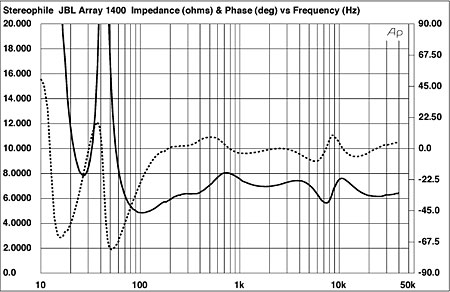
And if we look at the impedance/phase in the Stereophile review linked in the OP:
510JBLfig1.jpg


Very easy load (don’t even know how they get the phase to be ~0° for that wide a range), that paired with its 89dB sensitivity and likely high power handling means it can get loud.

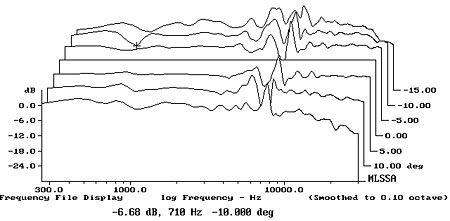
The vertical off-axis is also pretty good before the tweeter takes over:
510JBLfig6.jpg

So it’ll be more tonally neutral than another speaker with the same horizontal performance but worse vertical.
 
Thank you! IIRC, Greg Timbers referred to this speaker in an interview published online as one of his favorites of his own designs.
 

John Atkinson's comment at the end of the "Measurements" section:

"I'm not surprised that the Synthesis 1400 Array BG offers both superb speaker engineering and superb measured performance. I keep returning to that remarkably flat and even in-room response: Good grief!"

Here is what he's talking about:

510JBLfig7.jpg

IGNORE the peak at 100 Hz, it is an artifact of the close-mic technique used to measure the frequency response at lower end of the frequency range.
 
There's a picture online of the magico M9 being measured on an NFS. It is 80 inches tall, 40 inches deep, 29 inches wide and weighs 1000 pounds. Most speakers are smaller

Surely Amir or Erin would need a little help getting such a huge beast on to (into?) NFS though...I think there are some issues with practicability.
 
Surely Amir or Erin would need a little help getting such a huge beast on to (into?) NFS though...I think there are some issues with practicability.

The Magico M9 was lifted in place via crane/hoist, which was actually built around the NFS. All done in a warehouse. See below:
 
Last edited:
From first/second edition of "Sound Reproduction" by Toole: "Figure 18.17 shows samples of two excellent, high-priced loudspeakers, that
do almost everything well. To these should be added loudspeakers “R” and “I” in Figure 18.14. Collectively, these are examples of the present-day “kings of the hill.” There are others, of course, but the measurements do not look very different. When they are put against each other in double-blind tests, the audible differences are small, somewhat program dependent, and listener ratings tend to vary slightly and randomly around a high number. In the end there may be no absolute winner that is revealed with any statistical confidence; the differences in opinion are of the same size as those that could occur by chance."

18.17a appears to be the Revel Salon 2, 18.17b appears to be the JBL Array 1400.

Screen Shot 2021-11-07 at 8.15.33 PM.png
 
I believe that John Atkinson made an error in measuring these speakers. He comments on the tweeter axis, which is the ultra high-frequency driver crossed over at 8 kHz, then later about how "the tweeter is a high 46" from the floor." The horn is approximately 17" tall, so if one were to sit on-axis with what's called the midrange horn (750 Hz to 8 kHz), that would be around 36-37" from the floor, which would be a more typical height for a seated listener's ears.

I would expect measuring on-axis with the 8+ kHz driver to elevate these frequencies relative to those below 8 khz, and that may be why Stereophile's measurements seem to be trending upward above the presence region. Changing the on-axis to the center of the midrange horn would have been about 9" lower, so at a difference of 50" (distance used for measuring nearfield response,) that's a difference of about 10 degrees vertically, so if you look at the -10 degree curve in figure 6 and mentally use this to compensate for figure 4, you get a much more neutral response in the upper frequencies. Figure 5 suggests smoothly changing directivity through what I consider to be the critical region (a few hundred to several thousand Hz). Regarding the impedance, this was a relevant and possibly interesting article: https://www.stereophile.com/reference/707heavy/index.html

I can't come up with a good explanation for the in-room measurements (figure above) compared with the Salon 2 (figure 8 at https://www.stereophile.com/content/revel-ultima-salon2-loudspeaker-measurements), however.
 
Last edited:
Back
Top Bottom