• Welcome to ASR. There are many reviews of audio hardware and expert members to help answer your questions. Click here to have your audio equipment measured for free!

JBL CBT 70J-1 Review (Constant Beam Transducer)

That's great that you were able to empirically test and compare the fall-off between a short line array, and a conventional 2-way speaker. Thanks for taking the time to do that. It's also nice when the empirical data aligns with the theory.
It’s good to see someone else banging this drum. Theoretical constructs such as ‘infinite length line array’ are pretty hard to make in reality.

Same goes for concert systems; an unbroken straight line of cabinets 20 metres tall (per side!) would be needed to have consistent tonal coverage front to back for most large events, yet you never see that because it would be insanity. The best concert line array systems are tuned as a bunch of close coupled point sources with splay to avoid the horrible ‘nasal sound’ that plagued the early deployments in the late 90s.

The big benefit of CBT is in the first two letters, and the sheer power density. Plus the ability to achieve it with mostly passive component design.
 
I have been playing with the idea of using these speakers as side surrounds in my theater room, replacing the JBL SCS8's currently used. The room is 4 meters wide and listeners on the outside seat end up very close to those speakers. Obviously this not only results in a level imbalance across that row of seating but also is not a very diffuse sound, highligting the position of the speaker.

My question is, do these speakers fix both problems? I have also been looking at using some form of bipole speaker to get the diffusion and make the speaker "disappear", so to speak.
 
Last edited:
The wide dispersion helps mitigate the effect of level differences on the center image, but the precedence effect will still cause the image to move toward the nearest speaker. Another strategy to widen the phantom center sweet spot is to use narrow, constant directivity speakers with extreme toe-in. When you move to the side, the far speaker gets louder and the near speaker gets closer.
I'm using extreme toe-in in my current setup and it does widen the phantom center sweet spot. By reducing side wall reflections it also enhances dialog intelligibility, which further anchors the phantom center image to the TV screen. It sounds as if the precedence effect would hinder a CBT like the 70J-1 from matching or exceeding the phantom center image performance that can be achieved with more common speaker designs using extreme toe-in
 
I have been playing with the idea of using these speakers as side surrounds in my theater room, replacing the JBL SCS8's currently used. The room is 4 meters wide and listeners on the outside seat end up very close to those speakers. Obviously this not only results in a level imbalance across that row of seating but also is not a very diffuse sound, highligting the position of the speaker.

My question is, do these speakers fix both problems? I have also been looking at using some form of bipole speaker to get the diffusion and make the speaker "disappear", so to speak.
I have the smaller CBT50 as my side surrounds in a 5.1.2 configuration. While the immersive middle seat area is great (and feels wider), the most outside-seats right next to the surround speaker are still not very good.

I find outside-seats surround sound most distracting for listeners when watching live sporting events with Dolby Surround Upmix from stereo. Whenever the surrounds become distracting (for friends and family members ), I manually configure the speaker on my Denon AVR to 3.1.2 on the fly, and this provides a still reasonably immersive sound thanks to the two ceiling Atmos speakers (also CBT50) - even for outside-seats right underneath the speakers . I guess the relative listening distances differences from the ceiling are less between the seats. I like the immersive playback from Dolby Surround Upmix and it’s on by default. It really helps to anchor the center (also a CBT50 behind an AT screen) for stereo sources. With the CBT, infact, I do not need to turn on Dolby Center Spread - it sounds good without apparent soundstage collapse (Compared to my previous Martin Logan center…)

I get less complaints from Movie discrete surround - perhaps because they could link the surround to the actions on the screen.

My mixed purpose living room/home theater is a lot smaller than yours. And far from ideal. With more space, I think you will get even better results than mine.


Sofa seat width: 2.2m (against a backwall with 4” rockwool absorber)
Surround is only 0.3m from the most outside-seat
Ceiling height 2.6m

Hmm. So maybe a bipole will be better suited to what I am trying to acheive?
 
I have been playing with the idea of using these speakers as side surrounds in my theater room, replacing the JBL SCS8's currently used. The room is 4 meters wide and listeners on the outside seat end up very close to those speakers. Obviously this not only results in a level imbalance across that row of seating but also is not a very diffuse sound, highligting the position of the speaker.

My question is, do these speakers fix both problems? I have also been looking at using some form of bipole speaker to get the diffusion and make the speaker "disappear", so to speak.
My answer is yes. And my guests answers have always been yes. I’ve had multiple home theater enthusiasts from AVSForum tell me my surround field with the CBT 70j-1 is the best they’ve heard. The 70j-1 doesn’t blow the person out who sits closes to the seat because the sound is spread over 16 tweeters and four woofers. In fact I can walk right up to the speaker and put my ear next to it at reference volume on music and not get blown back. Also they are able to be heard everywhere in the room rather than just being dominated by the closest speakers. I highly recommend the CBT 70J-1 for surrounds.

Youthman is doing a tour of my theater with 13 JBL CBT 70j-1 this weekend. If you watch his videos in the coming weeks you can see his impression of it.

Here is our thread:
post 9788

I doubt it will work in his case:

Surround is only 0.3m from the most outside-seat

a possible solution I see is using the shallow vertical to a favor by turning the speaker 90 degrees. if you point it at the center seat and create an enough angle for the outside seat the SPL should be atenuated a lot.
 
a possible solution I see is using the shallow vertical to a favor by turning the speaker 90 degrees. if you point it at the center seat and create an enough angle for the outside seat the SPL should be atenuated a lot.
Yes. But I would probably need to move the sofa into the room quite a distance to get the right angle for the desired effect. Unfortunately not a possible option - room depth is only about 3.2m. And I have a 92” screen that will be too close…

As jhaider posted earlier, also a challenge to mount them as they would look like sticks jutting out (from the backwall).
 
The curved part of the speakers are attenuated by design. If you mounted the speakers high, with the curve facing down— above the head of the closest seated guest I can almost guarantee this is a best case scenario for a room that tight. Like I said I can walk right up to the speaker playing reference volume and not be blown back in discomfort because that volume is spread over a 2 foot vertical space and 16 tweeters each aren’t playing reference - rather each is playing 1/16 of reference, and the sum is reference. So having your ear by one tweeter as in my example of walking up to the speaker, or being underneath the majority of the sound in my high wall mount recommendation means you aren’t getting blasted.
This is my practical, first hand experience.
One of my seats is fairly close to my surround speaker as you’ll see in my pictures on the previous page. I’ll measure it and update this post. I put the surround speaker at a 110* angle instead of a 90* and anyone seating there is not annoyed by that speaker. I’ve never had a complaint, and instead many compliments on how it uniquely doesn’t blow out that guest, though close.

Can you put up a picture showing your seating and space to work with?
 
Last edited:
Yes. But I would probably need to move the sofa into the room quite a distance to get the right angle for the desired effect. Unfortunately not a possible option - room depth is only about 3.2m. And I have a 92” screen that will be too close…

As jhaider posted earlier, also a challenge to mount them as they would look like sticks jutting out (from the backwall).
Note there is a flush mount available too (assuming you don't need to angle it).
 
Yes. But I would probably need to move the sofa into the room quite a distance to get the right angle for the desired effect. Unfortunately not a possible option - room depth is only about 3.2m. And I have a 92” screen that will be too close…

As jhaider posted earlier, also a challenge to mount them as they would look like sticks jutting out (from the backwall).

you can also put them up high (normal oriantation). by aiming (down to) the center seat you would be off-axis (atenuated) on the right seat.
 
The curved part of the speakers are attenuated by design

the vertical plot is pretty symetrical. but it is atuanted just like the top in wide mode, as it seams to be a Bessel Array. nicely simulated by @voodooless here : https://www.audiosciencereview.com/...aper-experiment-of-a-bessel-line-array.24841/

the funny thing is that in narrow mode they are probably not atenuated and should be quieter off axis (so the lower part will appear quieter when standing before it, even though it is actualy playing louder). cancelation is a funny thing.
when we plan with a speaker like this we have to treat it like one driver. if it would behave "like intuitive 16 drivers" the horizontal would be enourmous in the near-field
 
@laetoli37 there is actualy a Ease file of the speaker for download here: https://jblpro.com/products/cbt-70j-1
Ease is a software to plan speakers for PA

the file didn't work with my Ease version but I played a litle with another line source with shallow vertical:

situation similar to yours. speaker at ear height:

1638393165092.png


the graph is normalized to the center position. we have up to 7dB gain close to the speaker.

I played with angles, but best I could get is just hanging it higher by 90cm

1638393377445.png


notice how close the midrange got. for such an extreme case I think it is a nice improvement.
also the farer seat now has a louder signal, too

there are sure other solutions, and it's not the same speaker nor exactly your room. just showing what can be done with the software.

EDIT: I forgot. I doesn't calculate any reflections. but anyways, a good starting point imo
 
Last edited:
Thanks Archaea, dasdoing and Dj7675 for your kind analyses and suggestions.

I guess a mixed living room/home theatre in a small apartment have more limitations on what I can do. I went with the much smaller CBT50 instead of CBT70J (also for $ reasons) as I think the latter will overwhelm my living room.

I am not complaining, I am infact giddily happy with the CBT sound compared to previous surround with Paradigm and Atmos with Mirage.

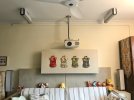
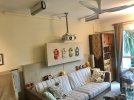
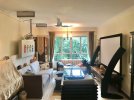
2DEF144A-18F1-4777-9354-DADE3213C9C4.jpeg
380665E2-BE72-46FF-ABE4-99E25DEFE28F.jpeg
3200997F-5911-46D6-AFA1-E7E2CBBE7F80.jpeg
 
I have been playing with the idea of using these speakers as side surrounds in my theater room, replacing the JBL SCS8's currently used. The room is 4 meters wide and listeners on the outside seat end up very close to those speakers. Obviously this not only results in a level imbalance across that row of seating but also is not a very diffuse sound, highligting the position of the speaker.

My question is, do these speakers fix both problems? I have also been looking at using some form of bipole speaker to get the diffusion and make the speaker "disappear", so to speak.
I considered the JBL control HST for surround duty prior to settling in the cbt50. may be worth a look in your narrow room. I'm not sure how you can walk around furniture without bumping into those scs-8's. Those are pretty imposing as ear level surrounds with mounting hardware, aiming, etc!
 
I considered the JBL control HST for surround duty prior to settling in the cbt50. may be worth a look in your narrow room. I'm not sure how you can walk around furniture without bumping into those scs-8's. Those are pretty imposing as ear level surrounds with mounting hardware, aiming, etc!

Thanks, I will take a look.

Yes they can be a bit of a pain. I bought them against my better judgement, however they are excellent for atmos speakers. Here is a photo:

index.php
 
I considered the JBL control HST for surround duty prior to settling in the cbt50. may be worth a look in your narrow room. I'm not sure how you can walk around furniture without bumping into those scs-8's. Those are pretty imposing as ear level surrounds with mounting hardware, aiming, etc!

Those HST's look perfect. Have you listened to them?
 
Those HST's look perfect. Have you listened to them?
I have not heard them myself, but I think they would likely be a good match in your setup looking at the proximity of the listening position to the wall mounting position. They won't deliver quite the earbleeding SPL as some of the CBT models, but I don't think you'll have to worry about much drop in SPL given the short distance from ears to speaker. For those interested, more info below on this particular speaker:
908CFD58-C039-4AE9-B106-1620E54C6B73.jpeg
4F1349FB-CF69-41BF-8B8C-96A01797E6B6.jpeg
 
This speakers are 4ohm with the Topping PA5 would do well
 
@laetoli37 there is actualy a Ease file of the speaker for download here: https://jblpro.com/products/cbt-70j-1
Ease is a software to plan speakers for PA

to add to this. there is a software called GLL Viewer: https://www.afmg.eu/en/gll-viewer
it can create all kinds of graphs with the Ease File.

example:

1638528456114.png


Harman includes spin data that shows much flatter response than above. Specifically there is no sign of that resonance in their measurements.

even the resonance is in the data:

1638533269547.png


The HST speaker has a GLL file, too
 
Last edited:
Back
Top Bottom