• Welcome to ASR. There are many reviews of audio hardware and expert members to help answer your questions. Click here to have your audio equipment measured for free!

Is there a measurable effect of a (too) weak amplifier on headphones?

MbphotoX

Senior Member
Joined
Mar 21, 2019
Messages
302
Likes
144
I keep reading from people claiming that amp x or amp y would be "not enough" to drive a certain headphone, claiming that bass would be "thin" and detail lacking, or whatever.

Have we got measurements showing what actually happens?
Meaning:
Instead of measuring a headphone on the GRAS with an adequate power source, use something like the Apple Dongle, and measure the output from the headphones?

Can we actually "see" what happens to distortion, frequency response, etc. ?

Does it make a difference for the Dongle, whether we have 13 Ohm or 300 Ohm headphones connected? Does the output voltage depend on the load?

Sorry if these questions have been asked before here.

E.g. The Dan Clark Aeon 2 Noire (with sensitivity adjusted down to 84dB/mW) should just barely work on an Apple USB-C dongle putting out 1V if the goal is to not exceed 100dB SPL.
Audio Stuff Headphone Amp calculator

1793446336595.png


But what happens to the signal if you want 110 dB (or use a 0.5 V Dongle/DAP instead?)
Do we see the "flat bass" and the "loss in detail"?
Does it somehow affect multitone?


Really curious about that, since I feel like most measurements are always of a single device, and never of a combination of amplifier and transducer (and I know that it would be futile to do so, considering the billions of possible combinations each), but wouldn't it help for people to better understand and maybe accept the results?

After all: there's lots of criticism towards the "you only measure one device, and not the entire chain.. interplay between cables and amps and speakers, blabla.."

Cheers
 
Have we got measurements showing what actually happens?
None that I know of.

Instead of measuring a headphone on the GRAS with an adequate power source, use something like the Apple Dongle, and measure the output from the headphones?

Can we actually "see" what happens to distortion, frequency response, etc. ?
Yes, would not be particularly difficult.

Personally, I'd use Null tests with actual music, rather than pure sine tones.

Play the same track at increasing volumes, then Null the recordings against each other: Delta of spectra will show the (if any) differences in tonality, and Difference RMS with amplitude compensation will show the Amp's increasing distortion with level.

Does it make a difference for the Dongle, whether we have 13 Ohm or 300 Ohm headphones connected?
Very much yes.
Lower impedance means higher current means higher distortion and earlier clipping.

Does the output voltage depend on the load?
In a gain- or voltage-limited scenario, with a modern voltage-source amplifier, no it does not.

In a current-limited scenario though, output voltage would scale with load impedance.

E.g. The Dan Clark Aeon 2 Noire (with sensitivity adjusted down to 84dB/mW) should just barely work on an Apple USB-C dongle putting out 1V if the goal is to not exceed 100dB SPL.
Audio Stuff Headphone Amp calculator

1793446336595.png


But what happens to the signal if you want 110 dB (or use a 0.5 V Dongle/DAP instead?)
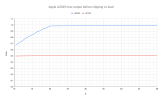
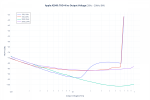
The 1V Apple headphone adapter will hard clip below 20Ω when attempting to output close to 1V, resulting in nasty distortion and a hard limit on SPL, but otherwise no effect on timbre/tonality as this clipping point is frequency independent (but other Amps may behave differently).

The 0.5V Apple headphone adapter OTOH is gain-limited all the way to <10Ω, meaning that you can set it to 100% volume with the Aeon 2 and you'll get clean playback with flat frequency response and no distortion, but also no more than 97dB SPL.

The 1.0V Apple adapter behaves the same, just for load impedances >20Ω.

So if you hear someone talk about anemic bass on the EU dongle with any headphone, or anemic bass with the US dongle with a >20Ω headphone, then you can be sure that it's just equal-loudness contours as the adapters themselves are incapable of affecting bass in that scenario.

b_Apple_A2049__THDN_vs_Output_Voltage___b_20Hz_-_20kHz_BW-4x_foolhardy_Remacri.png Apple_A2049_max_output_before_clipping_vs_load (2).png

Personally, I'd chalk most subjective reports of "anemic bass" and the like up to equal-loudness contours, rather than an effect in the Amp.
It's technically possible, but the former is much more likely.
 
Last edited:
I keep reading from people claiming that amp x or amp y would be "not enough" to drive a certain headphone, claiming that bass would be "thin" and detail lacking, or whatever.

Have we got measurements showing what actually happens?
Meaning:
Instead of measuring a headphone on the GRAS with an adequate power source, use something like the Apple Dongle, and measure the output from the headphones?

Can we actually "see" what happens to distortion, frequency response, etc. ?

Does it make a difference for the Dongle, whether we have 13 Ohm or 300 Ohm headphones connected? Does the output voltage depend on the load?

Sorry if these questions have been asked before here.

E.g. The Dan Clark Aeon 2 Noire (with sensitivity adjusted down to 84dB/mW) should just barely work on an Apple USB-C dongle putting out 1V if the goal is to not exceed 100dB SPL.
Audio Stuff Headphone Amp calculator

View attachment 568391


But what happens to the signal if you want 110 dB (or use a 0.5 V Dongle/DAP instead?)
Do we see the "flat bass" and the "loss in detail"?
Does it somehow affect multitone?


Really curious about that, since I feel like most measurements are always of a single device, and never of a combination of amplifier and transducer (and I know that it would be futile to do so, considering the billions of possible combinations each), but wouldn't it help for people to better understand and maybe accept the results?

After all: there's lots of criticism towards the "you only measure one device, and not the entire chain.. interplay between cables and amps and speakers, blabla.."

Cheers
As I always understood it, the result will be severe compression & at top levels intense hard clipping, so a major rise in THD, because of which FR would become raggy, pushing it towards similarity to non-harmonic noise spectrum.

If it would result in compression, @solderdude has some graphs available which show how FR behaves at high SPL - see ther HD681-AIR review "Linearity" graph. "Anemic bass at higher SPL" is then easily explainable, where (for example) you ask for 100dB SPL volume but you get 90dBSPL, while the rest of the signal goes up. Bass would be most severely affected, since, as @staticV3 noticed, due to equal-loudness contours you usually need 5-10dB more SPL in bass than in mids/treble, so you'd get more loudness in mids/treble, but not in bass, hence FR would get skewed towards mids/highs, bass staying where it was before. Add to that increase in THD, since compression also causes that, and you'd be getting sound that is very mid+treble heavy in nature, having noise-like features.
 
Last edited:
Personally, I'd chalk most subjective reports of "anemic bass" and the like up to equal-loudness contours, rather than an effect in the Amp.
It's technically possible, but the former is much more likely.

This.

Assuming that the output of the amplifier is just quieter, lack of bass and lack of treble ("detail") are exactly what you would expect to hear:

Lindos1.svg.webp
 
This.

Assuming that the output of the amplifier is just quieter, lack of bass and lack of treble ("detail") are exactly what you would expect to hear:

View attachment 568431
That is, of course, assuming that the "weak" amplifier is still acting in the linear range when driven to max available loudness.

I wonder whether it's actually possible to overdrive e.g. the european Apple 500mV dongle in any way with headphones?
 
Last edited:
so, the amp being too weak simply cannot play loud enough, hence why we perceive the bass as "lacking"?
 
In the end, V=IR (putting reactance to one side) and P=VI (which is where a USB power limit might happen)....

In the end, if boutique 'phones float your boat, you'll need a boutique means to drive them...

Meanwhile, all my 'phones or IEMs can get unbearably loud before I worry about clipping or big distortion on my USB-powered Topping DX1-1, or from headphone sockets on my amps. What am I doing wrong or missing out on? Or is there something to be said about efficient transducers?
 
so, the amp being too weak simply cannot play loud enough, hence why we perceive the bass as "lacking"?
In many cases. V-shaped FR favours low SPL (the famous "loudness compensation" button) and flatter bass/treble FR favours higher SPL. If as @staticV3 mentioned the amp you use stays in the linear range at full volume, you just hit the loudness ceiling while staying clean. If you run out of current, clipping + harsh distortion.
 
Just tested on my Plenue D2 from Cowon.
Rated at RMS 2V output on the non-balanced socket (don't have a 2.5mm cable to test balanced.. and am not going to , since the SMSL DL200 4.4mm socket doesn't even provide a balanced signal itself - considered getting that 2.5mm cable with a 4.4 mm adapter for this)

long story short, I've been used to having the volume at 60-75 on the player. With the Aeon 2 Noire, I'm at 90 for a comfortable level.
So, unless you do volume matching, I can totally see how people would find the "bass lacking"..
(I'm not even sure how loud I am right now, which kinda irks me.. but I know it's not dangerously loud)
 
Back
Top Bottom