• Welcome to ASR. There are many reviews of audio hardware and expert members to help answer your questions. Click here to have your audio equipment measured for free!

Is music mixed in Atmos genuine musical creativity, or just cheap gimmickry?

... Once my friend had planted those thoughts in my head, it became almost impossible for me not to notice the effects and simply listen to the music. :oops:

That certainly happens for me, but the focus usually passes with time (unless the effects are egregious/nonsensical). I more often listen to studio and part/full electronic material where the scenario of physical instruments in odd places is less common and less weird. You may want a certain sound to be a pinpoint in the distance, or another to be a fog that rolls across the floor, that has nothing to do with the location of a synth on stage or in studio.

If I hear a sound from behind, I turn round. What's the point of doing that with an Atmos film? I don't even like stereo sound for TV, as the soundstage width never matches the picture. It's especially annoying watching a symphony concert as the camera pans round, or focusses on an instrument whilst the sound stays put. ...

I don't have a surround loudspeaker setup, so my frequent Atmos listening) for film/TV is via Apple Vision Pro which presents the binaural down-mix (apparently enhanced by the device LiDAR reading the room and making other adjustments—per their promo, but I don't have the technical details). The surround soundstage is remarkably well rendered (in both scale and detail/focus) including positioning all around when the material includes that.

Also, the virtual screen can entirely span the room (if you like) so the mismatch between soundstage scale and image scale doesn't happen the way it usually does with a physical screen (outside a very lavish home theatre room, or actual cinema). There's no real supply of long-form surround visual material though, as promising as some of the demo material is.

Less well-presented is the audio bass and sub-bass—fortunately I don't have much of an appetite for blockbusters so I don't often miss it for film/TV. It's possible to remedy this somewhat by wearing AirPods Pro (or more than somewhat wearing AirPods Max, but the latter makes for a lot of headgear in aggregate). That means music listening is much less great. You can hear the very different approaches taken when mixing the material, which is informative. Some mixes are very broad/deep/articulated, others much less so.
 
Last edited:
I was recently presented with what was allegedly some of the best atmos mixes (Peter Gabriel among others, a mix which apparently won a Grammy) on a competent setup at an audio distributor.

My understanding is that the mixes that are perceived as the best are the "tasteful" ones that don't go crazy with effects just for the sake of it.

But on those mixes the result wasn't much more impressive than a good stereo setup to me. So personally I wasn't exactly blown away. If you have a surround setup to begin with I guess it's fine, but based on what I heard at that demo I would never set up additional speakers just for atmos music.

This is just my personal opinion of course. :)
 
It should be not forgotten that the reality of most home living room listening spaces are acoustically compromised with the loudspeakers and listening position being close to walls and one too far from the other for sufficient direct sound percentage. In such cases multichannel can provide a better/more impressive "spatial insight" than stereo reproduction.
 
It should be not forgotten that the reality of most home living room listening spaces are acoustically compromised with the loudspeakers and listening position being close to walls and one too far from the other for sufficient direct sound percentage. In such cases multichannel can provide a better/more impressive "spatial insight" than stereo reproduction.
OTOH, a setup that is not good enough might introduce even more "chaos" than stereo. For the layman, there are many "points of failure", from wrong position to inaccurate measurements etc. This, of course, may also happen to stereo setups, but then there are only two speakers playing wrong, instead of seven or more.
Headphones are the most "fail proof" in this aspect.
 
I can only offer my opinion.
Multichannel audio reproduction = gimmick.
Since "quad".
1) It has yet to catch on in a massmarket way for audio reproduction (although multichannel found a niche of no mean dimensions in 'home theater').
2) The format has never become standardized.

Say what you will about stereo, its [edit: fixed my grammatical/typographic gaffes] adoption has been widespread (pun semi-intended) since the late 1950s. ;)

The subject of multichannel audio certainly has an interesting history. In itself, it is arguably a good thing when new formats, recording techniques, mixes, and so on are tested. Some might even generate healthy commercial demand. Perhaps—but two-channel stereo still reigns supreme.:)

For instance, I wasn't even aware of this before I started this thread and read a few Wikipedia links:

Three-channel (Left-Center-Right) audio recording was introduced in the mid-1950s primarily by classical audiophile labels like Mercury Living Presence and RCA Victor to capture wide-stage orchestral realism before mixing down to two-channel stereo or mono.
Screenshot_2026-09-05_094836.815.jpg


But wait a minute. Three-channel (Left-Center-Right) audio recordings that are then mixed down to mono or stereo—isn't that "just" multitracking? Or recording with multiple microphones.
Multitracking, which, by the way, is a really interesting topic in itself—and one that is presumably linked, in a way, to the technical possibilities offered by multi-channel mixers:


Note that I’m no expert on the subject, so treat what I wrote above as questions rather than statements.

The subject is undeniably vast... and interesting.:)
 
Last edited:
Exactly why I returned to stereo. Too many (esp. movies) were "too much of a good thing", I wished for two "knobs" - one for width and one for depth. But, probably the performance as such was OK (assuming the producers know what they are doing), and my "poor man's Atmos" was at fault. Even so, in an average home it's hard to get much more than that.
I will try the new/coming immersive audio offerings, based on headphones, but don't want a "loudspeaker zoo" in the living room again
This and the next thing (because I have 2 of these) should have you fully covered (probably with just this but I put the other thing just in case)

Usage top

Intro Specifications Measurements Usage Recommendations

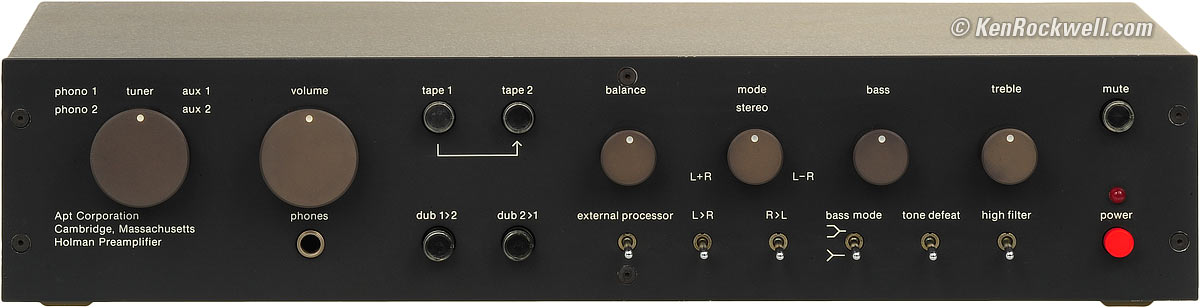
Apt Holman Preamplifier​

Apt Holman Preamplifier. enlarge.​

Stereo Mode Controls

Leave the MODE knob in the middle at STEREO, and leave the L > R and R > L switches down for normal stereo.

For mono, turn the knob to the left. The left-side of the control slowly narrows the image from stereo into mono. Controls like this were popular in the 1960s because people, used to mono, were sometimes uncomfortable with the full stereo effect.

Turning the knob to the right expands the stereo image. This doesn't excite me as much as I thought it would; it mostly just sucks out the center of the image.

The L > R and R > L switches select what input channels go to what output channels.

Here's what they do:​

L > RR > L
downdownNormal Stereo
UPdownLeft channel input heard as mono in both output channels
downUPRight channel input heard as mono in both output channels
UPUPReversed Stereo
If you'd like more detail, Tom ran out of panel space to label these more clearly as MONITOR INPUT SELECT RIGHT and MONITOR INPUT SELECT LEFT, which is what they're really doing.

If you lift the L > R switch, it puts the left channel into the right channel. The left channel remains in the left channel. You now are listening to the left channel (in mono of course) in both channels.

Lifting the R > L switch does the same thing, playing the right channel in both channels.

Lifting both switches at the same time simply flips the channels: left goes to right, and right goes to left.

These two switches allow the six line-level stereo inputs (including the tape and EPL loops) as up to twelve discrete mono inputs! This feature was popular in the 1960s, when mono tuners, phonographs and tape decks had but one output connector.

The other thing:
Quadraphonic Synthesis

With two Holman Preamplifiers, you can synthesis and control four output channels from just two input channels.

Apply all your inputs to the first Holman Preamplifier. Use it for all your tone controls, filters and source and tape selections. Leave its Stereo Mode in Stereo.

Connect the first Holman Preamplifier's MAIN 1 output to one power amplifier and your two front speakers.

Connect the first Holman Preamplifier's MAIN 2 output to any line-level input of the second Holman Preamplifier.

Connect the second Holman Preamplifier's MAIN 1 output to the power amplifier for your two rear speakers.

Rotate the second Holman Preamplifier's stereo mode control to L-R, and start by setting it to about unity gain or a bit less, and keep its tone controls flat. The tone and filter settings of the first Holman Preamplifier are fed automatically to the second Holman Preamplifier.

Set balance on the first preamp. Set front-rear balance on the Volume control of the second preamp.

Leave the power switch of the second preamp ON, and plug its power cord into a switched outlet of the first Holman Preamplifier. Now the power is controlled by the first Holman Preamplifier, too.​
 
I will try the new/coming immersive audio offerings, based on headphones, but don't want a "loudspeaker zoo" in the living room again.
That is exactly what I do. I all but abandoned loudspeakers for critical listening. And the idea of placing 5, 7 or 11 speakers around in the room seems crazy now.
In binauralisation I can switch from two channels to eleven channels with a click and if the recording needs some more room reflections (for me) that is just the turning of a knob. Bass rendering is sublime as my virtual room (≈500 cubic meters) avoids most of the compromises of small rooms and in VR there are no speaker placement compromises either.

In my experience a very good stereo mix can come close to what an Atmos mix delivers in the typical case of music from a frontal stage. [An ensemble placed “around“ the listener, several choirs or church music with realistic reverberation is a different story - no contest. The same will probably apply for sonic landscapes of electronic music or the like.]
But these stereo mixes are rare. Most of the time the Atmos mix conveys that extra portion of spaciousness and envelopment that makes me favour it in comparison, in particular for music being played in big venues (opera, orchestra, church,...)
For two channel stereo most of the times I prefer a configuration where the crosstalk is reduced (simple to do in an emulation over heaphones) in some form of Ambiophonics. It gets a bit closer to the spatial qualities of an Atmos mix in many cases.

I am talking streaming here, so the Atmos is in a lossy codec (Apple Music) and I am talking about classical music that is a) recorded in a reverberant room and b) the mixes are of the conservative kind with gimmicks absent.
Other stuff I just don't know about.
But I checked the height channels of the Grammy winning Gabriel track (I/O) that @SigbergAudio mentioned above and they have serious dropouts all the time, whilst i.e. a very good classical album like Peer Gynt (Järvi, Estonian National Symphony) has no such dropouts in height channels, they sound fine with the same codec. So maybe these are produced more carefully, too.
 
I understand, that discussion is about multichannel versus stereo. I'd like to notice the other aspect, which is PCM versus Dolby (and similar). Usually (but not necessary) stereo is PCM, while multichannel is Dolby.

Dolby has an obvious advantage over PCM, which is a defined reference level and required headroom. I like to listen to Dolby Atmos mixes, because they are free of overcompression and clipping, which is not the case with stereo PCM.
Compressed formats like Dolby, or uncompressed PCM have nothing to do with overcompression and clipping. Overcompression and clipping is a deliberate decision by the artists/producers/mastering engs to do it that way for maximum impact with listeners, who these days are mostly listening in less than ideal circumstances, on earbuds, on the bus, in the kitchen or whatever. How many people these days sit down in front of a pair of loudspeakers and listen? Very few relatively, I suggest.

It is a supreme irony that Red Book CD has for 40 years been the most transparent HiFi format available to the home listener whilst the results in recent years is fit only for the kitchen or the bus. Even LPs or cassettes can be more satisfying than some (most?) CDs.

The tools are there for superb recordings, they're just not used, indeed abused.

S.
 
Overcompression and clipping is a deliberate decision by the artists/producers/mastering engs to do it that way for maximum impact with listeners
True, you can clip music in Atmos too. But if expected impact is to make the track sound louder, then it wont work.
Actually replay gain in streaming services could have similar influence on loudenss war, but we don't see it yet.
 
I prefer the surround effect, even when playing stereo sources. I enjoy the feeling of being enveloped in the music from all directions. Even in my car, I try to set front/rear balance so that you casually can't determine exactly where the sound is coming from because it's flowing all around you.
 
I prefer the surround effect, even when playing stereo sources. I enjoy the feeling of being enveloped in the music from all directions. Even in my car, I try to set front/rear balance so that you casually can't determine exactly where the sound is coming from because it's flowing all around you.

Already with 2-channel audio I have a great sense of envelopment with my system. A few days ago, I compared an Atmos track to the 2-channel version of the same track, and when playing the latter, I actually had to make sure there wasn't any sound coming from surround speakers.
 
This feels like an overgeneralization. A gimmicky Atmos mix doesn’t make Atmos itself a gimmick.
It’s a deliberately crafted clickbait headline. We live in the YouTube clickbait headline era—even though this isn’t YouTube, ...you get what I mean. Though, really, there’s nothing new under the sun in that regard:
Screenshot_2026-09-06_112542.811.jpg
(Gemini AI)
In any case, the interesting part is the discussion in the thread, which I find nuanced, featuring various viewpoints and perspectives.:)
 
I was recently presented with what was allegedly some of the best atmos mixes (Peter Gabriel among others, a mix which apparently won a Grammy) on a competent setup at an audio distributor.

My understanding is that the mixes that are perceived as the best are the "tasteful" ones that don't go crazy with effects just for the sake of it.

But on those mixes the result wasn't much more impressive than a good stereo setup to me. So personally I wasn't exactly blown away. If you have a surround setup to begin with I guess it's fine, but based on what I heard at that demo I would never set up additional speakers just for atmos music.

This is just my personal opinion of course. :)
What I find interesting is that we didn’t get this endless debate about 5.1 SACD releases, a lot of those are actually capturing and delivering a sound field using a surround micing technique though. I don’t have any SACDs but I do have some of those recordings which various people are now selling as 5.1 FLAC.

It also doesn’t help that the ‘home’ Atmos delivery formats are technically terrible.

Eclipsa Audio is technically much better but there has been mostly radio silence on that since it was disclosed.
 
Imo stereo is an annoying gimmick but i may be in a minority in that one.
...but i may be in a minority in that one.
You don’t even have to guess about that.:);)

The exception would be, say, a space where you can’t reasonably place two speakers to achieve a good stereo effect—perhaps a basement,kitchen or bedroom that presents a challenge in this regard. Or perhaps for those who listen more to talk radio, podcasts than to music.
 
Imo stereo is an annoying gimmick but i may be in a minority in that one.
You mean stereo (2 channel) as opposed to mono?
What about mono being the greatest gimmick of all?
A sound that does not belong, coming from somewhere else or from some “media“, without a natural source.
What an abomination! ;-)
 
Why do some have a need to denigrate other people choices?
Most people enjoy stereo listening and multi channel listening, both way need us to accept their disconnect to what it is to listen to real musician playing somewhere.
They can both be spectacular or fall completely apart depending on implementation and source material.
They both take dedication and efforts to reproduce great music, but at the same time they can both deliver the fix we are after. Their is no right or wrong, just different approach to a common goal.

We are fortunate to live in a time when we have those beautiful choices and alternative.
Stereo did not replace Mono, Multi is not replacing Stereo, what most use or not, does not matter to us as individual.

My audio hobby and poison of choice involve, a dedicated room with a single seat listening to very specifically positioned 2 speakers, it gives me hours of pleasure every day. I hope all of you out there can say the same about how you end up experiencing your music in your space.
 
Back
Top Bottom