
-
Welcome to ASR. There are many reviews of audio hardware and expert members to help answer your questions. Click here to have your audio equipment measured for free!
- Forums
- Audio, Audio, Audio!
- Amplifiers, Phono preamp, and Analog Audio Review
- Turntables, Phono Amplifier, Cartridges Review
You are using an out of date browser. It may not display this or other websites correctly.
You should upgrade or use an alternative browser.
You should upgrade or use an alternative browser.
Introducing the Phono Cartridge Measurement Library
- Thread starter USER
- Start date

Nice , thanks.interesting alignment effect. How does it look without common normalisation at 1khZ, Current setting hides any channel imbalance..
It may need som azimuth adjustment, large crosstalk difference.
It may need som azimuth adjustment, large crosstalk difference.
Unfortunately, my tonearm does not have azimuth adjustment.Nice , thanks.interesting alignment effect. How does it look without common normalisation at 1khZ, Current setting hides any channel imbalance..
It may need som azimuth adjustment, large crosstalk difference.

One can use angled shims.Unfortunately, my tonearm does not have azimuth adjustment.
https://www.audiosciencereview.com/...inyl-measurements.20278/page-134#post-2546378
Channels are within 0.4 dB at 1 kHz.Nice , thanks.interesting alignment effect. How does it look without common normalisation at 1khZ, Current setting hides any channel imbalance..
It may need som azimuth adjustment, large crosstalk difference.

My trick: If you have a tonearm with a standard headshell, twist slightly the headshell to the right (or to the left) while inserting and tightening it into the arm wand, measure, repeat. It is easy to overshoot, multiple measurements are usually needed till you get it right.Unfortunately, my tonearm does not have azimuth adjustment.
Given the tolerances of the typical headshell mount (I have a Technics SL-1300G, it is very lose), this is as good as it gets...
fricc, I appreciate your help but unfortunately my Rega RB300 tonearm has not a standard headshell, it is in one piece with the tonearm.My trick: If you have a tonearm with a standard headshell, twist slightly the headshell to the right (or to the left) while inserting and tightening it into the arm wand, measure, repeat. It is easy to overshoot, multiple measurements are usually needed till you get it right.
Given the tolerances of the typical headshell mount (I have a Technics SL-1300G, it is very lose), this is as good as it gets...
Thomas, are you selling them?One can use angled shims.
https://www.audiosciencereview.com/...inyl-measurements.20278/page-134#post-2546378
Yes.Thomas, are you selling them?
Now I have tried to put a little piece of hard paper on the inner side, between the cartridge and the head shell, with a thickness of exactly 0.2 mm.
The crosstalk has become much more close between the channels, also the frequency response.

The crosstalk has become much more close between the channels, also the frequency response.
That is atan(0.2/12)=1 degree Azimuth adjustment.

Danish ear
Member
B&O MMC 2.
Hours unknown. Mounted on a Beogram 6500 with builtin RIAA loading it with 47K and 220pF.

Hours unknown. Mounted on a Beogram 6500 with builtin RIAA loading it with 47K and 220pF.
Micro-Acoustics 530-mp
This is a very interesting cartridge, it features an Electret (piezoelectric) transducer, no coils, no magnets.
The output impedance is purely resistive and it is completely load insensitive. An internal passive output equalizer stage makes it RIAA compliant.
More info in the Micro-Acoustics 1977 Catalogue, the MA 530-mp was the top of the line at the time with a beryllium cantilever and a Micro-Point stylus.
I just bought this as NOS for $550 on US Audio Mart. Looks like a winner

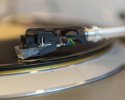

This is a very interesting cartridge, it features an Electret (piezoelectric) transducer, no coils, no magnets.
The output impedance is purely resistive and it is completely load insensitive. An internal passive output equalizer stage makes it RIAA compliant.
More info in the Micro-Acoustics 1977 Catalogue, the MA 530-mp was the top of the line at the time with a beryllium cantilever and a Micro-Point stylus.
I just bought this as NOS for $550 on US Audio Mart. Looks like a winner
Last edited:

MaxwellsEq
Major Contributor
- Joined
- Aug 18, 2020
- Messages
- 3,834
- Likes
- 6,951
Fascinating. When I first started buying cartridges, electret seemed to be classed as low-end, suitable only for cheap "music centres". If you were willing to spend "real money", MM, MI and MC seem to have been classed as higher quality. Now I'm confused!Micro-Acoustics 530-mp
This is a very interesting cartridge, it features an Electret (piezoelectric) transducer, no coils, no magnets.
The output impedance is purely resistive and it is completely load insensitive. An internal passive output equalizer stage makes it RIAA compliant.
More info in the Micro-Acoustics 1977 Catalogue, the MA 530-mp was the top of the line at the time with a beryllium cantilever and a Micro-Point stylus.
I just bought this as NOS for $550 on US Audio Mart. Looks like a winner
View attachment 569015
View attachment 569023View attachment 569024

somebodyelse
Master Contributor
- Joined
- Dec 5, 2018
- Messages
- 7,153
- Likes
- 7,160
Electret and piezoelectric aren't the same. Electret is variable capacitance with a fixed charge, usually varying the air gap between the plates. With piezoelectric the deformation of a solid produces a change in charge.This is a very interesting cartridge, it features an Electret (piezoelectric) transducer, no coils, no magnets.
Micro-Acoustics cartridges technically use a piezoelectric ceramic element (lead-zirconium titanate), though the company marketed them using the term electret.Electret and piezoelectric aren't the same. Electret is variable capacitance with a fixed charge, usually varying the air gap between the plates. With piezoelectric the deformation of a solid produces a change in charge.
There is some history here: Micro-Acoustics Corporation History Page.
The roots of the company were into old school ceramic cartridges, but they were also they were industry leaders in cutting heads for making records.Fascinating. When I first started buying cartridges, electret seemed to be classed as low-end, suitable only for cheap "music centres". If you were willing to spend "real money", MM, MI and MC seem to have been classed as higher quality. Now I'm confused!
Solid state piezoelectric materials are very light and, no moving parts, and have a very fast transient response.
My personal interest is in validating these claims and understanding the various cartridge manufacturing technologies and understand what matters for actual record sound reproduction.
In many ways cartridges used to be much more high tech back then, with exotic materials and a variety of very different designs. Now we have basically a single provider for stylus and cantilever and a bunch of manufacturers repackaging the same basic designs and adapting them to the materials and fabrication technologies available on the market.
We can measure things with a degree of resolution unprecedented though, and that helps
somebodyelse
Master Contributor
- Joined
- Dec 5, 2018
- Messages
- 7,153
- Likes
- 7,160
Seems like misleading marketing to avoid the poor reputation of ceramic (piezoelectric) cartridges, using a term associated with microphones.Micro-Acoustics cartridges technically use a piezoelectric ceramic element (lead-zirconium titanate), though the company marketed them using the term electret.
There is some history here: Micro-Acoustics Corporation History Page.
I don't know about "misleading marketing", they had a real good piece of technology, and they had to go for a different bucket than the cheap piezoelectric carts of the past.Seems like misleading marketing to avoid the poor reputation of ceramic (piezoelectric) cartridges, using a term associated with microphones.
What set it apart from cheap ceramics was the design: direct coupling, very low moving mass, element resonance well above 20 kHz, and a built-in network giving velocity output and load insensitivity.
In marketing that is called Positioning.
Similar threads

- Replies
- 11
- Views
- 6K

- Replies
- 12
- Views
- 4K

- Replies
- 18
- Views
- 6K


- Replies
- 42
- Views
- 22K