• Welcome to ASR. There are many reviews of audio hardware and expert members to help answer your questions. Click here to have your audio equipment measured for free!

Introducing DSPi | A powerful, user friendly and open source DSP for less than a cup of coffee

At the moment, this is the project roadmap:

- DSPi Link and mobile applications (Network control)
- Analog PWM output overhaul (Any output slot(s) assignable)
- Selectable system clocks and voltages (Increased performance)
- Automated room correction
- SPDIF RX and Soft VCXO overhaul (Cleaner clocks)
Is the linux/RPi bit you teased us with at the end of August still on the roadmap?
 
Hi ,

I’m exploring the possibility of using DSPi with two balanced analog XLR inputs instead of USB audio from a PC, while retaining the existing DSP processing features such as PEQ, gain, delay, and crossover.

My idea is to use an external stereo ADC, such as the PCM1808, with a balanced analog front-end to convert the XLR inputs into digital audio and feed it to the Pico 2 via I2S.

I have a few questions:

  1. Does DSPi currently support I2S audio input, or is the audio processing pipeline designed exclusively around USB audio and other existing digital inputs?
  2. Would it be possible to connect an external ADC like the PCM1808 to the RP2350 and route its stereo audio into the existing DSP processing pipeline?
  3. If I wanted to implement this, what parts of the firmware would need to be modified? Would it mainly involve adding I2S input, DMA buffering, and routing the ADC's audio samples into the DSP pipeline?
  4. Are there any clocking or synchronization limitations I should consider when using an external ADC?
  5. Would this be feasible without significantly affecting the existing DSP performance or latency?
I noticed that SPDIF RX is on the roadmap, so I’m curious whether a similar approach could be used for an external analog ADC input.

Any guidance on the feasibility and the best way to approach this would be greatly appreciated. Thank you for developing and sharing DSPi!

 
Hi ,

I’m exploring the possibility of using DSPi with two balanced analog XLR inputs instead of USB audio from a PC, while retaining the existing DSP processing features such as PEQ, gain, delay, and crossover.

My idea is to use an external stereo ADC, such as the PCM1808, with a balanced analog front-end to convert the XLR inputs into digital audio and feed it to the Pico 2 via I2S.

I have a few questions:

  1. Does DSPi currently support I2S audio input, or is the audio processing pipeline designed exclusively around USB audio and other existing digital inputs?
  2. Would it be possible to connect an external ADC like the PCM1808 to the RP2350 and route its stereo audio into the existing DSP processing pipeline?
  3. If I wanted to implement this, what parts of the firmware would need to be modified? Would it mainly involve adding I2S input, DMA buffering, and routing the ADC's audio samples into the DSP pipeline?
  4. Are there any clocking or synchronization limitations I should consider when using an external ADC?
  5. Would this be feasible without significantly affecting the existing DSP performance or latency?
I noticed that SPDIF RX is on the roadmap, so I’m curious whether a similar approach could be used for an external analog ADC input.

Any guidance on the feasibility and the best way to approach this would be greatly appreciated. Thank you for developing and sharing DSPi!
I2S audio input with something like the PCM1808 is already fully possible, so no need to try to implement new stuff :)
 
Regarding the I2S input, it would be interesting to be able to combine two ADCs to achieve 32-bit resolution, similar to how Zoom or Tascam devices do it—though I would prefer 32-bit integer rather than 32-bit float.
 
Regarding the I2S input, it would be interesting to be able to combine two ADCs to achieve 32-bit resolution, similar to how Zoom or Tascam devices do it—though I would prefer 32-bit integer rather than 32-bit float.

For what purpose though?
 
I noticed that SPDIF RX is on the roadmap, so I’m curious whether a similar approach could be used for an external analog ADC input.

SPDIF input to the DSPi is already implemented in the current firmware. The simplest way to use it is to add a toslink optical receiver. Coax SPDIF input is a little more complex.
 
For what purpose though?
"32-bit float audio is a digital recording format that eliminates the risk of distortion from sounds that are too loud and background noise from sounds that are too soft, making gain staging unnecessary."

I still hope that DSPi can be used for recording....
 
"32-bit float audio is a digital recording format that eliminates the risk of distortion from sounds that are too loud and background noise from sounds that are too soft, making gain staging unnecessary."

I still hope that DSPi can be used for recording....
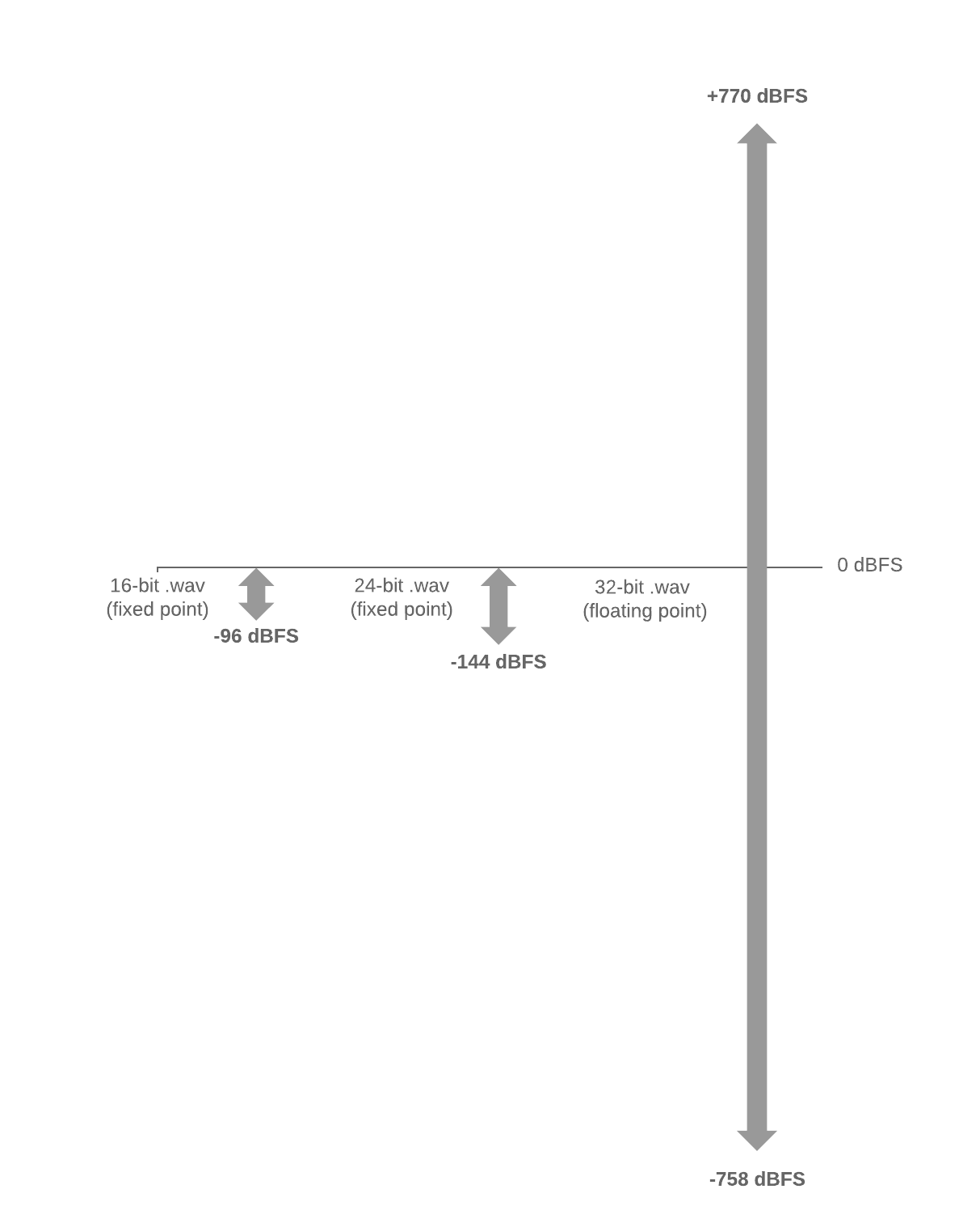
I think you might have lost the plot. 32-bit float recording is all well and good for capturing audio without clipping the input stage, but it is not relevant to input and output with DSPi. 24-bit already has a theoretical dynamic range of 144dB and a real world dynamic range of 120-130dB, which is already far beyond the limit of what you can actually hear.
 
Last edited:
"32-bit float audio is a digital recording format that eliminates the risk of distortion from sounds that are too loud and background noise from sounds that are too soft, making gain staging unnecessary."

I still hope that DSPi can be used for recording....

I don't think this would be of much benefit to this project. I also don't see how bit depth removes background noise from recordings. I think that part is made up.
 
no, I didn't invent it
 
no, I didn't invent it
Perhaps this new topic is substantial enough to deserve its own thread?

If you don't want to start a new one, this one was also created to handle diversionary discussion

 
I had two strange things happening:
1. the level of the HF channels (tweeters) slowly rising up to a level where the signal was completely distorted. After powering DSPi down and back up the levels were back to normal
2. I have some channel imbalances between the two speakers, but that's probably because they're using different amp modules. So I set them to the correct levels but after playing for a few hours one of the channels' level suddenly went about 3db up. I readjusted but after saving the level was back down to before the "incident".

Maybe these are related to loudness compensation.
 
Anyone uses LG Sound Sync feature with conjunction with CS8421 (e.g. Tinysine TOSLINKBee) by any chance and know if CS8421 rejects LG Sound Sync bits?

What I'm trying to do, is to deal with a loud noise when switching sources on my LG OLED TV connected to Topping DX1 Pro with optical cable, use DSPi features and control audio on TV with LG magic remote. I thought that I need CS8421 to deal with the noises, but with recent updates to DSPi (SPDIF RX and Soft VCXO overhaul (Cleaner clocks)) I started to think if I really need CS8421 or simple optical rx to i2s will be enough.
 
DSPi Console v1.1.6 Beta 4 is now available for Windows, complete with many bugfixes and all of the fancy new functionality found within the macOS version! :)

For a complete list of changes, please reference the previous macOS releases here and here. Console for Windows is now at full feature parity.

This release has been quite a time consuming one, as various core components needed to be rewritten in order to enable some of the new functionality such as RTA/FFT and on-graph editing.

1791137657373.png
1791137709464.png

1791137749447.png
1791138900129.png

1791137892075.png
1791137915855.png
1791137987034.png


Concurrently with the Windows release, I have also been working on Console for Linux. This version has been very far behind for many months, so it is now receiving some long overdue attention.

Console for Linux is targeting the KDE Plasma desktop environment and here is a little peek at its current state.

1791140545841.png
1791140762575.png

Screenshot_20261003_225623.png
Screenshot_20261003_225557.png

1791140971141.png
Screenshot_20261003_221729.png


Anybody who wishes to test Console for Linux is very welcome to do so via the repository. All of the latest commits are available on the linux-parity branch.

The usual disclaimer: While great care has been taken to thoroughly test all functionality, this is beta software and some bugs may remain. Should you encounter a bug or unexpected behavior, please don't hesitate to make a report so that it can be squashed! You can do that either here, on GitHub or via the Discord server (many helpful people there).

Finally and as always, DSPi is a not-for-profit open source project funded entirely by donations and out of pocket. If you wish to support the project, you can do that via Ko-fi or Patreon.
 
I guess there was a change of plan and you did a release instead:
https://github.com/WeebLabs/DSPi-Console-Linux/releases/tag/v1.1.6-beta4

It's found my RP2040 which is a good start. I've not tried hooking it up to anything yet.
I may have stayed up far too late working on it, bringing it up to full feature parity with Windows and macOS. :oops:

1791202921289.png
1791203053335.png
1791202987435.png
1791203114250.png


Some bugs may remain but in my limited testing (more tonight), everything appears to be working well. Having two existing codebases from which to port greatly accelerated the process.
 
Last edited:
Support for several control interfaces are planned. Among them are IR remote control, Bluetooth via phone application
Hi! Thank you for sharing this project! What do you think about bluetooth control via phone app now?
 
My mini-streamer. I love the IMD, improvised musical device. I like things in an attractive case too, but there's something about a rat's nest of wires that appeals to me. It's a Raspberry Pi 2W hooked up to DSPi on a breakout board with toslink output. The Pi is running MPD with umpdcli. I can play files that I own, and with a UPNP control point like BubbleUPNP on my Android devices I can play Qobuz too.
PXL_20261005_180801555[1].jpg
 
Back
Top Bottom