• Welcome to ASR. There are many reviews of audio hardware and expert members to help answer your questions. Click here to have your audio equipment measured for free!

Interspace USB to Balanced Box (DAC)

Rate this Balanced DAC:

  • 1. Poor (headless panther)

    Votes: 106 94.6%
  • 2. Not terrible (postman panther)

    Votes: 2 1.8%
  • 3. Fine (happy panther)

    Votes: 3 2.7%
  • 4. Great (golfing panther)

    Votes: 1 0.9%

  • Total voters
    112
Sure. And in a DBT test, I bet this thing will be undistinguishable from a SOTA Topping, under normal listening conditions.
With a roll-off at 90Hz (which could be even 2nd order) I think that would be readily audible. And I've seen many small transformers going into an abrupt and chaotic "fold-over" mode when driven with low frequencies at high levels (depends on the driving impedance).
 
Last edited:
With a roll-off at 90Hz (which could be even 2nd order) I think that would be readily audible. And I've seen many small transformers going into an abrupt and chaotic "fold-over" mode when driven with low frequencies at high levels (depends on the driving impedance).

So you may try the test. The smallest Neutrik NA2M-D2B-TX miniature transformer balancing adapter.
 
So you may try the test. The smallest Neutrik NA2M-D2B-TX miniature transformer balancing adapter.
Make something with deep bass and I will try it. That track is not it.
 
I looked them and was slightly surprised to see this company is just down the road from me. I've driven past many times and never realised they were there. By coincidence they're right next to a very good HiFi shop (Nintronics) but I don't think they have anything in common at all. They're tiny, I think it was a one-man-band for a long time, but have been going for a long time, and have a very long list of international distributors, so must be doing something right. This is PA equipment, not HiFi.
 
At the height of production of such ICs for computer use, they were likely this bad. I recall while at Microsoft trying to set the performance level better than 60 dB SNR and major PC OEMs cried loudly, keeping is from being able to do so!

The device you tested has remained unchanged since 2013 , so it is essentially a 13 + year old design and deliberately USB Class 1 (for true plug and play ).

Is that the era you're talking about here, or a time before that?

And out of interest, does the 600ohm impedance of the unit's transformers affect your measurements or the context of them?

I presume the 600ohm impedance is specified for use with internal A/V equipment standards still installed in old buildings - There are many dusty old buildings here in London for example, that have 1980s / 1990s equipment installed for presentations and events . Often, the more posh and 'old money' the clientelle and venue (think Lords, Ladies, retired politicians, judge, royal connections etc ) often the longer ago the equipment was installed ..
 
It´s a device designed to plug into live consoles via the MIC input; 0.7 V RMS is more than enough.
Most people are oblivious to such details. If you're running through an analog multicore carrying mic level signals, you don't want to send a high line level signal that will bleed into the mic level channels.
 
@Amir

For a professional product, I expect minimum of 4 volts output. Here, we don't even have 1 volt! And yes, this is with the pad disabled. Enabling the pad gives you candle light levels of output!

Unfortunately, this is a statement coming from a place of lack of knowledge .

0.7V is what you kind of want for line level into mixer.

For use with a microphone input you want "candle light levels if output" .. in the mVs . Tha is what the pad is for.

So it performs as one should expect for a professional product to be used in the professional environment it has been designed for ..

My only surprise is probably the age of the internal dac . I guess he made one ages ago and kept everything the same for predictability and longevity of product
 
Here 0 VU is about 1.23 Vrms, or +4 dBm referred to 600 ohms. I would expect a professional line-level source to provide that much, and preferably at least some headroom beyond (typically ~6 dB, or ~2.5 Vrms, IME).

Arguing the use case is somewhat pointless in a review thread IMO; the numbers show where it can be used.
 
Last edited:
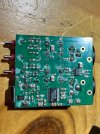
PCM2906C looks to be key to this high performance piece of equipment.
 

Attachments

  • IMG_5614.jpeg
    IMG_5614.jpeg
    578.2 KB · Views: 30
PCM2906C looks to be key to this high performance piece of equipment.
I wonder if they just got a good deal on them, otherwise why would you pick the version with the S/PDIF IO that's going unused rather than the version without? It isn't the weak link though - this significantly underperforms when compared with the Behringer UCA-202 with the genuine part, more like the ones with the CoolAudio clone part. Do you have a pic of the other side where the transformers are?
 
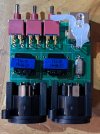
Do you have a pic of the other side where the transformers are?
I do. I’m sure there will be much love for the transformers! ;)
Slightly in defence of the item, it was sold until quite recently for approximately £100 in the U.K. which is around $134, significantly less than the US price.
Also I’m not sure anyone has mentioned the DC protection it provides which is important when working with microphone inputs that can have +48vDC and is easy to mistakenly leave on in a pressured situation.
But yeah, it’s pretty terrible for a device that was being sold new in early 2026.
 

Attachments

  • IMG_5613.jpeg
    IMG_5613.jpeg
    396.2 KB · Views: 22
Back
Top Bottom