• Welcome to ASR. There are many reviews of audio hardware and expert members to help answer your questions. Click here to have your audio equipment measured for free!

Interspace USB to Balanced Box (DAC)

Rate this Balanced DAC:

  • 1. Poor (headless panther)

    Votes: 106 94.6%
  • 2. Not terrible (postman panther)

    Votes: 2 1.8%
  • 3. Fine (happy panther)

    Votes: 3 2.7%
  • 4. Great (golfing panther)

    Votes: 1 0.9%

  • Total voters
    112
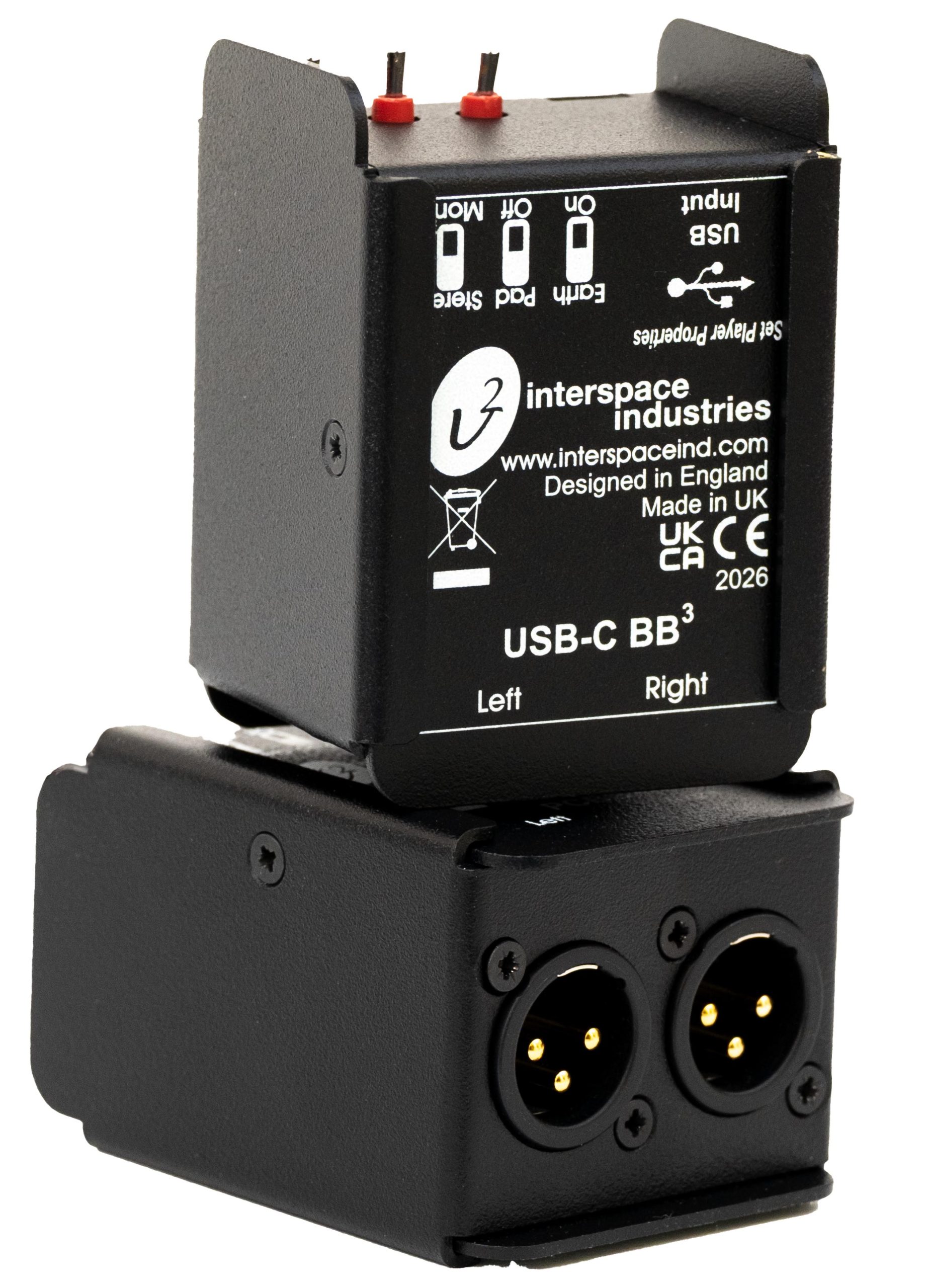
This is a review and measurements of the Hive Interspace USB Balbox adapter. It is built in UK and was kindly drop shipped to me by a member. The version I have is no longer on their site but they do have a version 3. No specs are provided to know if there are improvements in issues I have found.
View attachment 555679
The version 3 costs US $183. If mine is anything like it, it only exposed 16 bits at sampling rates of 44.1/48 KHz. It must be one obsolete, old PC targeted DAC silicon.

Measurements, after setting Windows Volume to max, was super disappointing on multiple fronts:
View attachment 555681
For a professional product, I expect minimum of 4 volts output. Here, we don't even have 1 volt! And yes, this is with the pad disabled. Enabling the pad gives you candle light levels of output!

Moving on, we see massive distortion as one would expect from super vintage DAC IC. I realize this is a "solution box" but come on, please give it modicum of attention to produce proper output, not this embarrassing level.

Didn't see the need to measure more.

Conclusions
A robust metal box ready to spit out quality audio over USB to balanced XLR would be nice to have. Alas, while the company manages to produce that as far as physical construction, the guts need major transplant surgery to even approach anything I recommend. As noted, it needs to have far higher output voltage, not underperforming even a $9 dongle!

Needless to say, I can't recommend it.
------------
As always, questions, comments, recommendations, etc. are welcome.

Any donations are much appreciated using: https://www.audiosciencereview.com/forum/index.php?threads/how-to-support-audio-science-review.8150/
Amir, you say "massive distortion as one would expect from super vintage DAC IC." but surely from that we should expect something close to Red Book?

EDIT: so those ICs really were that bad? Got any examples?
 
I'm sorry but IMO why waste time reviewing products like this? It's obviously not intended for the HiFi market. I looked at the website and it's sold as a tool/solution for PC presentations and makes no claims other than to eliminate possible hum/noise (which it was not tested for in the review).

I did a search for the product online and this review comes up first - which could potentially affect sales for the wrong reasons. If this were my business, I'd have a word or two with this site's owner for sure.
 

it's definitely advertised as an audio device. to understand the first sentence, you need to understand the problem it's trying to solve

it's designed for use in live environments, totally different to the products you mentioned

I used to work in AV hire at a venue. we'd use devices similar to these. the main concern is reliably getting audio to a mixing desk. using a device like this is far preferable than using the audio output of the laptop (if the laptop even has one). this isn't a high fidelity product and it doesn't claim to be one - it's likely just going to be used for a video in someone's powerpoint presentation. it'll ideally do a good enough job for that, the main concern is being reliable and robust.
The much cheaper Peavey USB-P seems aimed at the same function, and measured somewhat better, although with an even lower output level.
 

it's definitely advertised as an audio device. to understand the first sentence, you need to understand the problem it's trying to solve

it's designed for use in live environments, totally different to the products you mentioned

I used to work in AV hire at a venue. we'd use devices similar to these. the main concern is reliably getting audio to a mixing desk. using a device like this is far preferable than using the audio output of the laptop (if the laptop even has one). this isn't a high fidelity product and it doesn't claim to be one - it's likely just going to be used for a video in someone's powerpoint presentation. it'll ideally do a good enough job for that, the main concern is being reliable and robust.

On second look, yes, you may be right. But not aimed at audiophiles, I would say. Maybe more pro audio. Regardless, its sucks big time. A joke at that price.
 
Amir, you say "massive distortion as one would expect from super vintage DAC IC." but surely from that we should expect something close to Red Book?

EDIT: so those ICs really were that bad? Got any examples?
Red Book is 16-bit resolution which implies roughly 98 dB SNR and 144 dB SFDR (spurious-free dynamic range) for an ideal DAC. This DAC performs much worse the Red Book's ideal. Early DACs were not all that close to the ideal, but many were better than this. Third-harmonic distortion -60 dB is pretty poor. To provide context, -60 dB is 0.1% distortion, and my Sony CDP-101 (my first CD player) was rated at 0.004% THD (-88 dB).
 
Last edited:
I'm sorry but IMO why waste time reviewing products like this? It's obviously not intended for the HiFi market. I looked at the website and it's sold as a tool/solution for PC presentations and makes no claims other than to eliminate possible hum/noise (which it was not tested for in the review).

I did a search for the product online and this review comes up first - which could potentially affect sales for the wrong reasons. If this were my business, I'd have a word or two with this site's owner for sure.
Yes, but does it need to be quite this bad? Surely a minimum level of competence can be expected?
 
Red Book is 16-bit resolution which implies roughly 98 dB SNR and 144 dB SFDR (spurious-free dynamic range) for an ideal DAC. This DAC performs much worse the Red Book's ideal. Early DACs were not all that close to the ideal, but many were better than this. Third-harmonic distortion -60 dB is pretty poor. To provide context, -60 dB is 0.1% distortion, and my Sony CDP-101 (my first CD player) was rated at 0.004% THD.
Yes, I know all that. ;-) My point is that something better than the Leak Point One's <https://www.44bx.com/leak/PointOne2.html> distortion level should be expected these days even from non-audiophile gear.

Edit: the Sony's 0.004% is -88 dB, yes?
 
Last edited:
Yes, I know all that. ;-) My point is that something better than the Leak Point One's <https://www.44bx.com/leak/PointOne2.html> distortion level should be expected these days even from non-audiophile gear.

Edit: the Sony's 0.004% is -88 dB, yes?
Sorry, I took your comment to mean that the sort of distortion seen here was what we would expect from Red Book, and that is not true. I believe a number of pro sound reinforcement gear, particularly power amps, is still rated around 0.1% THD, but I have not looked recently.

20*log10(0.004/100) = -88 dB -- you are correct

For reference for others, 20*log() is for voltage, 10*log() is for power, so it's important to be aware of the parameter in the ratio for the log. See e.g. https://www.audiosciencereview.com/forum/index.php?threads/units-symbols-and-terms-oh-my.1923/
Sorry, rereading my comment, it now seems ambiguous. I meant that I would expect vintage DAC ICs to be a lot closer to Red Book than the DUT, so I was questioning Amir's comparison.
 
I'm sorry but IMO why waste time reviewing products like this? It's obviously not intended for the HiFi market. I looked at the website and it's sold as a tool/solution for PC presentations and makes no claims other than to eliminate possible hum/noise (which it was not tested for in the review).
It does make other claims:
IMG_3613.jpeg


It claims to be a self-contained sound card, providing beautiful and faithful reproduction of your sound…
 
Ok you got me there, but my point really was this is not marketed as a HiFi product for home audio enjoyment - it's for "live event audio". In its current state it just might provide sound quality that "is beautiful and a faithful reproduction of sound" to people at a conference or in a classroom, where the PA system being used likely has more distortion than this device does.
 
Ok you got me there, but my point really was this is not marketed as a HiFi product for home audio enjoyment - it's for "live event audio".
A large part of our viewers are professionals and as such, I routinely test a lot of products targeted at Pro market. This one has a ground life switch which can also come in handy for home use. I did try it but balanced had so little mains interference that it didn't make a difference.
 
Ok you got me there, but my point really was this is not marketed as a HiFi product for home audio enjoyment - it's for "live event audio". In its current state it just might provide sound quality that "is beautiful and a faithful reproduction of sound" to people at a conference or in a classroom, where the PA system being used likely has more distortion than this device does.
You could say the same about the Peavey USB-P which was previously measured here, and is directly comparable as it targets pretty much the same market, including the transformer coupled output. Price is about 1/3 of this one (assuming similar pricing to the v3) and it now we know it measures better too. It doesn't have the ground lift switch, and has a type B connector rather than a Type C (cue arguments about rated insertion cycles vs. board attachment reliability.) I think there was a cable-style USB to XLR DAC tested, also targeting this market and performing relatively poorly (but maybe better than these), but I can't find the review now.
 
It does make other claims:
View attachment 555898

It claims to be a self-contained sound card, providing beautiful and faithful reproduction of your sound…

That is Version 2; check the manual for Version 1, which is the one Amirm tested. Look at the bandwidth: 90 Hz to 18 kHz, which indicates terrible transformers.
1788335247189.png


Anyway, the actual price of version 3 is...£108≈$120
 
Last edited:
Ok you got me there, but my point really was this is not marketed as a HiFi product for home audio enjoyment - it's for "live event audio". In its current state it just might provide sound quality that "is beautiful and a faithful reproduction of sound" to people at a conference or in a classroom, where the PA system being used likely has more distortion than this device does.
Let's be honest, just about any amp-speaker system will have more distortion than this, "hi-fi" or not.
 
Let's be honest, just about any amp-speaker system will have more distortion than this, "hi-fi" or not.
Sure. And in a DBT test, I bet this thing will be undistinguishable from a SOTA Topping, under normal listening conditions.
 
Still one has to wonder why they didn't use isolation on the digital side which would have been more cost-effective and would give as good specs as the DAC chip would allow.
Maybe this was a design from times (decades ago) when USB2.0 full-speed isolators, let alone high-speed ones, were scarce, expensive, or effectively non-existent.
 
Back
Top Bottom